Showing posts with label Jerome. Show all posts

Thursday, November 27, 2025

Augustine and Jerome on Composition, Publication, and Biblical Scholarship

I was reading through Jerome's Letter 112 (Augustine's Letter 75) in which he wrote to Augustine of Hippo in reply to a number of questions that Augustine had sent by way of a Deacon named Cyprian. In this letter, Jerome is responding to a series of lengthy questions that Augustine had sent through to his location in Jerusalem. There are many interesting insights into the way in which books were composed and circulated in the late antique Roman world. 

Jerome mentions in passing that Cyprian had brought three long letters from Augustine that Jerome describes as "three letters, or rather three little books" (Ep. 112.1/1). The striking thing about this is that Jerome had only three days to write a response to these long letters before Cyprian had to leave for the long trip home. That is an amazing turn around by Jerome and was obviously aided by a secretary because he says that he wrote "in the hurry of extemporaneous dictation" (Ep. 112.1/1). Later in the letter Jerome mentions using an amanuensis for dictating quotations from various writers.

"I have dictated to my amanuensis sometimes what was borrowed from other writers, sometimes what was my own, without distinctly remembering the method, or the words, or the opinions which belonged to each." (112.3/4)

In his response, Jerome mentions that Augustine had acquired a copy of Jerome's work "On Illustrious Men," but without a title affixed.

"You say that you received from some brother a book of mine, in which I have given a list of ecclesiastical writers, both Greek and Latin, but which had no title; and that when you asked the brother aforesaid (I quote your own statement) why the titlepage had no inscription, or what was the name by which the book was known, he answered that it was called Epitaphium, i.e. Obituary Notices." (Jerome Ep. 112.2/3)

This is a fascinating interaction because Augustine, living in North Africa, was able to send a letter to Jerome, all the way across the Mediterranean, in Jerusalem, asking Jerome to explain what the intended title was for his work. That is a distance of some 1,500 to 2,000 miles by sea or land. Yet, despite the distance Augustine was able to send an inquiry, and Jerome was able to send a detailed and lengthy reply.

Besides the question about the title of Jerome's work, Augustine sent detailed examples of potential problems in Jerome's theological interpretation of Pauline theology. Jerome gives a detailed explanation and defense of his theological interpretations and makes the following statement in passing.

"Moreover, refrain from stirring up against me the unlearned crowd who esteem you as their bishop, and regard with the respect due the priestly office the orations which you deliver in the church, but who esteem lightly an old decrepit man like me, courting the retirement of a monastery far from the busy haunts of men; and seek others who may be more fitly instructed or corrected by you. For the sound of your voice can scarcely reach me, who am so far separated from you by sea and land. And if you happen to write me a letter, Italy and Rome are sure to be acquainted with its contents long before it is brought to me, to whom alone it ought to be sent." (112.4/18)

 Jerome appears to be complaining that the correspondence between himself and Augustine is not private, but traverses all of Rome and Italy (which is far closer to Augustine than Jerusalem) before the letter reaches Jerome in a backwater Monastery in Palestine. This is an interesting insight into the speed at which information by letter could be copied and distributed throughout the late Roman Empire. It shows the transparency of their correspondence and the inability for either to fabricate untruths or cover their tracks if they were to engage in heresy or less than stellar scholarship.

Finally, Jerome gives some insight into the way in which he and other early Christian scholars notated their works to indicate the sources of various readings.

"In another letter you ask why a former translation which I made of some of the canonical books was carefully marked with asterisks and obelisks, whereas I afterwards published a translation without these. You must pardon my saying that you seem to me not to understand the matter: for the former translation is from the Septuagint; and wherever obelisks are placed, they are designed to indicate that the Seventy have said more than is found in the Hebrew. But the asterisks indicate what has been added by Origen from the version of Theodotion. In that version I was translating from the Greek: but in the later version, translating from the Hebrew itself, I have expressed what I understood it to mean, being careful to preserve rather the exact sense than the order of the words." (112.5/19)

There are several examples of asterisks and obelisks being used in the margins of manuscripts throughout the centuries. Below are two examples, one image is of an asterisk between the columns of Codex Alexandrinus, and another image is of an obelisk in the margin of a 13th century Latin copy of 2 Corinthians.

Jerome's final jab at Augustine is filled with sarcasm and perhaps a touch of weariness at excessive questions from an unappreciative user of his work.

"Do you wish to be a true admirer and partisan of the Seventy translators? Then do not read what you find under the asterisks; rather erase them from the volumes, that you may approve yourself indeed a follower of the ancients. If, however, you do this, you will be compelled to find fault with all the libraries of the Churches; for you will scarcely find more than one manuscript here and there which has not these interpolations." (112.5/19)

This interchange gives valuable insight into the level of scholarship in the late 4th century. It questions the idea of a geographically locating certain readings within their copies of the Bible. For if a copyist found something that was questionable in their copy of the scriptures, they could potentially write to another acquaintance across the Roman world and enquire into the state of the text at their colleague's disposal. This is exactly what we see occurring in the case of Augustine and Jerome.

An obelisk in the margin of a 13th century Latin copy of 2 Corinthians


An asterisk between the columns of Codex Alexandrinus

Thursday, September 25, 2025

Scripture as Trash in Roman Oxyrhynchus


Excavations in the trash mounds at Oxyrhynchus
 

A number of years ago AnneMarie Luijendijk (a professor at Princeton University) wrote an article addressing the state of biblical manuscripts discovered in the trash heaps of Roman Oxyrhynchus.

 AnneMarie Luijendijk, "Sacred Scriptures as Trash: Biblical Papyri from Oxyrhynchus," Vigiliae Christianae 64 (2010): 217-254.

In this article she notes that many complete manuscripts of both secular classical literature and Christian literature were discarded as trash, often torn up into several pieces before being thrown away (Luijendijk, "Sacred Scriptures," 244). The fact that these seemingly useful manuscripts were intentionally torn up before discarding is noted as far back as the original excavation reports at Oxyrhynchus by Grenfell and Hunt (Grenfell and Hunt, “Excavations at Oxyrhynchus," 361). Don Barker has also noted that many of the book fragments found at Oxyrhynchus give evidence of being torn up before being discarded (Barker, “Codex, Roll, and Libraries in Oxyrhynchus,” 140, n33). It is nearly impossible to know the exact circumstances of why these papyri were torn up. Luijendijk gives an insightful answer at the end of the article, comparing the late antique practice of destroying sacred icons before discarding them as a way of breaking the sacred image away from the physical icon.

"I consider it quite likely that people, in this case early Christians from Oxyrhynchus, purposely shredded sacred scriptures when they discarded them in order to definitely break the link between sacred text and sacred manuscript." (Luijendijk, "Sacred Scriptures," 249)
At the end of the article Luijendijk lists out several copies of New Testament writings (and a few of the Shepherd of Hermas) that where likely thrown out as whole or nearly whole manuscripts, yet torn up into smaller fragments before being tossed into the trash mound. Why would Christians feel the necessity to throw away a copy of their scriptures, even if they were damaged? Luijendijk, indirectly gives an answer, a likely scenario is that these papyrus copies of the New Testament (and the Shepherd of Hermas) were replaced by new parchment copies (Luijendijk, "Sacred Scriptures," 230-231). Jerome informs us that at one point, an extensive project was undertaken at the Cesarean Library to restore the aging papyrus manuscripts onto parchment codices.
"Euzoius was educated as a young man at Caesarea along with Gregory, the bishop of Nazianzus, under the rhetor Thespesius and later became bishop of the same city; with very great toil he attempted to restore on parchment the library of Origen and Pamphilus that had been damaged." (Jerome, Vir ill. 113; translation taken from Carriker, p. 23, n. 70)

This possibility becomes more likely when considering that there was a manufacturer of manuscript parchment located in Oxyrhychus. Luijendijk argues this fact in another work, suggesting that Sotas, the third century bishop of Oxyrhynchus was likely involved in the production of books, noting that he wrote two letters on fragments of parchment, rather than papyrus. This was highly unusual and indicates that scraps of parchment left over from book production were available for use in letter writing (Luijendijk, "Greetings in the Lord," 144-151).

There are two implications that can be drawn from this evidence concerning the early Christian view of scripture, at least as it was held in Roman Oxyrhynchus at the time these manuscripts were discarded. First, Christians seem to have viewed the “text” of their scripture, the message that they conveyed, as more important than the physical objects of the scriptures. They did not hold onto their physical books as sacred relics to be worshiped, rather, they valued the message that the texts conveyed.

Second, related to this idea, these Christians did not seem to give greater value to the these more ancient books for their closer proximity in time to the “autographs.” In other words, they saw no need to hold onto and preserve these older copies of the New Testament writings as if they would help to safeguard the New Testament from textual corruption. Once good copies of these manuscripts were made, the old ones could be discarded.

Though admittedly speculative, these observations push hard against the idea that the “autographs” of the New Testament survived for centuries. As I have noted in a previous post, it is highly likely that early copies of at least some of the New Testament books lasted for many years. Yet, if the attitudes of Christians at Oxyrhynchus can be extrapolated more broadly in the early Christian community, it is likely that many of the “autographs and first copies” (to borrow Craig Evans’s language) of the New Testament writings were tossed into the trash heaps once good copies were made. It wasn't the guarding and keeping of the "autographs" that preserved the New Testament so amazingly well, it was the early and widespread abundant copying of the New Testament that ensured its preservation.

_______________________

AnneMarie Luijendijk, Greetings in the Lord: Early Christians and the Oxyrhynchus Papyri. Cambridge/Massachusetts:Harvard University Press, 2008.
  
AnneMarie Luijendijk, "Sacred Scriptures as Trash: Biblical Papyri from Oxyrhynchus," Vigiliae Christianae 64 (2010): 217-254.
 
Andrew James Carriker. The Library of Eusebius of Caesarea. VCsup 67. Leiden: Brill, 2003.
 
Craig A. Evans, “How Long were Late Antique Books in Use? Possible Implications for New Testament Textual Criticism,” Bulletin for Biblical Research 25.1 (2015): 23-37.
 
Don C. Barker, “Codex, Roll, and Libraries in Oxyrhynchus,”Tyndale Bulletin 57.1 (2006): 131-148.
 
Bernard Grenfell and Arthur Hunt, “Excavations at Oxyrhynchus: Fifth Season (1905-6).

Monday, February 10, 2020

Interview With Stephen Boyce on "Myths About Autographs"

https://www.youtube.com/watch?v=6CBCAwRoFuo&t=2076s
Click to Play YouTube Video

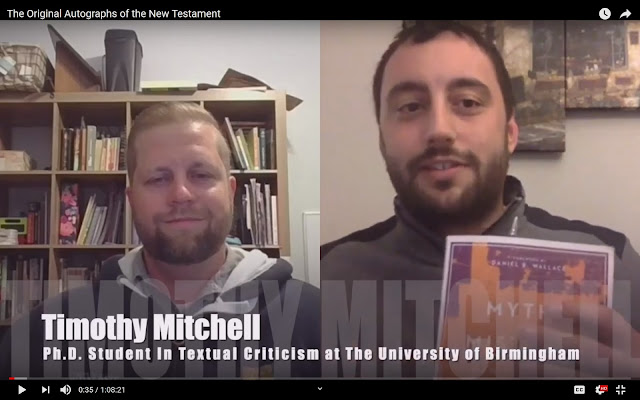
Here is an interview that I had with Stephen Boyce of City Light Church. We talked about my chapter "Myths About Autographs: What They Were and How Long They May Have Survived" in "Myths and Mistakes sin New Testament Textual Criticism" (Downers Grove: InterVarsity Press, 2019). We discussed the definition of "Autograph" as it pertains to the New Testament writings and doctrinal statements, ancient publication, letter carriers, scribes, and textual corruption.

Tuesday, July 26, 2016

Early Christian Scholarship

In about 403 CE two men, Sunnias and Fretela wrote to Jerome asking for an explanation as to why there were so many differences between the Septuagint LXX these men were using and the Latin Psalter Jerome had produced many years before in about 383 CE. Along with this letter, these men sent a long list of passages where there were differences in the text between the LXX and the Latin Psalter.

The Latin text of this Epistle 106 can be found in the Corpus Scriptorum Ecclesiasticorum Latinorum volume 55. An English translation of Epistle 106 can be found here. This letter is interesting because this is an instance where Christian scholars in late antiquity that were studying scripture wrote to another scholar asking for explanation on various readings in their manuscripts. Of course, in this instance, the scholars had the privilege of writing to the translator himself. Perhaps, though, scholars in antiquity also wrote to other scholars asking for readings from manuscripts in their possession. For example (see previous post), Irenaeus (ca. 180 CE) discussed a variant reading found in some manuscripts of Revelation indicating that the number of the beast was 616 rather than 666 (Hear. 5.30.1). Irenaeus could have very easily written to any of his other Christian contacts throughout the Mediterranean (for example Polycarp), who possessed copies of Revelation, to check which readings their copies contained. Irenaeus mentions that the number 666 was "found in all the most approved and ancient copies" (Hear. 5.30.1). It is certainly possible.

Saturday, July 9, 2016

How Long a Book? The Useful Life of Papyrus and Parchment Books

George Houston, in his work “Inside Roman Libraries,” surveyed book collections in antiquity, analyzed their contents, the date of composition, and the rough date of the discarding of the collection in a trash heap, or, in the case of the library at Herculaneum, the last known period of use. From these data Houston concluded that the useful life of papyrus bookrolls was on average 100-125 years and 300 to 500 years in extreme cases (pg. 257).

There is some difference, however, in the useful life of papyrus and parchment books in the various climates where they may be used for making books. In the later part of the second century, the physician Galen described the process of copying out books that were in a Roman library in order to preserve, for his own collection, copies of these works;
"These (books), then, did not cause me a small pain when copying them. As it is, the papyri are completely useless, not even able to be unrolled because they have been glued together by decomposition, since the region is both marshy and low-lying, and, during the summer, it is stifling." (Peri Alupias 19)
It is clear that in the more humid climate of Rome, the useful life of papyrus, if not properly cared for, was much reduced. As Galen so richly describes, the damp atmosphere quickly decomposed the organic papyrus material.
Library of Celsus in Ephesus (ca. 135 CE)
Examples From the Caesarean Library
In the more arid environment of the East, papyrus books could have a very long life. In the library of Caesarea in Palestine, Pamphilus (ca. 280 CE) set about making copies of Origen's works, in his own hand, in order to build the library's inventory. Apparently, these works were still present in the library, and in use, over 100 years later when Jerome wrote (ca. 392 CE);
Pamphilus the presbyter, patron of Eusebius bishop of Caesarea, was so inflamed with love of sacred literature, that he transcribed the greater part of the works of Origen with his own hand and these are still preserved in the library at Caesarea. (Jerome, Vir ill. 75; NPNF 2:377)
It is apparent that Pamphilus copied these works on papyrus because Jerome noted that Eusebius' immediate successors set about restoring the Caesarean Library's inventory in parchment codices.
"Euzoius was educated as a young man at Caesarea along with Gregory, the bishop of Nazianzus, under the rhetor Thespesius and later became bishop of the same city; with very great toil he attempted to restore on parchment (codices(?); membranis) the library of Origen and Pamphilus that had been damaged." (Jerome, Vir ill. 113; translation taken from Carriker, p. 23, n. 70)
Therefore, the works that Jerome had noted, that were in the hand of Pamphilus, were papyrus books that were still in use in the Caesarean library over 100 years later during Jerome's lifetime.

It is noteworthy, however, that Euzoius set about to restore the library's works in parchment codices, rather than papyrus. This was likely due to the fact that parchment was much more durable and had an incredibly long shelf life. As was noted in a previous post, the parchment Codex Sinaiticus, which was copied sometime ca. 350 CE, was still being used in the 6th or 7th centuries when scribes corrected the text to "an extremely old copy corrected in the hand of the holy martyr Pamphilus." Thus, the Codex Sinaiticus was still being used and consulted by scholars 200-300 years after its creation!

At least in the case of the Caesarean Library, papyrus books had a useful life of more than 100 years, and parchment many times longer.
____________
Bibliography

Carriker, Andrew James. The Library of Eusebius of Caesarea. VCsup 67. Leiden: Brill, 2003.

Houston, George W. Inside Roman Libraries: Book Collections and Their Management in Antiquity. Chapel Hill: UNC Press, 2014.

Clare K. Rothschild and Trevor W. Thompson. "Galen: 'On the Avoidance of Grief,' " Early Christianity 2 (2011) 110-129

Wednesday, June 1, 2016

Jerome Against Lavish Bible Manuscripts

Codex Palatinus
While reading through Hugh Houghton's excellent new work "The Latin New Testament," I came across an excellent reference to Jerome (p. 45; see also p. 45 note 5).

Jerome (ca. 347-420 CE), while residing in Rome, wrote to Eustochium (ca. 384), a woman who had placed herself under his spiritual guidance. In the letter Jerome set out the proper motives for those who wished to enter into a life of virginity. Also included in the letter was a vivid description of the decadence of the city of Rome. Among many other sins of extravagance Jerome mentions a curious trend of the Christians of Rome;
"Parchments are dyed purple, gold is melted into lettering, manuscripts are decked with jewels, while Christ lies at the door naked and dying." (Epist. 22; NPNF2 6:36)
In his Prologue to Job, Jerome wrote that he had worked hard at translating Job from Hebrew and Greek into Latin. In this prologue he described the horrid textual state of the Latin manuscripts of Job. Apparently responding to those who criticized his efforts, he wrote
"Let those who will keep the old books with their gold and silver letters on purple skins, or, to follow the ordinary phrase, in “uncial characters,” loads of writing rather than manuscripts, if only they will leave for me and mine, our poor pages and copies which are less remarkable for beauty than for accuracy."(NPNF2 6:492)
It seems that there where those who only cared about the beauty and craftsmanship of their manuscripts and not the accuracy of the text of the Bible that they contained. Christians also cared more about the appearance of piety, spending their money on lavish copies of the gospels, rather than on the furtherance of the gospel, or on the poor and needy. 
What is particularly interesting is that a "relatively high proportion of early Latin gospel books are written on purple parchment" (Houghton, p. 187). One in particular, Codex Palatinus, dates to the 4th-or 5th century (during the life-time of Jerome) and is written on purple dyed parchment with gold and silver lettering. Judging by the manuscript evidence, it seems that Jerome's criticisms were no exaggeration.

___________________

H. A. G. Houghton, "The Latin New Testament: A Guide to its Early History, Texts, and Manuscripts" (Oxford: OUP, 2016).