Showing posts with label early christian literature. Show all posts

Saturday, April 12, 2025

Discontinuous Reading and the Christian Codex


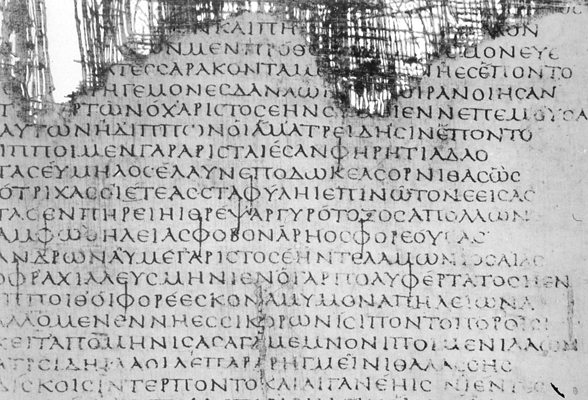
Nag Hammadi Codex VI, opened at the center of the quire

The special issue of Early Christianity 12 published the presentations of the conference “The Material Gospel." It was organized by Jeremiah Coogan and David Lincicum and was held at the University of Notre Dame, Indiana, on May 31, 2019. I found two of the essays in the issue especially intriguing, Clare K. Rothschild's "Galen’s De indolentia and the Early Christian Codex," and Jeremiah Coogan's "Gospel as Recipe Book."

Rothschild's article gives five reasons for Galen's use of the codex in contrast to the bookroll. First, the codex format allows easy transportability for "repeated non-linear consultation" (pg. 35). Second, "open medium, meaning every page is instantly and equally accessible" to the reader (pg. 35). Third, the codex allows for the introduction of new material anywhere within the codex (pg. 36). Fourth, combining the information in Martial (Epigr. 1.66) with that in Galen's De indolentia indicate that the codex was "also a portable medium, ideal for travel" (pg. 37). Fifth, the codex format was intended more for private use (pg. 37). Applying these insights to the Christian use of the codex, Rothschild concludes,
"If use of the codex, as reflected in Galen’s letter-tractate De indolentia, can be extrapolated to understand early Christian usage of the codex, especially prior to the year 200 CE, we infer a utilitarian over an aesthetic purpose, with the combination of durability (transmissibility), accessibility, expandability, and portability as the format’s compelling attributes." (pg. 37).
Coogan's article compares the features of early Christian codices with features found in contemporary secular documents such as recipe collections and magical texts. Each of these share a common approach at accessing the material through discontinuous reading. What this means is that users of these texts do not read the material straight through from beginning to end. Instead, the texts are engaged with at various points where needed. Coogan compares the way a modern reader would engage with a phone book or dictionary as opposed to a novel or news article. The dictionary or phone book is accessed at various points wherever the relevant material is located in the text. Whereas a novel or news article would be read from beginning to end (pg. 41-42). Coogan concludes by arguing that,
"gospel codices invited nonlinear access and performative use in ways that paralleled other late ancient practical texts, such as ritual formularies, medical recipes, and agricultural manuals" (pg. 58).
I agree with Rothschild and Coogan that Christians seem to have preferred the Codex format for practical reasons. Along with the historical references found in Martial and Galen, there are theological considerations that may be behind the Christian preference. The two letters to Timothy in particular have several references to the study of the scriptures. In each of these passages, it is the practical application and teaching that is stressed.
"Until I come, devote yourself to the public reading of Scripture, to exhortation, to teaching." (1 Tim 4:13, ESV)

"Let the elders who rule well be considered worthy of double honor, especially those who labor in preaching and teaching." (1 Tim 5:17, ESV)

"Follow the pattern of the sound words that you have heard from me, in the faith and love that are in Christ Jesus." (2 Tim 1:13, ESV)

"and what you have heard from me in the presence of many witnesses entrust to faithful men, who will be able to teach others also." (2 Tim 2:2, ESV)

"Do your best to present yourself to God as one approved, a worker who has no need to be ashamed, rightly handling the word of truth." (2 Tim 2:15, ESV)

"All Scripture is breathed out by God and profitable for teaching, for reproof, for correction, and for training in righteousness, that the man of God may be complete, equipped for every good work." (2 Tim 3:16-17, ESV)
Each of these references combine the study of the scriptures with the teaching of the scriptures. This teaching and preaching includes exhortation to action and service (Hebrews 10:24-25). These are very practical and dynamic settings that would likely necessitate the discontinuous reading of the Christian scriptures. The letters to Timothy are likely Paul's last letters, setting the tone of ministry for Timothy to carry forward to the next generation and for generations to come. The second letter of Peter, also likely written at the end of his life, already made reference to a collection of Paul's letters. Peter's reference to Paul's letters appears to be in the context of study and teaching.
"And count the patience of our Lord as salvation, just as our beloved brother Paul also wrote to you according to the wisdom given him, as he does in all his letters when he speaks in them of these matters. There are some things in them that are hard to understand, which the ignorant and unstable twist to their own destruction, as they do the other Scriptures." (2 Pt 3:15-16, ESV)
Bookrolls could certainly be navigated for discontinuous reading by those adept to their use. Yet, the codex format is particularly useful for this type of access. Of course, the Jewish synagogue also had similar practical uses for their scriptures (teaching and exhortation), yet continued to read from bookrolls. Christian practice was different in that it was more mobile, with itinerate preaching (Col. 4:16), and less tied to a specific location, such as house Churches (Acts 1:13; 2:2, 46; 12:12) or meeting in public places (Acts 17:17; 19:9), than one would find in the Jewish Synagogue. This would seem to make the codex more inviting for discontinuous reading and study than the bookroll. 
_______________________________

For earlier blog posts on the early Christian preference for the codex see the following links,

Saturday, January 25, 2025

The Frankfurt Amulet, The Epistle of Barnabas, and Nomina Sacra

Inscription digitally unrolled. Credit: LEIZA. / Prof. Dr. Markus Scholz

News of a paradigm shifting find hit popular news outlets late in 2024. An ancient Roman cemetery has been known since the 19th century in the Roman town of Nida near modern day Frankfurt, Germany. In grave number 134, a man aged around 40 years was excavated in 2018 and a small amulet was discovered underneath the chin of the skeletal remains. The grave goods such as an incense burner and a clay jug allow for a date range of around 230-260 or 270 CE.

Rolled silver amulet, ca. 230-260 or 270 CE. Credit: U. Dettmar, AMF

The amulet was worn around the neck and contained a rolled up silver foil with an inscription in Latin. Though the artifact was discovered in 2018, the foil was only recently "digitally unrolled." The Latin text is interesting because it has several Greek elements (see image below for Latin transcription).

The Latin text of the Amulet translated into English reads:

(In the name?) of St. Titus.
Holy, holy, holy!
In the name of Jesus Christ, Son of God!
The lord of the world
resists to the best of his [ability?]
all seizures(?)/setbacks(?).
The god(?) grants well-being
Admission.
This rescue device(?) protects
the person who
surrenders to the will
of the Lord Jesus Christ, the Son of God,
since before Jesus Christ
bend all knees: the heavenly ones,
the earthly and
the subterranean, and every tongue
confess (to Jesus Christ). (Translation from Archaeology Mag)

The trisagion, the "Holy, Holy, Holy" is written in the Latin alphabet but uses the Greek word for Holy "AGIOS AGIOS AGIOS" (ἅγιος). Also, there are two places in the text where a nomen sacrum for "Jesus" (Ἰησοῦς) and for "Christ" (Χριστός) are used. The text also contains a loose quotation of Philippians 2:10-11 strongly indicating an early and wide acceptance of this Pauline letter as scripture and authentically Pauline. Early because the wearer likely had worn the amulet for some time before he had died and was buried with it. Widely accepted because the letter to the Philippians circulated in Greek and would have had to have been translated in Latin, then circulated as a Latin copy before it's text was incorporated into the text of the amulet. 

Edit: Another scenario occurred to me after initially publishing this blog post. There is a possibility that this is an old hymn that had circulated very early in Christian communities. It has long been thought that this passage in Philippians was a hymn that Paul had incorporated into his letter to the Philippians.

Close-up detail of IH and XP of Nomina Sacra

What is very interesting here is the choice of nomen sacrum for Jesus, it uses suspension of the Greek word for Jesus, ιη(σους), leaving the majuscule, letters ΙΗ. It is intriguing that the iota is superimposed over the eta and is extended vertically to such a degree that it intersects with the customary supralinear stroke so that it forms a cross. All three instances of the nomen sacrum for Jesus are written in this manner so the cross shape appears to have been intentional. Another aspect of this nomen sacrum for Jesus is that it is the earliest known that is mentioned in a literary text. In a well known passage in the Epistle of Barnabas 9:7-8 the author refers to this scribal convention.
"Learn abundantly, therefore, children of love, about everything: Abraham, who first instituted circumcision, looked forward in the spirit to Jesus when he circumcised, having received the teaching of the three letters. For it says: "And Abaraham circumcised ten and eight and three hundred men of his household." What, then, is the knowledge that was given to him? Observe that it mentions the "ten and eight" first, and then after an interval the "three hundred." As for the "ten and eight," the I is ten and the H is eight; thus you have "Jesus." And because the cross, which is shaped like the T, was destined to convey grace, it mentions also the "three hundred." So he reveals Jesus in the two letters, and the cross in the other one. He who placed within us the implanted gift of his covenant understands." (Barn. 9.7-8; Holmes, Apostolic Fathers, 299)
This is referring to a story out of Genesis 14:14 where Abraham takes 318 servants to rescue Lot, where Barnabas see symbolic significance in the number of the servants. In the Greek number system 300 was designated by the Greek letter tau, a "T" shaped letter, and 18 was designated by the Greek letter combination IH. The author of Barnabas is obviously referring to the nomen sacrum for Jesus. Larry Hurtado has argued that this nomen sacrum was the first and led to the widespread Christian practice that in later centuries, expanded to include more sacred names. Though no Greek letter tau is present in the Frankfurt amulet, the scribe created a cross with the iota and supralinear stroke. Barnabas is typically dated to sometime before the Bar Kokhba revolt in 132 CE, so this is a very early example of something like what we see 100 years later in the Frankfurt Amulet inscription. What is unique in this amulet is that this Greek nomen sacrum is found in a Latin text. This indicates that by the mid third century CE this nomen sacrum had been in use for some time and had been transfered into the Latin text.

Clement of Alexandria mentions this same story in Genesis 14:14 about 200 CE and derives similar symbolic meaning.
"As then in astronomy we have Abraham as an instance, so also in arithmetic we have the same Abraham.“For, hearing that Lot was taken captive, and having numbered his own servants, born in his house, 318,” he defeats a very great number of the enemy. They say, then, that the character representing 300 is, as to shape, the type of the Lord’s sign, and that the Iota and the Eta indicate the Saviour’s name; that it was indicated, accordingly, that Abraham’s domestics were in salvation, who having fled to the Sign and the Name became lords of the captives, and of the very many unbelieving nations that followed them." (Strom. 6.11; ANF 2:500)
The cross, or "T" shaped symbol, had become so familiar in Alexandrian Christianity that Clement could simply refer to it as "the Lord's sign." Clement refers to this symbolism as if it had been understood in this way for some time. So common in fact that some fifty or so years later it was found way up on the northern frontier of Roman Empire in a grave in the town of Nida 1,800 miles away.

(For further discussion on this passage in Barnabas, see the previous blog post here.)

Screen grab from 25:41 of YouTube Frankfurt Press Release

____________________________________________

Anna Lisa Lüft, "Archäologischer Sensationsfund. "Der älteste Christ nördlich der Alpen war Frankfurter"," hessenschau.de. 11 December 2024.

Dario Radley, "Silver amulet unearthed in Frankfurt grave Is the oldest evidence of Christianity north of the Alps," Archaeology News. 15 December 2024.

Holmes, Michael W., ed. The Apostolic Fathers: Greek texts and English translations. Grand Rapids: Baker Books, 1999.

Larry Hurtado, “The Origin of the Nomina Sacra: A Proposal.” Journal of Biblical Literature 117.4 (1998): 655–73.

Thursday, December 5, 2024

The Christian Codex And The Pocket Sized Bookroll


Scholars often attribute the compactness and portability of a codex as the impetus for Christians to have adopted this format for their scriptures at an early date. For example, the itinerate preaching of the early apostles and evangelists could have necessitated the compactness and portability of the codex over the roll (Epp, "The Codex," 20-22). As is often counter argued, these types of modern attitudes towards the codex are likely influenced by anachronistic ideas about the book (Larsen and Letteney, "Christians and the Codex," 390-391). With this in mind I came across a few references in Aulus Gellius's Attic Nights (2nd cen. CE) that shed light on the alleged portability of the codex verses the roll.

In Gellius's account, Scipio Africanus was being accused in front of the senate of taking a bribe from King Antiochus. In response to this Gellius recounts,
"Thereupon Scipio arose, and taking a roll from the fold of his toga, said that it contained an account of all the money and all the booty; that he had brought it to be publicly read and deposited in the treasury. "But that," said he, "I shall not do now, nor will I so degrade myself." And at once, before them all, he tore the roll across with his own hands and rent it into bits, indignant that an account of money taken in war should be required of him, to whose account the salvation of the Roman State and its power ought to be credited." (Gellius, Noctes Atticae, 4.18.9-12)
In this account, Scipio wasn't carrying a proper bookroll containing a lengthy literary work. It appeared to be some sort of leger of smaller size because Scipio was able to tear it into shreds fairly easily. This would have been much more difficult for a normal full-sized literary roll.

Later in the work, Gellius recounts a personal story in which he was in a book shop and a "foolish man" was boasting that he was the only person who could truly understand Marcus Varro's Satires.
"At the time I chanced to have with me a book of those Satires, entitled Ὑδροκύων, or The Water Dog. I therefore went up to him and said: "Master, of course you know that old Greek saying, that music, if it be hidden, is of no account.​ I beg you therefore to read these few lines and tell me the meaning of the proverb contained in them." (Gellius, Noctes Atticae, 13.31.2-3)
This account is a fascinating retelling of a duel of minds, with Gellius exposing the "foolish man's" ignorance of the text. In this instance, the bookroll carried by Gellius was a proper roll containing literature. Thus, in the same manner as Scipio, Gellius was able to carry this roll on his person and produce it quickly and rapidly find the relevant passage with ease.

Later in his work, Gellius recounts a story in which a bright young man was having a conversation in a public space about an historical fact concerning a passage in Homer's Illiad. Some "half educated fellows" were present and ignorantly interjected themselves into the conversation.
"One or two half-educated fellows who were present there, of the class that the Greeks call ἀγοραῖοι, or “haunters of the market-place,” laughed in derision of this statement, and declared that the man who had made it had read a copy of Homer which happened to lack the following verse: "And rotted the ship's timbers, loosed the ropes (σπάρτα)." Then the youth, in great vexation, replied: “It was not my book that lacked that line, but you who badly lacked a teacher, if you believe that σπάρτα in that verse means what we call spartum, or 'a rope of Spanish broom'.” They only laughed the louder, and would have continued to do so, had he not produced the twenty-fifth book of Varro's Human Antiquities, in which Varro writes as follows of that Homeric word: “I believe that σπάρτα in Homer does not mean sparta, or 'Spanish broom,' but rather σπάρτοι, a kind of broom which is said to grow in the Theban territory. " (Gellius, Noctes Atticae, 17.3)
In this account, it is not exactly clear where the story takes place. Judging by the description of the "half-educated fellows" it likely occurred in a public marketplace of some kind. The bright young man happened to be carrying a roll that contained a copy of the twenty-fifth book of Marcus Varro's Human Antiquities. This was a literary work written in a bookroll and the youth had no problem finding the relevant passage quickly and producing it for the other "foolish-men" to read for themselves.

In each of these cases recounted by Gellius, a bookroll was easily carried by the hero of the story. The relevant passage was quickly located and produced for the protagonist to read for themselves. Though limited in scope, this evidence reveals the anachronistic tendencies of modern arguments for the Christian preference for the codex. It seems that an educated itinerant preacher would have had no problem carrying a gospel in a roll format, producing it during an evangelism event, and finding a relevant gospel passage from which to engage with the listeners.

EDIT: A reader of the blog, Viktor Johansson, responded with some excellent observations through private message. Some important objections to my quick take on Gellius, especially concerning the account at 17.3, are these: 

First, I can't assume that the discussion with the educated young man takes place in a marketplace outdoors. This account could have just as easily occurred in a personal library or outside of a public library where texts like Varro's would have been readily available.

Second, and most importantly of all, because the heroes of these stories are educated well-to-do men, they most likely had a retinue of slaves at hand with them. These would have been invisible in the story. Any one of these attendants could have gone and fetched the book for the protagonist either from the location at hand (in a public or private library) or had been carrying it upon their persons.

All in all, this excellent response reveals my own anachronistic assumptions that I bring to the text of Gellius. At best these accounts from Gellius reveal that educated men in the high Roman empire were adept at handling a bookroll and could easily find the relevant passage a roll.

EDIT#2: Johansson responded again with some more excellent observations on these passages in Attic Nights. Gellius, speaking in the first person, recounts a scene where he visits Fronto who was sick and sitting on a couch "surrounded by men famous for learning, birth, or fortune." In the middle of this scene, Fronto is being shown plans for a bath "drawn on little pieces of parchment." A dispute suddenly arises over the meaning of a word that Fronto uses. To settle the matter, a famous grammarian sitting nearby is pointed out. The grammarian argues that the word is "better known in the talk of mechanics than in that of cultivated men." Fronto replied in the following manner.
"But Fronto, raising his voice and with a more earnest expression, said: “Sir, does this word seem to you so degraded and utterly faulty, when Marcus Cato and Marcus Varro, and the early writers in general, have used it as necessary and as good Latin?” And thereupon Julius Celsinus reminded him that also in the tragedy of Ennius entitled Iphigeina the very word about which we were inquiring was found, and that it was more frequently corrupted by the grammarians than explained. Consequently, he at once asked that the Iphigenia of Quintus Ennius be brought and in a chorus of that tragedy we read these lines: . . .When this had been read there, then Fronto said to the grammarian, who was already wavering . . . ." (Gellius, Noctes Atticae, 19.10)
This account is fascinating and should be read in its entirety. I only wanted to quote the relevant few lines here because they paint a vivid picture of the scene. Fronto is ill, surrounded by many educated men in his private home. A dispute arises with a grammarian and Fronto asks his attendants (not mentioned up to this point) to fetch a specific book of literature. Gellius doesn't specify who reads the text, whether Fronto himself or an attendant, or perhaps the grammarian himself. Either way it appears that the text was read out loud to everyone present. This account sheds light on the other reading events quoted above, especially at 17.3. It is possible that these events took place in a similar situation as 19.10 with attendants present and in a location with books readily available.
________________________________
Eldon J. Epp, "The Codex and Literacy in Early Christianity and at Oxyrhynchus: Issues Raised by Harry Y. Gamble’s Books and Readers in the Early Church" in Critical Review of Books in Religion 11 (1988): 15-37.

Matthew D. C. Larsen, Mark Letteney, "Christians and the Codex: Generic Materiality and Early Gospel Traditions" in Journal of Early Christian Studies 27.3 (2019): 383-415.

William A. Johnson, Readers and Reading Culture in the High Roman Empire: A Study of Elite Communities (New York: Oxford University Press, 2010), 129 footnote 54.

Monday, December 6, 2021

Greco-Roman Education and Textual Criticism

Raffaella Cribiore is Professor at New York University and specializes in ancient Greco-Roman education, papyrology, and Greek rhetoric among other specialties. She has written several books on these topics, several of which are "must-reads" for anyone interested in understanding the wider culture in which early Christian book culture arose, particularly her works related to Greco-Roman education more broadly. Two of these books are;


"Writing, Teachers, and Students in Graeco-Roman Egypt" (Atlanta: Scholar's Press, 1996).

"Gymnastics of the Mind: Greek Education in Hellenistic and Roman Egypt. Princeton" (NJ: Princeton University Press, 2005).

I have learned so much from Cribiore's work and was excited when I discovered that she had been interviewed on an episode of one of my favorite Podcasts, Ancient Greece Declassified. Here is the link to the interview.

Ancient Greece Declassified: 11 Caves and Classrooms w/ Raffaella Cribiore (libsyn.com)

There were many interesting insights that Cribiore gave, but one that really resonated with my own research was her emphasis on the broadly defined "universality" of Greco-Roman education across the Roman Empire. Along with this, I list out several other interesting insight from the interview below;

1) Education from Hellenistic to the late antique period was remarkably uniform. Someone from Syria, to Egypt, to Rome would have been educated in a similar manner and with a similar body of literature.

2) Much more people attended at least the first tier of education than is often realized by scholars more broadly. 

3) At least at the lowest levels, Education was available to girls as well as boys.

These details from the ancient world help to shine a light on early Christian reading and scribal culture. In an environment where a text was read out and copied within a social network, many Christians would be in a position to engage with these texts at various levels, and with some uniformity across the Empire. This would lead to a circumstance in which any "macrolevel" changes to a text in circulation would be noticed by the community engaging with these same texts. I make this argument in my JSNT article,

"Exposing Textual Corruption: Community as a Stabilizing Aspect in the Circulation of the New Testament writings during the Greco-Roman Era." JSNT 43.2 (December 2020): 266-298.


Monday, August 13, 2018

Aristides of Athens and Early Christian Writings

 Aristides was an Athenian Philosopher who lived sometime during the reign of Emperor Hadrian (117-138 CE). His apologetic work was good enough to have staying power because Eusebius, in his "Church History," makes reference to Aristides and his Apology (ca.325 CE),
"Aristides also, a believer earnestly devoted to our religion, left, like Quadratus, an apology for the faith, addressed to Hadrian. His work, too, has been preserved even to the present day by a great many persons." (Hist. Eccl. 4.3.3)
Jerome, in his "On Illustrious Men," also mentions Aristides and his Apology (ca. 393 CE).
"Aristides a most eloquent Athenian philosopher, and a disciple of Christ while yet retaining his philosopher's garb, presented a work to Hadrian at the same time that Quadratus presented his. The work contained a systematic statement of our doctrine, that is, an Apology for the Christians, which is still extant and is regarded by philologians as a monument to his genius." (De vir. 20)
In this Apologetic work Aristides compares the Christian God with the Pagan God's. At one point, Aristides begins to point Hadrian to the Christian scriptures or writings in order to validate his arguments.
"Take, then, their writings, and read therein, and lo! you will find that I have not put forth these things on my own authority, nor spoken thus as their advocate; but since I read in their writings I was fully assured of these things as also of things which are to come. And for this reason I was constrained to declare the truth to such as care for it and seek the world to come. And to me there is no doubt but that the earth abides through the supplication of the Christians. But the rest of the nations err and cause error in wallowing before the elements of the world, since beyond these their mental vision will not pass. And they search about as if in darkness because they will not recognize the truth; and like drunken men they reel and jostle one another and fall." (Apol. 16)
It appears that Aristides is stating that he was converted to Christianity after he accessed their writings and read them for himself. If we can trust his testimony here, I find it fascinating that Aristides was able to identify a collective body of recognizable Christian writings. In other words, there was at the time (ca. 117-138 CE), a collection of writings that were recognizable by a non-Christian outsider as their definitive supporting documents. In turn, Aristides expected Hadrian to be able to recognize these writings as well.
It is also interesting that these writings were even available to the outsider. Aristides does not mention how he obtained a copy, but it had to be either through a book seller, a library, a friend, or a Church. In the early decades of the second century, these early Christian writings were circulating to such a degree that a Philosopher in Athens could obtain copies and read them for himself.

Monday, March 5, 2018

Philosophical Schools: Early Christian and Jewish Scripture Reading


I have been slowly reading through Brian J Wright’s excellent new book “Communal Reading in the Time of Jesus: A Window into Early Christian Reading Practices,” which came out December 2017. I can’t recommend this work enough and I hope to give an extensive review once I finish plodding through the amassed information (it is rich with primary source material). Until then, I can’t help but write a little on some of the gems. One such nugget are the references to Philo of Alexandria’s (ca. 20 BCE-50 CE) descriptions of synagogue worship (Wright, 102-104). There are two such references in Philo’s works and Wright quotes both of these in full. What is particularly striking to me is how similar these descriptions are to Justin Martyr’s famous reference to Christian worship around 100 years later. The similarities are still present even later in the writings of Tertullian of Carthage who wrote about 150-160 years after Philo. I thought it might be helpful to quote each of these in full for comparison purposes. Philo wrote
“For that day [Sabbath] has been set apart to be kept holy and on it they abstain from all other work and proceed to sacred spots which they call synagogues [συναγωγαί]. There, arranged in rows according to their ages, the younger below the elder, they sit decorously as befits the occasion with attentive ears. Then one takes the books [τὰς βίβλους] and reads aloud [ὰναγινώσκει] and another [ἕτερος] of especial proficiency [τῶν ὲμπειροτάτων] comes forward and expounds [ὰναδιδάσκει] what is not understood.” (Good Person 81-82; Wright, 103)
Philo gave another similar description of synagogue worship in a different work;
“And indeed [δῆτα] they do always [μὲν αἰεί] assemble and sit together, most of them in silence except when it is the practice [νομίζεται] to add something to signify approval [προσεπευφημῆσαι] of what is read [ἀναγινωσκομένος]. But some priest who is present or one of the elders reads [ἀναγινώσκει] the holy laws to them and expounds [ἐξηγεῖται] them point by point till about the late afternoon, when they depart having gained both expert knowledge of the holy laws and considerable advance in piety.” (Hypothetica 7.13; Wright, 104)
Now compare this reference to the Christian worship gathering described by Justin Martyr (ca. 100-165 CE) from about 100 years after the time of Philo. Justin wrote,
“And on the day called Sunday, all who live in cities or in the country gather together to one place, and the memoirs of the apostles or the writings of the prophets are read, as long as time permits; then, when the reader has ceased, the president verbally instructs, and exhorts to the imitation of these good things.” (1 Apol 67)
Justin Martyr is likely describing the practices in and around Rome which is where he likely wrote his 1st Apology. However, considering that Justin was born in Palestine, and spent some time in Ephesus, his description may include Christian communities in these regions as well. Fast-forward another 50 or so years and we have Tertullian (ca. 155-240 CE) who gave a description of Christian worship practices in Carthage. Tertullian wrote,
“We are a body knit together as an assembly and congregation, that, offering up prayer to God as with united force, we may wrestle with him in our supplications….We assemble to read our sacred writings, if any peculiarity of the times makes either forewarning or reminiscence needful. However it be in that respect, with the sacred words we nourish our faith, we animate our hope, we make our confidence more stedfast; and no less by inculcations of God’s precepts we confirm good habits. In the same place also exhortations are made, rebukes and sacred censures are administered.” (Apol 39)
The similarities between Philo’s synagogue services and Justin and Tertullian’s Christian services are these;

1) The scriptures are read out to the gathered assembly. Without getting into detail about which Christian texts, it can be fairly certain that the Hebrew scriptures were being read, obviously in the Jewish synagogues, but also by the Christians (in Greek or possibly Latin) in both Justin and Tertullian’s descriptions.

2) Someone else stands and exhorts, preaches, or teaches to the congregation from the text that was read. In Philo, this person is either an individual of “especial proficiency,” a priest, or an elder. In Justin, the speaker is the “president,” the “προεστὼς” who gives the “speech,” the “διὰ λόγου" (Blunt, 100).

3) The congregation comes together, at least in part, in order to gain instruction on Godly living and habits. In Philo, it is to “advance in piety,” in Justin, it is to “imitate these good things” found in the scriptures, and in Tertullian it is to “confirm good habits” that are derived from “God’s precepts.”

From these references one can see how much the Christian worship practice of reading scriptures and preaching and exhorting from them is rooted in the Hebrew synagogue tradition. There seems to be very little parallel in the Greek and Roman culture, even though communal reading of texts was a widespread and common phenomena (see Wright’s work on this for nearly exhaustive coverage of primary source material), the systematic study of texts coupled with a lifestyle of adherence to these same texts can only really be found in the various philosophical schools. This comparison comes out in the writings of the physician Galen of Pergamum (ca. 129-215/16 ce) who, when briefly mentioning the Jews and Christians, refer to them in the context of philosophical ‘schools’;
“They compare those who practice medicine without scientific knowledge to Moses, who framed laws for the tribe of Israel, since it is his method in his books to write without offering proofs, saying ‘God commanded, God spake.’” (On Hippocrates Anatomy; Wilken, 72)
In another place he mentions Christians and Jews together as belonging to philosophical schools;
“For one might more easily teach novelties to the followers of Moses and Christ than to the physicians and philosophers who cling fast to their schools. So in the end I decided that I should avoid unnecessary talk by having nothing to do with them at all, which is what I do at present and what I shall continue to do in the future.” (De pulsuum differentiis; Wilken, 72)
When writing for a Roman audience, Flavius Josephus (ca. 37-100 CE) in similar way compared his own Jewish tradition with Greek and Roman philosophical schools. He wrote;
“For there are three philosophical sects among the Jews. The followers of the first of which are the Pharisees, of the second, the Sadducees, and the third sect, which pretends to a severer discipline, are called Essenes.” (Jewish War 2.8.2)
Both the Jewish and Christian communities stood out against other contemporary religions of antiquity in that they were more like the philosophical schools of the day. Both Jews and Christians were communities of followers who gathered together for the close reading of their books and a discussion of how to apply these texts into their everyday lives.

_____________________

BIBLIOGRAPHY

A. W. F. Blunt, ed. "The Apologies of Justin Martyr" (Cambridge Patristic Texts. A. J. Mason, ed. London: Cambridge University Press, 1911).

Brian J. Wright, "Communal Reading in the Time of Jesus: A Window into Early Christian Reading Practices" (Minneapolis: Fortress Press, 2017).

Robert Louis Wilken, "The Christians as the Romans Saw Them" (2nd ed. New Haven: Yale University Press, 2003).

English translations of Justin Martyr and Tertullian of Carthage are taken from, The Ante-Nicene Fathers. Edited by Alexander Roberts and James Donaldson. 1885–1887. 10 vols.

English translation of Josephus taken from the translation of William Whiston located at http://penelope.uchicago.edu/josephus/index.html

Tuesday, November 8, 2016

Quintilian on The Critical Skills Grammarians Teach (ca. 95 CE)

While reading through Eric W. Scherbenske's "Canonizing Paul: Ancient Editorial Practice and the Corpus Paulinum," I came across a reference from Quintilian. He was sketching the critical skills taught as part of the standard literary education given by the Greek and Latin Grammarians (teachers); 
"As soon as the boy has learned to read and write without difficulty, it is the turn for the teacher of literature (grammatici). My words apply equally to Greek and Latin masters, though I prefer that a start should be made with a Greek: in either case the method is the same. This profession may be most briefly considered under two heads, the art of speaking correctly and the interpretation of poets; but there is more beneath the surface than meets the eye. For the art of writing is combined with that of speaking, and correct reading precedes interpretation, while in each of these criticism has work to perform. The old school of teachers (veteras grammatici) carried their criticism so far that they were not content with obelizing lines [marking for deletion] or rejecting books whose titles they regarded as spurious, as though they were expelling a supposititious child from the family circle, but also drew up a canon of authors, from which some were omitted altogether." (Inst. or. 1.4.1-3)
Quintilian notes here that it was customary for Grammarians to teach the art of analyzing a piece of literature for a correct textual reading as well as determining its authenticity in relation to an author's other writings. Of course, Quintilian is describing the ideal Greco-Roman education. It may have been uncommon for literates (of lesser or greater ability) to acquire this level of analytical skill. Nevertheless, the teaching of these critical skills appears to occur early in a child's literary education (soon after acquiring an adequate level of reading and writing ability). Thus, most literates may have had at least a rudimentary understanding of recognizing textual/transmission issues as well as the problems associated with authorship.  

Apostles, disciples, and other early Christian leaders who were literate, may have had at least some ability in analyzing and evaluating a particular writing's textual character or authorship claims.  This can be seen in Peter's assessment of those who have miss-interpreted and possibly textually altered Paul's epistles in 2 Peter 3:16, and Luke's evaluation of previous Gospel writings in 1:1-4. Similar parallels could be made with regard to the collecting of Ignatius's letters in Poly. Phil. 13.1-2.


Mosaic of Plato's academy (Pompeii)
__________
Quintilian, Institutio Oratoria (trans. H. E. Butler; LCL; London: William Heinman, 1920), 61-63.

Scherbenske, Eric W. Canonizing Paul: Ancient Editorial Practice and the Corpus Paulinum (Oxford: Oxford University Press, 2013), 16.

Saturday, October 15, 2016

Lucian on Christians and Their Books (165 CE)

Lucian (125-180 CE) was a Syrian satirist and author who wrote his works in Greek and was from the Roman city of Samosata on the banks of the Euphrates river. In one particular work, Lucian wrote about a Cynic philosopher named Peregrinus who had converted over to Christianity in his early years and was imprisoned for his beliefs. In his older years, Peregrinus converted back over to Cynicism and later cremated himself at the Olympic games in 165 CE. Lucian's work is of interest as it is one of the earliest references to Christians by a Roman author. One especially interesting and lengthy description reads;
"It was then that he learned the wondrous lore of the Christians, by associating with their priests and scribes in Palestine. And—how else could it be ?—in a trice he made them all look like children; for he was prophet, cult-leader, head of the synagogue, and everything, all by himself. He interpreted and explained some of their books and even composed many, and they revered him as a god, made use of him as a lawgiver, and set him down as a protector, next after that other, to be sure, whom they still worship, the man who was crucified in Palestine because he introduced this new cult into the world. Then at length [Peregrinus] Proteus was apprehended for this and thrown into prison, which itself gave him no little reputation as an asset for his future career and the charlatanism and notoriety-seeking that he was enamoured of. Well, when he had been imprisoned, the Christians, regarding the incident as a calamity, left nothing undone in the effort to rescue him. Then, as this was impossible, every other form of attention was shown him, not in any casual way but with assiduity; and from the very break of day aged widows and orphan children could be seen waiting near the prison, while their officials even slept inside with him after bribing the guards. Then elaborate meals were brought in, and sacred books of theirs were read aloud, and excellent Peregrinus—for he still went by that name—was called by them 'the new Socrates.'" (Peregr. 11-12)
Of course, Lucian is most likely exaggerating or caricaturing some of the more prominent features of the Christian communities known to him. Even so, Lucian expects his readers to pick up on these salient aspects of Christians in order for the satirical humor to be effective. These features are;
  • The community leaders are the priests, scribes, prophets and interpreters of their sacred books.
  • Christians were meeting in a particular location; referenced as a "synagogue" by Lucian.
  • The centrality of the Christian's worship of the crucified Jesus.
  • The imprisonment and persecution of Christians for their beliefs.
  • Orphans and widows were a large component of the Christian community.
  • Christians visited prisoners and were doing all they could to help them.
One interesting feature of Lucian's description, however, is the prominence given to sacred writings and books. At one point Lucian draws attention to Peregrinus' facility in composing religious writings; no doubt a reference to the prolific output of Christian writings in the first and second centuries. Lucian also highlights the reading-out of sacred books in their community gatherings around Peregrinus while he was imprisoned. Overall, Christians of the second century were recognized by the importance they placed upon their sacred books; studying and interpreting them as well as publicly reading them in their worship gatherings.
Portrait of Lucian from an Early Translation of his Writings

_________________
Lucian, The Passing of Peregrinus. A. M. Harmon (trans.). Vol. V. Loeb Classical Library. Cambridge: Harvard University Press, 1962.

Wednesday, September 7, 2016

Scripture For Sale in 4th Century North Africa

Hugh Houghton, in his monograph "Augustine's Text of John: Patristic Citations and Latin Gospel Manuscripts" (p. 23-24), brought attention to several quotations from the writings of Augustine that illustrate the sale of biblical manuscripts. (The following English translations are taken from Houghton's book)
"The Lord’s manuscripts are daily on sale, and readers read them; buy one for yourself and read it when you have time—in fact, make time for it: it is better to have time for this than for trifles." (Sermo 114B.15)
"Let someone complain, let him grumble, if this Scripture is not proclaimed and chanted throughout the world, if it should even stop being available to buy in public." (Enarratio in Psalmos 36.s1.2)
"Our writings reveal our religion to them, but we are not afraid. Our manuscripts are put on sale in public: the daylight does not blush for shame. Let them buy them, read them and believe them; or let them buy them, read them and laugh at them. Scripture knows how to call to account those who read and do not believe. A manuscript is carried around for sale, but the one whom its pages proclaim is not for sale...Buy a manuscript and read it: we are not ashamed." (Sermo 198.20)
These comments by Augustine are striking and indicate a flourishing time in North Africa when the scriptures were widely available and literacy was more wide spread than in previous centuries of the Roman imperial age.
For more fascinating insight into the production of books and manuscripts during this time, read Chapter 2 "The Use of the Bible and the Production of Books in the Time of Augustine" (p. 22-43) in Houghton's monograph. The chapter is filled with quotations from Augustine, Jerome and other contemporary figures that paint a picture of rich scholarship and free flow of ideas and books across the Mediterranean region during this time.


___________
Houghton, Hugh. Augustine's Text of John: Patristic Citations and Latin Gospel Manuscripts. Oxford: Oxford University Press, 2008.

Monday, May 30, 2016

New Journal Article Published

I have had the honor of having an article published in the latest issue of Bibliotheca Sacra. The article contrasts the ways in which early Christians manufactured their books that contained New Testament writings with the way Romans manufactured their books.

"Christian Papyri and the Ancient Church." Bibliotheca Sacra 173 (April-June 2016): 182-202.

The abstract of the article is as follows:

Modern scholarship and popular media outlets often depict the earliest Christians as holding wildly divergent beliefs about Jesus and as reading and writing secret gospels that never made it into the New Testament. This view fails to consider the material re-mains of early Christian manuscripts from the second and third centuries that have been discovered in Egypt. These manuscripts mainly consist of New Testament writings and contain certain paralinguistic and formatting features that highlight unique socio-cultural aspects of the early Christians that stand in stark contrast to these modern theories of Christian origins.


Tuesday, April 19, 2016

The Staurogram and The Epistle of Barnabas: Further Discussion

In a previous post, the comments of Dr. Brent Nongbri in reference to the staurogram and its place in a third century manuscript were taken up. At issue is whether Christian scribes of the second and third centuries were experimenting with images of Jesus on the cross in their art and worship practices. Dr. Nonbgri argued that,
"At the very least, such experimentation with cruciform imagery [in the staurogram] would appear less out of place in the fourth century than in the late second or early third century. (pg. 33-34)"
These observations are striking when looking at the many references in early Christian writings of the second and third century; Minucius Felix, Tertullian, Clement of Alexandria, and the author of the Epistle of Barnabas. These authors mention the cross and cross shapes as venerated symbols of Christian identity. Yet, it is argued by Nongbri, each of these early Christian examples are merely allusions to the cross and its shape and not to the image of the crucified Jesus, which scholars purport the staurogram to be.
There was an oft repeated story in early Christian literature that may serve to illustrate that the image of Jesus as a crucified figure on the cross was a familiar Christian icon. In the Epistle of Barnabas, reference is made to the story of Israel defeating the armies of Amalek in Exodus 17:8-13. In this account, Moses lifted up his hands as a sign to the Lord; when his hands were held aloft, Israel was victorious, when his hands fell to his side, Amalek was victorious. Aaron and Hur eventually held Moses' hands aloft as he grew weary and the Israelites won the battle. In light of this story, the Epistle of Barnabas (70-135 CE) wrote;
"Once again you have a reference about the cross and about him who was destined to be crucified. And again he speaks to Moses, when war was being waged against Israel by foreigners, and in order that he might remind those being attacked that they had been handed over to death because of their sins, the Spirit says to the heart of Moses that he should make a symbol of the cross and of him who was destined to suffer because, he is saying, unless they place their hope in him, war shall be waged against them forever. Therefore Moses piled one shield upon another in the midst of the battle, and standing high above them all he stretched out his hands, and so Israel was again victorious. But whenever he lowered them, the men began to be killed. Why so? So that they might learn that they cannot be saved unless they place their hope in him. (12:1-3)"
There are some aspects of this story that bear reflection. First, the Epistle of Barnabas assumes that Moses raised his hands horizontally, in the shape of the cross, and this is mentioned in such a way that this must have been a familiar Christian interpretation of this story. And second, the Epistle of Barnabas specifically references this as a symbol of the crucified Jesus and not just of the cross. At one point Barnabas uses the word "suffer" (πασχειν) (12:2) and the middle/passive infinitive (σταυρουσθαι) to refer to this event as a reference to Jesus (12:1). It is clear that Barnabas was viewing the imagery of Moses standing with arms outstretched as a visual representation of Jesus suffering on the cross.
Moses with outstretched hands as a symbol of Jesus on the cross
This story in Barnabas is set in the midst of several allegorical references to the cross that were found in the familiar passages and stories of the Old Testament. At Barnabas 8:1,5; 9:7; 11:1,8; and 13:5. In each of these other references the cross is mentioned as a stand alone representation of salvation with no visualization of the crucified Jesus. However, at 12:1-3, specific mention is made to the imagery of Moses with outstretched hands as a visual representation of the suffering Jesus on the cross.

Though, there is no specific reference to scribes taking this iconography and creating a staurogram, the impetus for doing so is already present in Barnabas some 80-100 years before it is found, represented by the staurogram, in the texts of P66, P45, and P75. The reverence for Jesus and the cross was already tied to a textual representation in the nomina sacra at Barn. 9:7-8. It takes no stretch of the imagination to conclude that a visual representation of Jesus on the cross, as found at Barn. 12:1-3, would find expression in a staurogram.

_______________ 
 
Holmes, Michael W., ed. The Apostolic Fathers: Greek texts and English translations. Grand Rapids: Baker Books, 1999.
Hurtado, Larry W. Lord Jesus Christ: Devotion to Jesus in Earliest Christianity. Grand Rapids: Eerdmans, 2005.
Hurtado, Larry W. The Earliest Christian Artifacts: Manuscripts and Christian Origins. Grand Rapids: Eerdmans, 2006.
Longenecker, Bruce W. The Cross Before Constantine The Early Life of a Christian Symbol. Minneapolis: Fortress Press, 2015.

Nongbri, Brent. “The Limits of Palaeographic Dating of Literary Papyri: Some Observations on the Date and Provenance of P. Bodmer II (P66),” Museum Helveticum 71 (2014): 1-35.

Tuesday, February 23, 2016

Greek Palaeography: Bookhands of the Imperial Peak


The previous post discussed the type of writing used for copying Greek literature, the bookhand. During the Roman imperial era, this handwriting was bilinear, that is, each letter was written between two parallel imaginary lines. This period is often referred to as the "Imperial Peak" because there is an increase in the number of ancient papyri preserved from this time. Several styles of bookhands developed during the Roman era. This abundance of writing samples has allowed scholars to study the development of these various hand writing styles. This is good news for scholars who are assigning dates to early Christian papyri. The earliest copies of the New Testament writings have been dated during this "imperial peak," from the 2nd through the 4th centuries. In regard to the Roman period, Cavallo wrote;

"[Bookhands], in the course of this period not only reach full maturity but also exhibit a typological variety that allows us to distinguish a whole series of graphic streams sometimes also visible in documents, thereby enabling us to arrive at better-founded dates." (Cavallo, "Greek and Latin Writing in the Papyri, p. 112)

During this period, there are several main types of what palaeographers refer to as “scripts,” that is, a type of handwriting used by a scribe that has common stylistic features.

Round Majuscule (Turner: Formal Round)
(In use ca. 1st to the 2nd century CE)
Characterized by the “Hawara Homer” papyrus

Biblical Majuscule
(In use ca. 2nd to the 9th or 10th century CE)
Characterized by Codex Sinaiticus and Vaticanus

Alexandrian Majuscule (Turner: Informal Round)
(In use ca. 2nd to the 8th century CE)
Characterized by PSI V 446

Severe Style (Turner: Formal Mixed)
(In use ca. 2nd to the 3rd century CE)
Characterized by the “Bacchylides” papyrus

Ogival Majuscule (Pointed Majuscule)
Developed from the "Severe Style"
(In use ca. 3rd to the 11th century CE)
Upright type characterized by P.Oxy XI 1352
Sloping type characterized by PSI X 1165

Though the development of these scripts are discernible in the papyri, palaeographers are careful not to assign too narrow a date to any particular manuscript. Turner wrote,

"For book hands a period of 50 years is the least acceptable spread of time. A palaeographer familiar with the material will refuse assent to a precise date allocated to a manuscript simply by comparison with other texts and by no other criterion." (Turner, GMAW, p. 23)

_________________
Select Bibliography

Bianconi, Daniele. "Greek Palaeography." Pages 297-305 in Comparative Oriental Manuscript Studies: An Introduction. Edited by, Alessandro Bausi, Pier Giorgio Borbone, Françoise Briquel-Chatonnet, Paola BuziJost Gippert, Caroline Macé, Marilena Maniaci, Zisis Melissakis, Laura E. Parodi, Witold Witakowski, Eugenia Sokolinski. Hamburg: Tredition, 2015.

Cavallo, Guglielmo. "Greek and Latin Writing in the Papyri." Pages 101-148 in The Oxford Handbook of Papyrology. Edited by Roger S. Bagnall. Oxford: Oxford University Press, 2009.


Orsini, Pasquale and Willy Clarysse, “Early New Testament Manuscripts and Their Dates: A Critique of Theological Palaeography,” Ephemerides Theologicae Lovanienses 88 (2012): 443-74.

Turner, E. G. Greek Manuscripts of the Ancient World. 2nd edition. Edited by P. J. Parsons. London: University of London, Institute of Classical Studies, 1987.

 
(Round Majuscule) "Hawara Homer" P.Haw 24-28
(Biblical Majuscule) Codex Sinaiticus
(Alexandrian Majuscule) PSI V 446
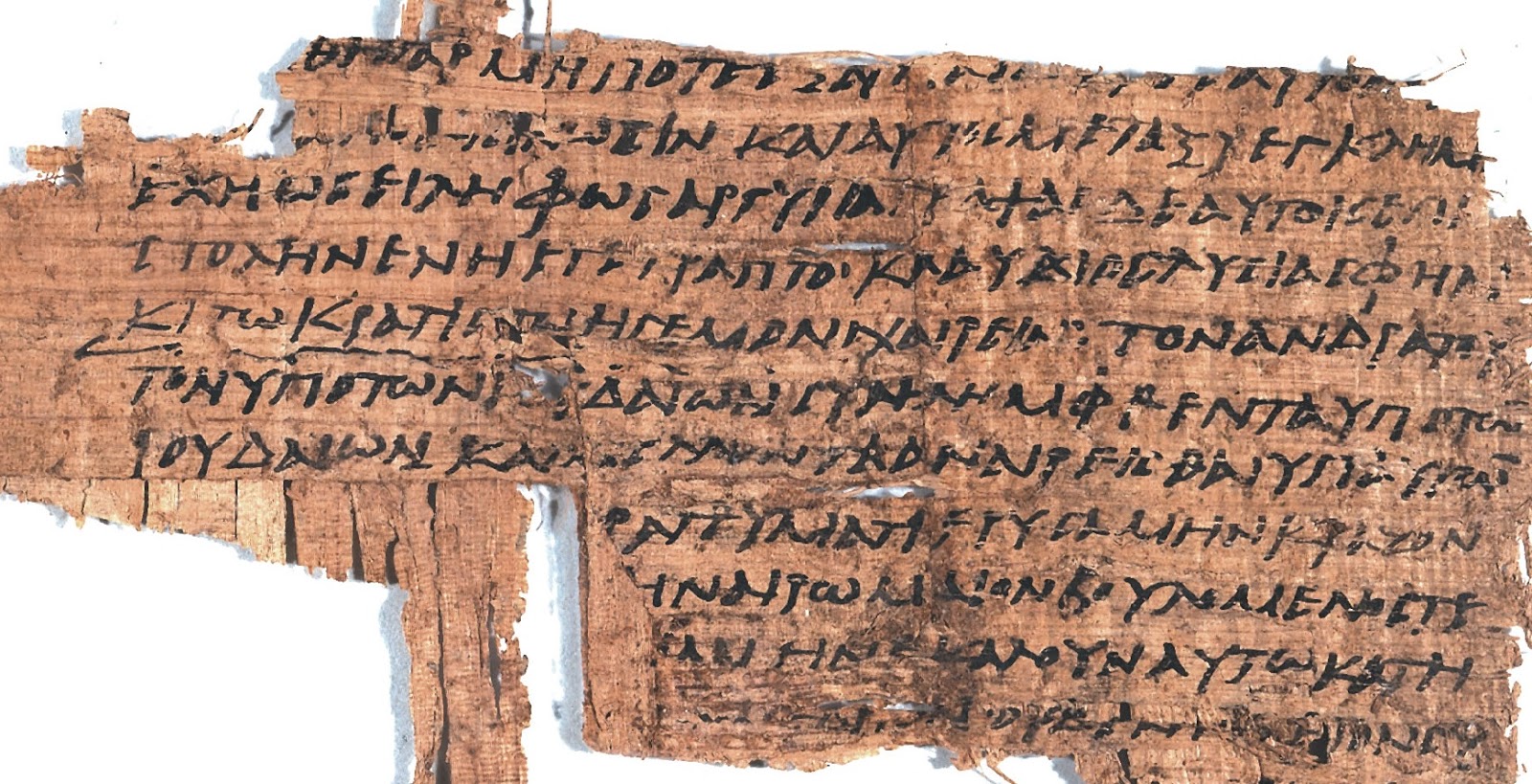
(Severe Style) Bacchylides Papyrus [PSI V 446]

(Upright Ogival Majuscule) P.Oxy XI 1352


(Sloping Ogival Majuscule) PSI X 1165