Showing posts with label oxyrhynchus papyri. Show all posts

Tuesday, January 14, 2025

Wes Huff, Joe Rogan, P. Ryl. 3.457 (P52) and the Gospel of John

Joe Rogan Holding up a facsimile of P52 that Huff made and presented to Rogan.

Christian Apologist and New Testament Scholar Wes Huff of Apologetics Canada appeared on the Joe Rogan Experience podcast. The interview has gone viral within the New Testament Textual Criticism communities in the online sphere particularly because of Huff's statements around the John Ryland papyrus known as P52 (shelf number P.Ryl. III 457).

It seems that everyone has wanted to jump into the discussion surrounding this fragment, including Brent Nongbri, professor of History of Religions at MF Norwegian School of Theology, Religion, and Society in Oslo. Over on his excellent blog Variant Readings, he listed several points of critique concerning P52 that Huff discussed on the Joe Rogan Experience. Nongbri has published extensively on the uncertainties of assigning dates to manuscripts using other non-dated papyri, especially with regard to P52. Despite Nongbri's obvious expertise I was a bit surprised by some of his criticisms of Huff's comments.

First was Huff's statements about the Christian use of the Codex. I had to re-watch that portion of the interview to be certain of the wording. When I first watched the interview I was in complete agreement with what Huff said, that Christians used the Codex exclusively with regard to their scriptures, which is absolutely true.Yet Nongbri seems to think Huff was arguing that ONLY Christians used the codex.

"The codex is “almost exclusively a Christian convention”: False. We have many codices that contain non-Christian material."

I don't think that this was what Huff was trying to convey when he was recounting the story to Rogan. Following are Huff's words in their full context.

"C. H. Roberts is, you know, literally going through these piles of manuscripts in these drawers that are being, like, stashed away and he finds this guy [P52], and he sees that it's written on both sides, which is almost exclusively a Christian convention. Because in the ancient world, they used scrolls. And the Christians, for reasons we're not entirely clear on, they start to make codices, books. Mhmm. And so, they write on both sides and so he says, okay this is written on both sides it's probably a Christian manuscript." (This at the 01:57:31-01:57:54 mark of the YouTube interview)
Nongbri's criticism appears to be taking issue with something that Huff never meant to say. It is most certainly true that Christians exclusively used the codex for their sacred writings, and this is likely what Huff was referring to and not that Christians invented the codex or that secular writings never appeared in the codex format. This becomes clear when his statements are taken in full context. In my hearing, Huff was highlighting the importance given in the discovery and publication by Roberts of the fact that P52 was the earliest known copy of a New Testament writing and it was a codex. In the description of the P52 in the Catalogue of Greek and Latin Papyri in the John Rylands Library Vol. III Theological and Literary Texts, it is in the preparation of this volume that Roberts "discovered" the Ryland's fragment, he notes that, 
"The fragment is part of a leaf of a papyrus codex and thus conforms to the almost universal rule that works of Christian literature were written in the codex form" ("Catalogue," pg. 1).
Along with this, in the editio princeps of P52, Roberts had this to say.
"The fact that it is part of a codex, not of a roll, need now cause no surprise; thanks to recent discoveries we are coming to regard the codex as the normal vehicle for Christian literature even in the second century." ("An unpublished fragment," pg. 12)

The fact that the fragment was so early (at least according to the dating conventions of the day) and that it was a codex played a part in the excitement surrounding it's discovery and publication and Huff was right to point this out.

In this info graphic Wes Huff gives details concerning the Christian use of the Codex. Note that Huff acknowledges that Christians did NOT invent the Codex and that Christian papyri only amounts to 20-40% of codices.

Second, Nongbri called attention to Huff's statement that the Ryland's fragment likely originated from Oxyryhnchus Egypt. Nongbri wrote.

"Most likely comes from Oxyrhynchus, Egypt.” Misleading. We don’t really know where this piece came from because it was bought on the antiquities market and not scientifically excavated. It’s possible that it comes from Oxyrhynchus, but Grenfell was buying from dealers elsewhere in Egypt in addition to the area of Oxyrhynchus."
The pushback by Nogbri about Huff's statement concerning provenance is hardly warranted. Roberts stated this about the fragment.
"Unfortunately, the provenance of the papyrus cannot be exactly determined. It was one of a large number purchased for the Library by the late B. P. Grenfell in 1920; the group to which it belongs consists of some literary texts and documents of the Ptolemaic and Roman periods, all of which are stated to have come either from the Fayum or from Oxyrhynchos." ("An unpublished fragment," pg. 24).

Not only does Roberts believe P52 originated in the Fayum or Oxyrhynchus, Nongbri himself stated that either of these locations were it's likely provenance. In his article, 'The Use and Abuse of P52: Papyrological Pitfalls in the Dating of the Fourth Gospel," Nongbri wrote in response to Roberts statements quoted above,

"Even absent that statement of provenance, we would be on safe ground assuming one of those two locales simply given the relative numbers of papyri discovered at those locations." ("The Use and Abuse of P52," pg. 27 footnote 14)

Therefore, if both Roberts in the editio princeps and Nongbri himself confirms that P52 is likely from Oxyrhynchus or from the Fayum, then Huff's statement was not misleading, it was on point.

Thirdly, with regard to the dating of P52 and the composition of John's Gospel, Nongbri has long taken issue with arguments like the one mentioned by Huff. It is worth quoting both Huff's comments, and Nongbri's reply together.
""But the unanimous consensus is that it’s comfortably second century, potentially beginning of the second century, which means that, this is found in Egypt; John is probably writing his gospel in Ephesus. So it has to be written by John, spread around, find its way to Egypt, copied and then end up in this manuscript, which means at minimum, you’ve already pushed the Gospel of John back into the first century, comfortably.” Very much debatable. This is the same story that was being told pretty much from the time of the publication of P52 in 1935. In older versions, the date of the papyrus was usually given as “circa 125 AD,” but here the rhetoric is a bit more slippery: “comfortably second century, potentially beginning of the second century.” But for the logic to work, that “potentially beginning of the second century” has to become “definitely beginning of the second century.” But the dating of P52 is not at all certain; it is just based on handwriting analysis, and there are good parallels for the script of P52 in papyri from the late second century and even the third century (see my 2020 New Testament Studies piece)"
A few things that should be noted here, one is the date range given by Nongbri. It is certainly true that this type of hand used by the scribe of the Rylands fragment has comparable examples into the third century. No one is disputing this. It is also true that, as Nongbri notes himself, these date ranges do not mean that P52 definitely dates to the early third century either. I really do think that Nongbri overstates his case somewhat. The fact that so many copies of John have survived, even if they all do date to the early third century, does say something about when the Gospel of John was composed. It at least speaks to the popularity and frequent copying of the text which reflects positively on its reception. It is certainly possible that P52, or even P.Bodmer II were copied in the second century. All Huff would need to do is change a few words of his comments and Nongbri's criticism would completely miss the mark.
"But the unanimous consensus is that it’s comfortably second [to early third] century, potentially beginning of the second century, which means that, this is found in Egypt; John is probably writing his gospel in Ephesus. So it has to be written by John, spread around, find its way to Egypt, copied and then end up in this manuscript, which means at minimum, you’ve already pushed the Gospel of John back into the first century, comfortably. [If the fragment dates to the early second century.]”
If these few minor changes were made and stated, then nothing that Huff claimed would have fallen within the realm of Nongbri's technical criticism. Along with this, Huff's comments were made in the context of the fragment's discovery. And with regard to the initial impact of the publication of the editio princeps, it certainly did have this affect on the consensus surrounding the date of composition for the Gospel of John.

Joe Rogan Experience #2252. Click Image for Link to YouTube Video

_______________________________________

Brent Nongbri, "The Use and Abuse of P52: Papyrological Pitfalls in the Dating of the Fourth Gospel," Harvard Theological Review, 2005; Vol. 98, p. 23-52.

Brent Nongbri, “Palaeography, Precision and Publicity: Further Thoughts on P.Ryl.Iii.457 (P52),” New Testament Studies 66, no. 4 (2020): 471–99.

C. H. Roberts, Catalogue of Greek and Latin Papyri in the John Rylands Library Vol. III Theological and Literary Texts (Nos. 457-551), Manchester: Sherratt and Hughes, 1938.

C.H. Roberts, "An unpublished fragment of the Fourth Gospel in the John Rylands Library," Bulletin of the John Rylands Library, 1936; Vol. 20 (1), p. 45-55.

Friday, March 24, 2023

The Oxyrhynchus Papyri and The Titles to Paul's Letters

I have been reading through a new book by Benjamin Laird, Associate Professor of Biblical Studies at Liberty University. This new monograph covers the formation of the Pauline letter collection; "The Pauline Corpus in Early Christianity: Its Formation, Publication, and Circulation."


I was planning on giving a concise review of the book (I was given a copy for review), but haven't yet finished reading it. I found the topic so intriguing and thought provoking, however, that I wanted to give a few of my thoughts before I was completely finished reading through the book. In the monograph, Laird discusses such topics as the early Christian use of the codex, the manner in which Greco-Roman authors circulated "editions" of their letter collections, etc. I hope to comment on these topics in further posts, for now, what has caught my interest was Laird's observations and arguments on the titles to Paul's letter collection. To briefly summarise, Laird highlights the uniformity of the titles to the Pauline letter collection in the earliest extant manuscripts, reviewing such early witnesses as P46 and Codex Sinaiticus among other witnesses (pages 74-82). He notes that the titles throughout all the collections remain consistent (page 82). Laird argues that because Paul's letters were carried by trusted letter carriers that knew the author and the recipients, "it may not have been necessary at the time the writings were originally dispatched for subscriptions or letter titles to be included" (pages 74). Because the Pauline letters were named after the recipients of the letters, Laird argues, it was unlikely that they circulated as part of other letter collections (page 83). He uses Philemon as an example, in this case, the letter was actually addressed to several individuals, Philemon being only one of them (Phlm 1; page 84). Because of this, Laird surmises,

"Because the address includes the names of several individuals, it is not a foregone conclusion that the title ΠΡΟΣ [Φ]ΙΛΗΜΟΝΑ would have been universally recognized had it not been created by a particular individual or a small team on a specific location." (page 84)

Supporting this notion, Laird points to the letter to the Ephesians (page 87). The earliest manuscripts (P46, 01, and 03) all testify to the title ΠΡΟΣ ΕΦΕΣΙΟΥΣ. Yet in these earliest witnesses the letter is uniformly written as ΠΡΟΣ ΕΦΕΣΙΟΥΣ. According to Laird, this points to the early circulation of an influential edition of Paul's letters.

These assertions had me thinking about the many examples of personal letters that have survived from Oxyrhynchus. There are a plethora of letters preserved that have the recipient written on the reverse side and have a named letter carrier known and trusted by the sender of the letter. Of course, I cannot be exhaustive, but here are a few examples.

P.Oxy 3.530. This second century letter is one from a son to his mother concerning money matters. The letter carrier is named, a certain Chaeremon, and is obviously known and trusted by the sender of the letter because Chaeremen holds money to give to the sender's mother. Even though the letter carrier is known and trusted by the sender of the letter, the name of the one to receive the letter is still written on the back of the document.

"Dionysius to Tetheus his mother, greeting. I have received all the letters concerning which you write, and with regard to the wheat which the collectors have demanded from you it is admitted (?), but I had forgotten to make any order for payment; I have however paid in full the naubion and other taxes. Do not be concerned that the matter about which I wrote to Theon has not been carried out and that I have so long been engaged with Pausirion’s business to no purpose ... Please receive from Chaeremon the bearer of this letter 112 drachmae of silver of which you will give to my friend Sarapion son of Apei 100 drachmae and redeem my clothes, with 8 drachmae on account of interest, and keep 4 drachmae for yourself for the expenses of the festival. If I had had more I would have forwarded a further sum; I have borrowed to send even this. So pay him the money and get my clothes back safe, and put them in a secure place. Do not be anxious about us, for there is nothing the matter with us and we are at harmony with each other. Theonas salutes you. Salute the boys Apion and his brother Hermatois, Dionutas, those with Nice and the little Thaisous, all those with..., Heras and his household, Leontas the proud and his household, those with Taamois, and Thermoutharion. Good-bye. The 20th of the month Caesareus. (P.S.) Send me word about this immediately after the festival, whether you received the money and whether you recovered my clothes. Salute Dionutas and Theon. (Addressed) To my mother Tetheus." (translation taken from https://papyri.info/ddbdp/p.oxy;3;530)

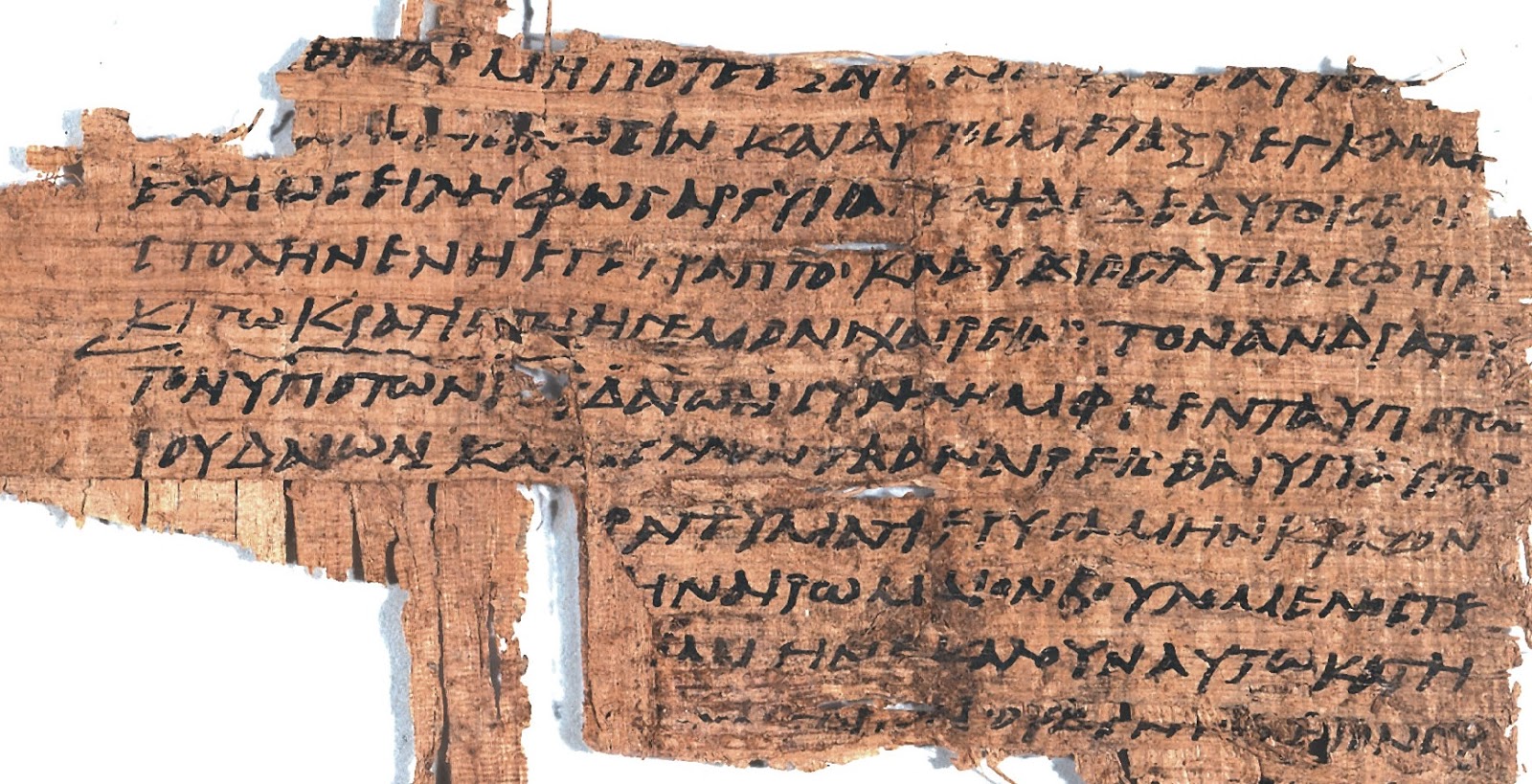
P.Oxy 3.530

P.Oxy 3.530 with the reverse showing to whom the letter is addressed:
Τεθεῦτι μητρί (Tetheus my mother)

P.Oxy 6.930. This is a letter written from a mother to her son. The first part of the letter normally containing the opening greeting is missing. Yet the receiver of the letter is preserved, written on the reverse side. Along with this, the mother is equally adressing her son's tutor who is apparently responsible for the boy. Even though the letter is addressed to her son on the reverse, she is also writing to her son's tutor Eros. 
" ... do not hesitate to write to me about anything which you require. It grieved me to learn from the daughter of our teacher Diogenes that he had sailed, for I had no anxiety about him, knowing that he intended to look after you to the best of his ability. I took care to send and ask about your health and learn what you are reading; he said that it was the sixth book and testified at length concerning your attendant. So my son, I urge both you and your attendant to take care that you go to a suitable teacher. Many salutations are sent to you by your sisters and Theonis’ children, whom the evil eye shall not harm, and by all our friends by name. Salute your esteemed attendant Eros ... (Addressed) ... to her son Ptolemaeus." (translation taken from https://papyri.info/ddbdp/p.oxy;6;930)

P.Oxy 6.930

Both of these papyri are examples of why Laird's observations on the titles of Paul's epistles do not necessitate an early edited and released collection published in a single codex. The titles of Paul's letters most likely came from the recipient written on the back of the letter as we see from these two examples. Or, for the longer epistles, written on the outside of the folded sheets of papyrus. P.Oxy 3.530 is an example of a trusted letter carrier (Chaeremon) who is known by the sender, yet the address is stil written on the back. P.Oxy 6.930 helps to answer Laird's concerns over Ephesians. In this oxyrhynchus letter, the written recipient is not preserved at the beginning of the letter (as is the case for Ephesians in P46, etc). Yet we still know who the intended recipient of the letter was because it was preserved by being written on the back of the letter. The same could be true for the letter to the Ephesians. Assuming the theory of a circular letter is true, if the earliest copy of the letter to Ephesians had the recipients omitted in the text of the letter, but the first copy was sent to the Church at Ephesus and the recipient was written on the back, then this could account for the recipients being left blank in the body of the text, but the title being preserved as "to the Ephesians."

Considering these two letters, it is much more likely that the titles of the Pauline letters actually derived from the intended recipients being written on the outside of the original folded and dispatched letter. Especially when we consider that Colossians 4:16 actually gives evidence that individual letters were being circulated at the begining and not as part of an "official" published edition.
"And when this letter has been read among you, have it also read in the church of the Laodiceans; and see that you also read the letter from Laodicea." (Col 4:16; ESV)
Despite this disagreement with Laird on the title origins of the Pauline letter collection, I still have found Laird's book thought provoking and suggestive. I hope to post more thoughts and reflections in the near future.

Monday, September 14, 2020

Review of Sabine R. Huebner. Papyri and the Social World of the New Testament


In the September issue of the Journal of the Evangelical Theological Society has published a fresh review from me of 

Sabine R. Huebner's, Papyri and the Social World of the New Testament (Cambridge: Cambridge University Press, 2019). 

Though I have some criticisms of the book, mainly her view of early Christianity in Egypt, overall, the book is very good and is chock full of interesting insights. Especially refreshing is Huebner's treatment of the problems in the census of Luke 2:1-3 which are original and appear to satisfactorily reconcile the chronological problems of this census with other known imperial censuses mentioned in the ancient writings.

Friday, May 8, 2020

Plague and Palaeography


The effects of the Antonine plague in the later half of the second century (ca. 165-190s CE) were far reaching. It is commonly accepted that the outbreak was some form of the Smallpox virus (Harper, 102). Scholars estimate anywhere from 1.5 to 25 million dead throughout the empire over the course of the plague (Harper, 108). This, and many other concomitant factors brought in its aftermath great economic and social upheaval in the later half of the second and long into the third century. The large death toll caused a slackening of the many social and class restrictions due to depopulation. For example, in 174-175 CE, emperor Marcus Aurelius loosened his own requirements for holding office in the city of Athens, that is, membership in the Areopagus. This was because there just wasn't enough "well-born" candidates to fill the ranks and Marcus mentions that this shortage was due to the "disasters" that had occurred in the cities (Duncan-Jones, 134).

Partly due to personell shortages across the empire and partly due to increasing inflation, wage hikes lead to an increasing cost of labor in the third century. The labor shortage and inflation also caused a large increase in the price of commodities from the second to the third centuries (Scheidel, 103-104). The papyrological record from Egypt reveals this increase in wages showing that the cost of rural labor at least doubled from the second to the third centuries (Scheidel, 104-105).

This level of economic and social change should be visible within the material and literary remains of Roman writing and book culture. Already in the third century the writing of Roman law changed quite drastically due to the Constitutio Antoniniana, that is the declaration by Emperor Caracalla of all peoples within the bounds of the empire as Roman citizens around the year 212 CE (Zwalve, 367). There was also a drastic decrease in the number documentary records produced during the last half of the second century (Duncan-Jones, 124-125).

It appears then that the economic decline did indeed leave it's traces in Roman literary and book culture. Raffaella Cribiore, in her work, "Writing, Teachers, and Students in Graeco-Roman Egypt," which focused on the material remains of teacher and student writing samples, noted that the quality of papyrus used in student exercises dropped off after the third century (Cribiore, 58). This corresponds with Turner's observations who noted that the quality of papyrus declined after the third century, describing it as "resembling cardboard" (Turner, 2). This decline in quality coincides with the drastic increase in labor and material costs mentioned above. For Pliny the Elder in the first century wrote that papyrus paper was manufactured in varying levels of quality and Cicero gives hints that these differing qualities had a proportionate level of cost (see earlier post here).

Though Scheidel's study of Roman-Egypt wage increases specifically did not include the wage of scribes (Scheidel, 105), the cost of hiring a scribe must have continued to increase along with the price of commodities for the Emperor Diocletian in 301 CE gave an edict capping the price on commodities and wages for different services (for an English translation of the edict see, here). The price that could be charged by both a scribe and a notary are listed as follows.
Scribe, for the best writing, for 100 lines, 25.
Scribe, for writing of the second quality, for 100 lines, 20.
Notary, for writing petitions or legal documents, for 100 lines, 10.
(English translation of edict)
It is apparent that during the third century and into the fourth century, the cost of employing a scribe increased enough so that the cost of producing a high quality book by hand would have increased as well. This cost increase might be reflected in the popularity of certain styles of writing used in the third century and beyond. Cribiore noted that decorated and serifed styles in Greek are found in school hands from the second century BCE into the third century CE in Roman Egypt with only a few examples found after this time (Cribiore, 115). This style of handwriting was referred to as "Zierstil" by palaeographer Wilhelm Schubart and was the subject of a thorough study by Giovanni Menci (see also Turner and Parsons, 21). Menci noted that these types of serifs were used across different handwriting styles and were added to several different hands across the centuries (Menci, 48-50). Menci also mentions that the first and second centuries CE were the high point in serifed writing and notes that the hands that became dominate in the later centuries do not exhibit the "decorated style" (Menci, 49-51). In support of this observation, Turner noted (before Menci's study) that there where few securely dated examples of serifed writing in this "informal round" style found in the third century noting two in the first half of the third century at the extreme end of a four hundred year life, P.Oxy 42.3030 and P.Oxy 43.3093.


P.Oxy 42.3030


P.Oxy 43.3093

Without knowing for sure what Diocletian's "best writing" is referring to, it might be that, due to the ever increasing cost in paying a scribe to copy out a book, more serifed writing styles ("Diocletian's "best writing") may have dropped out of vogue due to pressures of economy.

_________________________

Cribiore, Rafaella "Writing, Teachers, and Students in Graeco-Roman Egypt" (Atlanta: Scholar's Press, 1996).

Duncan-Jones, R.P., "The Impact of the Antonine Plague," in Journal of Roman Archaeology 9 (1996): 108-136.

Harper, Kyle, "The Fate of Rome: Climate, Disease, and the End of an Empire" (Princeton: Princeton University Press, 2017).

Menci, Giovanni, "Scritture greche librarie con apici ornamentali," in Scrittura e Civilta 3 (1979): 23-53.

Scheidel, Walter, "A Model of Demographic and Economic Change in Roman Egypt After the Antonine Plague" in the Journal of Roman Archaeology 15: 97-114.

Turner, E. G. Greek Manuscripts of the Ancient World. 2nd edition. Edited by P. J. Parsons. (London: University of London, Institute of Classical Studies, 1987).

Turner, E.G, "Greek Papyri: An Introduction" (Princeton: Princeton University Press, 1968).

Zwalve, Willem, "Codex Justinianus 6.21.1: Florus's Case," pg. 367-378 in "Crises and the Roman Empire" (Leiden: Brill, 2007).

Tuesday, February 23, 2016

Greek Palaeography: Bookhands of the Imperial Peak


The previous post discussed the type of writing used for copying Greek literature, the bookhand. During the Roman imperial era, this handwriting was bilinear, that is, each letter was written between two parallel imaginary lines. This period is often referred to as the "Imperial Peak" because there is an increase in the number of ancient papyri preserved from this time. Several styles of bookhands developed during the Roman era. This abundance of writing samples has allowed scholars to study the development of these various hand writing styles. This is good news for scholars who are assigning dates to early Christian papyri. The earliest copies of the New Testament writings have been dated during this "imperial peak," from the 2nd through the 4th centuries. In regard to the Roman period, Cavallo wrote;

"[Bookhands], in the course of this period not only reach full maturity but also exhibit a typological variety that allows us to distinguish a whole series of graphic streams sometimes also visible in documents, thereby enabling us to arrive at better-founded dates." (Cavallo, "Greek and Latin Writing in the Papyri, p. 112)

During this period, there are several main types of what palaeographers refer to as “scripts,” that is, a type of handwriting used by a scribe that has common stylistic features.

Round Majuscule (Turner: Formal Round)
(In use ca. 1st to the 2nd century CE)
Characterized by the “Hawara Homer” papyrus

Biblical Majuscule
(In use ca. 2nd to the 9th or 10th century CE)
Characterized by Codex Sinaiticus and Vaticanus

Alexandrian Majuscule (Turner: Informal Round)
(In use ca. 2nd to the 8th century CE)
Characterized by PSI V 446

Severe Style (Turner: Formal Mixed)
(In use ca. 2nd to the 3rd century CE)
Characterized by the “Bacchylides” papyrus

Ogival Majuscule (Pointed Majuscule)
Developed from the "Severe Style"
(In use ca. 3rd to the 11th century CE)
Upright type characterized by P.Oxy XI 1352
Sloping type characterized by PSI X 1165

Though the development of these scripts are discernible in the papyri, palaeographers are careful not to assign too narrow a date to any particular manuscript. Turner wrote,

"For book hands a period of 50 years is the least acceptable spread of time. A palaeographer familiar with the material will refuse assent to a precise date allocated to a manuscript simply by comparison with other texts and by no other criterion." (Turner, GMAW, p. 23)

_________________
Select Bibliography

Bianconi, Daniele. "Greek Palaeography." Pages 297-305 in Comparative Oriental Manuscript Studies: An Introduction. Edited by, Alessandro Bausi, Pier Giorgio Borbone, Françoise Briquel-Chatonnet, Paola BuziJost Gippert, Caroline Macé, Marilena Maniaci, Zisis Melissakis, Laura E. Parodi, Witold Witakowski, Eugenia Sokolinski. Hamburg: Tredition, 2015.

Cavallo, Guglielmo. "Greek and Latin Writing in the Papyri." Pages 101-148 in The Oxford Handbook of Papyrology. Edited by Roger S. Bagnall. Oxford: Oxford University Press, 2009.


Orsini, Pasquale and Willy Clarysse, “Early New Testament Manuscripts and Their Dates: A Critique of Theological Palaeography,” Ephemerides Theologicae Lovanienses 88 (2012): 443-74.

Turner, E. G. Greek Manuscripts of the Ancient World. 2nd edition. Edited by P. J. Parsons. London: University of London, Institute of Classical Studies, 1987.

 
(Round Majuscule) "Hawara Homer" P.Haw 24-28
(Biblical Majuscule) Codex Sinaiticus
(Alexandrian Majuscule) PSI V 446
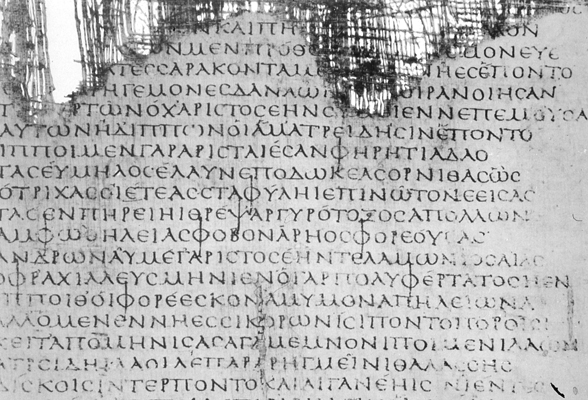
(Severe Style) Bacchylides Papyrus [PSI V 446]

(Upright Ogival Majuscule) P.Oxy XI 1352


(Sloping Ogival Majuscule) PSI X 1165