Showing posts with label papyrus. Show all posts

Monday, July 6, 2026

Papyrus Facsimiles from Manuscript Shop

I recently received a gift from Wes Huff of three facsimile papyrus manuscripts from the Manuscript Shop. I have been so impressed by the quality and attention to detail that I wanted to share some of the features of these museum quality replicas. The three manuscripts are P75, P52, and P46.

P75
The facsimile of the Pap.Hanna.1 (Mater.Verbi) papyrus, formerly known as Papyrus Bodmer XIV–XV (also known as P75) is an excellent representation of the original. Comparing the overall shape of the replica with the online images provided by the Vatican Library (page 2A.8r) reveals how exactly the outline was matched with the original fragment, even the worn through-holes and edges of the original are recreated. On page 2A.8r are preserved the titles of both the Gospel of Luke and of John. Zooming into the titles on the facsimile and on the online images reveals an exact match of the letter shapes and the darkness of the ink represented in the ink of the original letters, however, the replica reveals what appears to be some bleeding of the title letters (see image below). 

P75 Facsimile on stand

The stand has a very nice inscription that includes the reference of the biblical text preserved on each side


P52
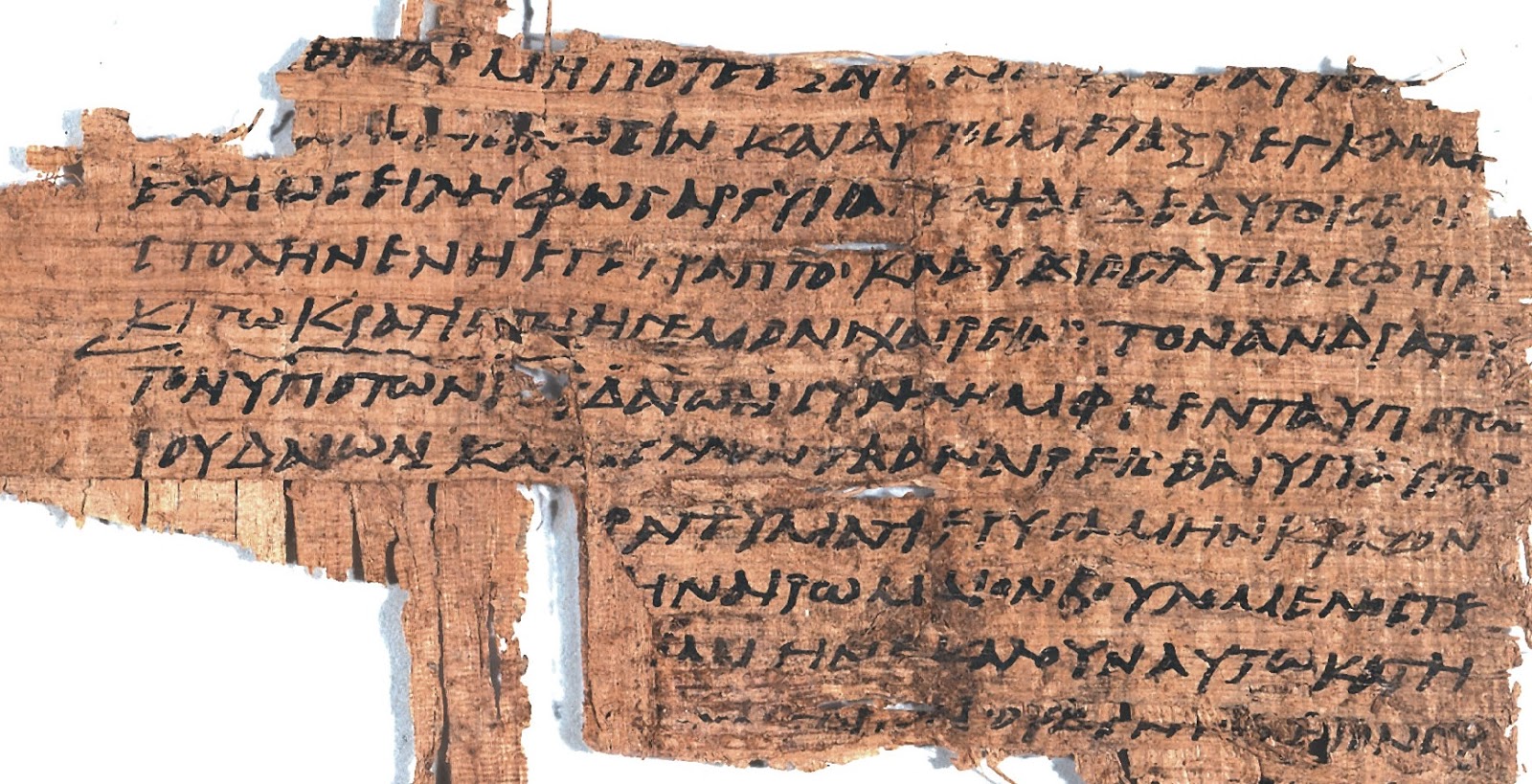
The famous Rylands Papyrus 457, more widely known as P52, is housed in the John Rylands library at the University of Manchester in the UK. This facsimile is quite striking and it is difficult to tell the difference between the original and the replica. The letters in the P52 facsimile are more exact than the P75 replica and do not have the "bleeding" effect. Even with my poor quality photograph, when the original P52 and the facsimile are seen side by side, the likeness of the two pieces is quite striking. The P52 copy is unique in that the description and content of the fragment is etched directly on the plexiglass plate covering the papyrus rather than on the stand as with the P75 and P46 stands (though the online version for sale doesn't have the plexiglass etched).


P46
The last facsimile is an excellent copy of a page from P46 that is owned by the University of Michigan where it is assigned the shelf number P.Mich inv. 6238 (both the recto and the verso). The lettering on this replica is very sharp allowing the small details of the interlinear correction on the recto, third line from the top, to show clearly. There is very little "bleeding" in the lettering and the worn holes in the papyrus are mimicked quite well, though, as the comparison image shows, the holes in the replica are slightly larger than in the original. 

Closeup of the etching on the stand for P46


All three replicas with their accompanying cloth protective pouches.

Despite the minor details that I mentioned above (the slightly larger wear holes and the "bleeding" of the letters) these facsimiles are absolutely stunning and the craftsmanship and attention to detail shows at every level and thus, they seem to be priced very low for their level of quality (consider the hefty price tag of these comparative quality papyrus facsimiles). It would take someone very familiar with the originals to be able to tell that they were reproductions. I would guess that if these facsimiles were placed beside their original counterparts, it would be difficult to discern which was the replica and which the original. At the very least, they are museum quality and would be very useful as classroom aids in learning palaeography, textual criticism, or learning to read Greek. Besides these useful applications, these pieces are excellent additions to any collection for display, whether a seminary, university, home, or office library.

Friday, June 26, 2026

Open Access Books: Manual of Roman Everyday Writing Volume 1 and 2


Alex Mullen & Alan Bowman, Manual of Roman Everyday WritingVol. 1: Scripts and Texts (Nottingham: LatinNow ePubs, 2021).

Anna Willi, Manual of Roman Everyday Writing. Volume 2: Writing Equipment (Nottingham: LatinNow ePubs, 2021).

Recently I came across these two new(ish) open access books on Roman Latin writing and extant writing tools and artifacts. Here is the information about these resources quoted from volume 1.

"The manual is split into two volumes. Vol. 1 prioritizes the reading and understanding of Roman cursive and the documents in which it is found. Vol. 2 provides an overview and catalogue of Roman writing implements, the main writing materials and accessories, and information about archaeological finds, photographs, drawings, and literary and iconographic testimony. It also presents a commentary on the social aspects of literacy and writing." ("Scripts and Texts," pg. 9)

The first volume, Scripts and Texts, focuses on the development of Latin scripts across the various geographical regions. There are ample pictures of artifacts and tables of the various letter forms of the Latin scripts. This volume is valuable for the study of Latin Palaeography.

The second volume, Writing Equipment, contains several excellent essays on the mechanics of writing and composition and the use of ancient writing tools and media. There are ample pictures of extant artifacts that represent these various writing tools. There is an excellent final chapter that consists of quotations from ancient Greek and Roman literary sources that reference the use of writing tools or writing tools and media (pgs. 109-145). Here is just a random sampling of these quotations.

"To whom am I to present my pretty new book, freshly smoothed off with dry pumice-stone?" (Catullus 1.1-2)

"I suppose he has got some ten thousand or even more written out in full, and not, as is often done, put down on used sheets; imperial paper, new rolls, new bosses, red ties, parchment wrappers; all ruled with lead and smoothed with pumice." (Catullus 22.4-8)

"The wretched tablet, which I tire myself out waxing each month, lies orphaned before the bed-post next the wall, except when he looks at it as if it were Hades and writes nothing good but scrapes it all smooth." (Herodas, Mimes 3.14–18) 

"But as ink when handled leaves mark and stain, so ofttimes with unseemly verse poets put a blot on bright exploits." (Horace, Epistles 2.1.235–237) 

"We are informed that there are three kinds of sponge: a thick and very hard and rough one is called goat-thorn sponge, a less thick and softer one loose-sponge, and a thin one of close texture, used for making paint-brushes, Achilles sponge." (Pliny, Natural History 9.148)

"In her right hand she holds her pen, in her left an empty waxen tablet. She begins, then hesitates and stops; writes on and hates what she has written; writes and erases; changes, condemns, approves; by turns she lays her tablets down and takes them up again." (Ovid, Metamorphoses 9.522–525)

These two volumes are excellent open-access resources for those wishing to understand the writing tools, media, composition practices, and mechanics of writing in the Greco-Roman era. I think that it is very useful and valuable that students, professors, teachers, New Testament Textual Critics, and scholars of the New Testament more widely understand these processes in greater detail.


Tuesday, December 9, 2025

Nomina Sacra and Assigning dates to Early Christian Papyri


Closeup detail of P75 showing the "staurogram" at Luke 14:27
(https://digi.vatlib.it/view/MSS_Pap.Hanna.1(Mater.Verbi) Image 1B.10r)

An article by Peter Rodgers was recently published postulating that the number and presence of words abbreviated as nomina sacra can be used as a rough marker for assigning a date to a particular manuscript.

Peter Rodgers, 'Papyrus 75 and Papyrus 4 Reconsidered," Filología neotestamentaria 38, no. 58 (2025): 77-88.

In this article Rodgers is responding to the argument laid out in the following article.. 

Brent Nongbri "Reconsidering the Place of Papyrus Bodmer XIV–XV (𝔓75) in the Textual Criticism of the New Testament." Journal of Biblical Literature 135, no. 2 (2016): 405-437.

In this piece, Nongbri argues that Papyrus Bodmer XIV–XV (P75) should be dated into the fourth century (ca. 350 CE) rather than in the first half of the third century (see previous post here). Nongbri uses the similarity in script used in P75 with similar scripts used in other securely dated fourth-century manuscripts to widen the possible dates of P75 into the fourth century. He then argues that the fourth century is a more likely date for the copying of P75 because of its close textual affinity to the fourth-century Codex Vaticanus.

In response to Nongbri's claims, Rodgers brings in the second-century P4 as supporting evidence for an early second-century stream of text found in P75 and Vaticanus. However, because Nongbri has also questioned the traditional second-century date for P4 as well, Rodgers looks to details other than handwriting to shine light on the dates of these two papyri (Nongbri, God's Library, 247-68). Rodgers does this by looking at the number of words abbreviated as nomia sacra in each papyrus. There are fifteen total words that have been abbreviated as nomia sacra in the most developed systems in the later manuscripts. In P4 "[o]nly God, Jesus, Lord, Christ and Spirit are abbreviated" (Rodgers, 84). In P75, there are eleven words that have been abbreviated as nomina sacra. Rodgers concluded,

"If we consider the use of the first four or five as earlier, and the addition of others as of a later date, we may surmise that, other things being equal, P4 is of a decidedly earlier date than P75. It is therefore reasonable to consider P4 to be from the late second century, and P75 to date from some time in the third or fourth century" (Rodgers, 84).

Because the tau-rho ligature, the staurogram, is used in P75, this adds an additional layer of complexity to the dating issue (see image above). Rodger notes that because the device is used within the context of the gospel narrative and is not used as a stand alone symbol, its use fits more comfortably in the third century rather than the fourth (Rodgers, 86).

I agree with Rodgers that the presence of the staurogram fits better in the third century, and that it may have been used as early as the late second century. For example, in an earlier post, I highlight the presence of the IH nomen sacrum for Jesus's name in the Latin text of the Frankfurt Amulet. It is interesting that there is a cross shape that is formed as the lengthened iota of the nomen sacrum intersects with the interlinear superscript to form a cross shape. This appears to be deliberate, and considering these nomina sacra in the amulet are Greek in a Latin text, it points to a much earlier adoption of these symbols in older Greek manuscripts. Considering the date (230-260 or 270 CE) of the context the amulet was found in, it means that cruciform imagery was used in nomina sacra at least by the begining of the third century, or even the late second century (if the burial where the amulet was found can be dated to 230 CE). (See also this earlier post discussing the staurogram and the Epistle of Barnabas)

Rodgers notes the presence of the staurogram at Revelation 11:8 in Codex Sinaiticus. Yet, its lack of use in the Gospel accounts in Sinaiticus means that its presence in Revelation 11:8 is most likely due to it being carried over from the exemplar (as Rodgers indicates on page 85). 

Though I do think that the details of Rodgers's arguments could be fleshed out in greater and more convincing detail, this article is a step in the right direction. Though I seriously doubt it will move the needle much in the debates surrounding the dates of these papyri.

______________________________________
Bibliography

Nongbri, Brent, God’s Library (New Haven: Yale University Press, 2018).

_______________, "Reconsidering the Place of Papyrus Bodmer XIV–XV (𝔓75) in the Textual Criticism of the New Testament" Journal of Biblical Literature 135, no. 2 (2016): 405-437

Rodgers, Peter, 'Papyrus 75 and Papyrus 4 Reconsidered," Filología neotestamentaria 38, no. 58 (2025): 77-88.

Saturday, September 9, 2023

How Marginal Comments Can Corrupt a Text in Transmission


A leaf from P.Mich.inv. 6238 (P46) showing the
end of Romans and the beginning and title of Hebrews

A number of years ago Michael W. Holmes wrote a book chapter in which he argued that several variations in the text of Romans in P46 were evidence of marginal comments entering into the body of text. This occurred, Holmes argued, when a copyist confused a marginal comment for a correction to be entered into the body of text (Holmes pg. 202-205).
"What now appear only as variant readings in the text originally were, I suggest, comments in the margins about the text—the earliest “commentary” (in the sense of activity, rather than genre) on the text of Romans." (Holmes pg. 205)
Though Holmes gave no examples from antiquity, there are two instances in which an ancient author mentions this phenomenon occurring during the copying of a text. 

The second century physician Galen in his commentary on Hippocrates "Epidemics" gives two explanations for a corruption in the text of Hippocrates. The first explanation Galen gives is that Hippocrates gave a parenthetical statement in order to point out the difference between two types of patients currently being discussed in the work. Galen makes the following comment for the second.
“The other explanation is something you often observe in many books: we sometimes write two expressions for the same thing, putting it in two different ways, and place one of them in the text body and the other in the margin of the book so as to pick the better of the two at leisure when we want to edit the book. It seems that Hippocrates did the same in this place. The first editor of this book then copied both expressions together into the book’s text. We then did not look at and consider it again, pause and fix this error. Many people passed on the copy of the book, and it remained uncorrected.” (In Hipp. epid. comm. I, 1.36) (Vagelpohl pg. 167)
Here Galen describes a practice in which the author of a work gives an explanatory note in the margin of their "autograph." When the text is initially edited and copied, the scribe would think that the marginal note was meant to be entered into the text as a correction. The result is that the book was then widely copied and circulated with the error uncorrected.

Another instance of this phenomenon is mentioned by Jerome. In about 403 CE Jerome received a letter from two men asking for an explanation as to why there were so many differences between the Septuagint LXX these men were using, and the Latin Psalter Jerome had produced many years before in about 383 CE. Along with this letter, these men sent a long list of passages where there were differences in the text between the LXX and the Latin Psalter. For one of the variations in the text, Jerome gave the following explanation.
"I wonder why some rash fellow has thought that the note: “the correct form is not καταπαύσωμεν, as some think, but κατακαύσωμεν, that is, incendamus,” which was placed by me for the guidance of the reader into the margin, should be put into the body of the text." (Ep. 106.46)
Apparently, in the first edition of Jerome's Psalter he had placed an explanatory comment in the margin. A later copyist confused this entry as a correction to be entered into the body of text. Thus, all subsequent copies of his Psalter had this variation transmitted in the text.

______________________________

Corpus Medicorum Graecorum 5.10.1. English translation taken from, Galen, Commentary on Hippocrates’ Epidemics Book I: Parts I-III (Translated by Uwe Vagelpohl. Corpus Medicrum Graecorum Supplementum Orientale V1. Berlin: Walter De Gruyter, 2014).

Holmes, Michael W. “The Text of P46: Evidence of the Earliest ‘Commentary’ on Romans?” In New Testament Manuscripts: Their Text and Their World (ed. by Tobias Nicklas; Leiden: Brill, 2006) 189-206.

Translation of Jerome's Epistle 106 by Michael Metlen, The Journal of English and Germanic Philology, Vol. 36, No. 4 (Oct., 1937), pp. 515-542.

Friday, June 11, 2021

Ancient Tablets, Notebooks, and Speeches in the Writing of the Gospels

Roman scribe with his stylus and tablets on his tomb stele at Flavia Solva in Noricum

In Book 6, Letter 5 to his friend Ursus, Pliny the Younger (ca. 61-113 AD) vividly describes a senate hearing. He mentions that during the proceedings two figures were debating each other; Licinius Nepos and Juventius Celsus. Apparently, Nepos re-opened a case that had been previous resolved and gave an untimely speech dealing with the matter that those present considered to be a breach of protocol. This is when the Jurist Celsus stepped in.

“The praetor Juventius Celsus vehemently upbraided him in a long speech, in which he taunted him with seeking to reform the senate. Nepos replied; Celsus answered him back, and neither spared reproaches and insults. I do not wish to repeat the words which pained me when I heard them spoken, but I blame even more some of our number who kept running first to Celsus and then to Nepos, according as one or other was speaking, in their desire to hear every word. At one moment they seemed to be encouraging and inflaming their passions, at another to be seeking to reconcile them and smooth matters over, and then they kept on appealing to Caesar to take the side of each, or even of both, just as actors do in a farce. What annoyed me most of all was that each was told what his opponent was going to say, for Celsus replied to Nepos from his note-book, and Nepos answered Celsus from his tablets. The friends of each kept talking to such an extent that the two disputants knew exactly what each was going to say, as though it had all been arranged beforehand.” (Ep. 6.5)

What caught my interest was the reference to “note-book” and “tablets,” both figures were referencing notes that they had obviously prepared beforehand. Celsus is described as making his reply to Nepos from a “note-book” which is translated from the Latin word “libellus.” And Nepos is depicted as referencing his “tablet,” which is translated from the Latin word “pugillaris."

The term "libellus" in this context is likely referring to "a book written in pages, and not in long rolls," especially some kind of legal brief or case notes (From Lewis and Short). This could be either papyrus or parchment. Though if it was a parchment codex the Latin word "membranis" would have more likely been used (Quintilian, Ins. Or. 10.3.31). Therefore this is likely referring to individual sheets stacked together.

P.Oxy 3929 a third century libellus or certificate of sacrifice for the Decian persecution 

The word "pugillaris" is a reference to a type of smaller hand held writing surface that was made from thin board hollowed out and filled with wax. This could then be inscribed upon by a pointy stylus and then erased easily by smoothing out the wax.

Teacher's Example Above, Student's Writing Below. Wax Tablet, II CE. (British Museum MS. 34186)

I find it fascinating that Pliny specifically mentions that these two figures are making their speeches directly from notes on writing materials rather than from rote memorization. This made me think of the intersection of early Christian "preaching" and the giving of public speeches in the Roman Senate. Irenaeus tells us that the Gospels of Mark and Luke first began as preaching events.

"Matthew also issued a written Gospel among the Hebrews in their own dialect, while Peter and Paul were preaching at Rome, and laying the foundations of the Church. After their departure, Mark, the disciple and interpreter of Peter, did also hand down to us in writing what had been preached by Peter. Luke also, the companion of Paul, recorded in a book the Gospel preached by him. Afterwards, John, the disciple of the Lord, who also had leaned upon His breast, did himself publish a Gospel during his residence at Ephesus in Asia." (Haer. 3.1, ANF)

Also, Eusebius hands down to us a tradition that the Gospel of John also first began as the oral preaching of the Jesus story. Only after he was urged by the Christian community did he write down the gospel of John in his old age.

"For Matthew, who had at first preached to the Hebrews, when he was about to go to other peoples, committed his Gospel to writing in his native tongue, and thus compensated those whom he was obliged to leave for the loss of his presence. And when Mark and Luke had already published their Gospels, they say that John, who had employed all his time in proclaiming the Gospel orally, finally proceeded to write for the following reason. The three Gospels already mentioned having come into the hands of all and into his own too, they say that he accepted them and bore witness to their truthfulness; but that there was lacking in them an account of the deeds done by Christ at the beginning of his ministry." (Eusebius, Hist. Eccl. 3.24.6-7, NPNF).

After thinking about the incident recounted by Pliny of Celsus and Nepos giving speeches while consulting their notebooks and tablets, I immediately thought about the apostles using notebooks and wax tablets as references and guides in their preaching. Perhaps these kinds of preaching notes were what was contained in Paul's mysterious "notebooks" (μεμβράνας, membranis) mentioned in 2 Timothy 4:13. If so, then perhaps some of these materials were in mind when Luke mentioned "many have undertaken to compile a narrative" (Luke 1:1-4). In the same way, perhaps some of Peter's preaching notes were used by Mark and arranged and ordered by him as Eusebius quotes Papias recounting (Eusebius, Hist. Eccl. 3.39.15). John too may have had these types of written notes when he proclaimed the Gospel story orally (as Eusebius recounts) and could have used them in the composition of his Gospel as well.

Of course this is all wild speculation, and there is no way to explore this further. However, considering the few snapshots that we have from contemporaries of the Evangelists like Pliny the Younger, this type of speculative scenario is not outside the realm of possibility.

______________________________________

Latin text and English translation of Pliny’s Letter taken from Pliny: Letters - Book 6 (attalus.org)

Monday, February 1, 2021

Elijah Hixson and P50 as A Possible Forgery

Here is a fantastic presentation by Dr. Elijah Hixson of CSNTM arguing that Papyrus 50 is likely a forgery by Kirsopp Lake.

[CLICK THE IMAGE TO LINK TO THE VIDEO]


Friday, May 8, 2020

Plague and Palaeography


The effects of the Antonine plague in the later half of the second century (ca. 165-190s CE) were far reaching. It is commonly accepted that the outbreak was some form of the Smallpox virus (Harper, 102). Scholars estimate anywhere from 1.5 to 25 million dead throughout the empire over the course of the plague (Harper, 108). This, and many other concomitant factors brought in its aftermath great economic and social upheaval in the later half of the second and long into the third century. The large death toll caused a slackening of the many social and class restrictions due to depopulation. For example, in 174-175 CE, emperor Marcus Aurelius loosened his own requirements for holding office in the city of Athens, that is, membership in the Areopagus. This was because there just wasn't enough "well-born" candidates to fill the ranks and Marcus mentions that this shortage was due to the "disasters" that had occurred in the cities (Duncan-Jones, 134).

Partly due to personell shortages across the empire and partly due to increasing inflation, wage hikes lead to an increasing cost of labor in the third century. The labor shortage and inflation also caused a large increase in the price of commodities from the second to the third centuries (Scheidel, 103-104). The papyrological record from Egypt reveals this increase in wages showing that the cost of rural labor at least doubled from the second to the third centuries (Scheidel, 104-105).

This level of economic and social change should be visible within the material and literary remains of Roman writing and book culture. Already in the third century the writing of Roman law changed quite drastically due to the Constitutio Antoniniana, that is the declaration by Emperor Caracalla of all peoples within the bounds of the empire as Roman citizens around the year 212 CE (Zwalve, 367). There was also a drastic decrease in the number documentary records produced during the last half of the second century (Duncan-Jones, 124-125).

It appears then that the economic decline did indeed leave it's traces in Roman literary and book culture. Raffaella Cribiore, in her work, "Writing, Teachers, and Students in Graeco-Roman Egypt," which focused on the material remains of teacher and student writing samples, noted that the quality of papyrus used in student exercises dropped off after the third century (Cribiore, 58). This corresponds with Turner's observations who noted that the quality of papyrus declined after the third century, describing it as "resembling cardboard" (Turner, 2). This decline in quality coincides with the drastic increase in labor and material costs mentioned above. For Pliny the Elder in the first century wrote that papyrus paper was manufactured in varying levels of quality and Cicero gives hints that these differing qualities had a proportionate level of cost (see earlier post here).

Though Scheidel's study of Roman-Egypt wage increases specifically did not include the wage of scribes (Scheidel, 105), the cost of hiring a scribe must have continued to increase along with the price of commodities for the Emperor Diocletian in 301 CE gave an edict capping the price on commodities and wages for different services (for an English translation of the edict see, here). The price that could be charged by both a scribe and a notary are listed as follows.
Scribe, for the best writing, for 100 lines, 25.
Scribe, for writing of the second quality, for 100 lines, 20.
Notary, for writing petitions or legal documents, for 100 lines, 10.
(English translation of edict)
It is apparent that during the third century and into the fourth century, the cost of employing a scribe increased enough so that the cost of producing a high quality book by hand would have increased as well. This cost increase might be reflected in the popularity of certain styles of writing used in the third century and beyond. Cribiore noted that decorated and serifed styles in Greek are found in school hands from the second century BCE into the third century CE in Roman Egypt with only a few examples found after this time (Cribiore, 115). This style of handwriting was referred to as "Zierstil" by palaeographer Wilhelm Schubart and was the subject of a thorough study by Giovanni Menci (see also Turner and Parsons, 21). Menci noted that these types of serifs were used across different handwriting styles and were added to several different hands across the centuries (Menci, 48-50). Menci also mentions that the first and second centuries CE were the high point in serifed writing and notes that the hands that became dominate in the later centuries do not exhibit the "decorated style" (Menci, 49-51). In support of this observation, Turner noted (before Menci's study) that there where few securely dated examples of serifed writing in this "informal round" style found in the third century noting two in the first half of the third century at the extreme end of a four hundred year life, P.Oxy 42.3030 and P.Oxy 43.3093.


P.Oxy 42.3030


P.Oxy 43.3093

Without knowing for sure what Diocletian's "best writing" is referring to, it might be that, due to the ever increasing cost in paying a scribe to copy out a book, more serifed writing styles ("Diocletian's "best writing") may have dropped out of vogue due to pressures of economy.

_________________________

Cribiore, Rafaella "Writing, Teachers, and Students in Graeco-Roman Egypt" (Atlanta: Scholar's Press, 1996).

Duncan-Jones, R.P., "The Impact of the Antonine Plague," in Journal of Roman Archaeology 9 (1996): 108-136.

Harper, Kyle, "The Fate of Rome: Climate, Disease, and the End of an Empire" (Princeton: Princeton University Press, 2017).

Menci, Giovanni, "Scritture greche librarie con apici ornamentali," in Scrittura e Civilta 3 (1979): 23-53.

Scheidel, Walter, "A Model of Demographic and Economic Change in Roman Egypt After the Antonine Plague" in the Journal of Roman Archaeology 15: 97-114.

Turner, E. G. Greek Manuscripts of the Ancient World. 2nd edition. Edited by P. J. Parsons. (London: University of London, Institute of Classical Studies, 1987).

Turner, E.G, "Greek Papyri: An Introduction" (Princeton: Princeton University Press, 1968).

Zwalve, Willem, "Codex Justinianus 6.21.1: Florus's Case," pg. 367-378 in "Crises and the Roman Empire" (Leiden: Brill, 2007).

Sunday, March 19, 2017

Papyrus and the New Testament Epistles

I came across a reference in the letters of Cicero (54 BCE). He was writing to his brother Quintus, and mentioned, off-hand, that he was going to use high quality papyrus.
“This time it will be quality pen and well-mixed ink and ivory-finished paper (charta etiam dentata), since you say you could hardly read my last letter” (Quint. fratr. 2.14)
It is interesting that Cicero mentions that the paper is "ivory finished," that it was very white, or bright in appearance. This, of course, must have been more expensive papyrus than that which he normally used for writing letters. As Pliny the Elder wrote, there were various grades of papyrus manufactured (Nat. 74-82). Papyrus was not always available, either due to price or through scarcity. An early 2nd century letter from Terentianus to Tasoucharion reads, "I sent you papyrus so that you might be able to write me concerning your health" (P. Mich. VIII 481). Perhaps it was difficult for the recipients of the letter to obtain papyrus. Unwanted Bookrolls were often repurposed by turning them over and writing on the blank back surface. Martial mentioned that if his poems failed to please the critics boys would "scribble on the backs" of his epigrams (Epig. 4.86). One fragment of John's Gospel appears to be written on the back of a reused bookroll (See Larry Hurtado's description here).

In the New Testament, there is almost no reference to the type of writing material used by the authors. Therefore it is nearly impossible to know what materials upon which the authors wrote. In one instance, John mentions papyrus,
"Though I have much to write to you, I would rather not use paper and ink (διὰ χάρτου καὶ μέλανος). Instead I hope to come to you and talk face to face, so that our joy may be complete." (2 John 12. ESV)
At least in this instance John likely used papyrus rather than a wooden or wax tablet, or any other material for that matter, in writing his epistles.

 
Alma Tadema's depiction of a Roman Scribe

Wednesday, December 21, 2016

Cassiodorus On Papyrus Paper

 
A leaf from P46, an early copy of Paul's epistles on papyrus.

During his service as a Praetorian Praefect under Theodoric The Great (ca. 533-538 CE), Cassiodorus maintained an extensive official correspondence. In a letter to Joannes, Canonicarius of Thuscia, Cassiodorus extensively praised papyrus paper;
"A wonderful product in truth is this wherewith ingenious Memphis has supplied all the offices in the world. The plants of Nile arise, a wood without leaves or branches, a harvest of the waters, the fair tresses of the marshes, plants full of emptiness, spongy, thirsty, having all their strength in their outer rind, tall and light, the fairest fruit of a foul inundation. 
Before Paper was discovered, all the sayings of the wise, all the thoughts of the ancients, were in danger of perishing. Who could write fluently or pleasantly on the rough bark of trees, though it is from that practice that we call a book Liber ? While the scribe was laboriously cutting his letters on the sordid material, his very thought grew cold: a rude contrivance assuredly, and only fit for the beginnings of the world. 
Then was paper discovered, and therewith was eloquence made possible. Paper, so smooth and so continuous, the snowy entrails of a green herb; paper which can be spread out to such a vast extent, and yet be folded up into such a little space; paper, on whose white expanse the black characters look beautiful; paper which keeps the sweet harvest of the mind, and restores it to the reader whenever he chooses to consult it; paper which is the faithful witness of all human actions, eloquent of the past, a sworn foe to oblivion." (Letters 11.38)
The popularity and utility of papyrus is also reflected in the manuscript tradition of the New Testament writings. A significant portion of New Testament manuscripts that date to the time of Cassiodorus and earlier are preserved on papyrus. Therefore, in the case of the New Testament writings, we can agree with Cassiodorus that "Before Paper was discovered, all the sayings of the wise, all the thoughts of the ancients, were in danger of perishing."
_________________
Hodgkin, Thomas, trans. The Letters of Cassiodorus. London: Henry Frowde, 1886. (pg. 483)

Monday, May 30, 2016

New Journal Article Published

I have had the honor of having an article published in the latest issue of Bibliotheca Sacra. The article contrasts the ways in which early Christians manufactured their books that contained New Testament writings with the way Romans manufactured their books.

"Christian Papyri and the Ancient Church." Bibliotheca Sacra 173 (April-June 2016): 182-202.

The abstract of the article is as follows:

Modern scholarship and popular media outlets often depict the earliest Christians as holding wildly divergent beliefs about Jesus and as reading and writing secret gospels that never made it into the New Testament. This view fails to consider the material re-mains of early Christian manuscripts from the second and third centuries that have been discovered in Egypt. These manuscripts mainly consist of New Testament writings and contain certain paralinguistic and formatting features that highlight unique socio-cultural aspects of the early Christians that stand in stark contrast to these modern theories of Christian origins.


Tuesday, April 19, 2016

The Staurogram and The Epistle of Barnabas: Further Discussion

In a previous post, the comments of Dr. Brent Nongbri in reference to the staurogram and its place in a third century manuscript were taken up. At issue is whether Christian scribes of the second and third centuries were experimenting with images of Jesus on the cross in their art and worship practices. Dr. Nonbgri argued that,
"At the very least, such experimentation with cruciform imagery [in the staurogram] would appear less out of place in the fourth century than in the late second or early third century. (pg. 33-34)"
These observations are striking when looking at the many references in early Christian writings of the second and third century; Minucius Felix, Tertullian, Clement of Alexandria, and the author of the Epistle of Barnabas. These authors mention the cross and cross shapes as venerated symbols of Christian identity. Yet, it is argued by Nongbri, each of these early Christian examples are merely allusions to the cross and its shape and not to the image of the crucified Jesus, which scholars purport the staurogram to be.
There was an oft repeated story in early Christian literature that may serve to illustrate that the image of Jesus as a crucified figure on the cross was a familiar Christian icon. In the Epistle of Barnabas, reference is made to the story of Israel defeating the armies of Amalek in Exodus 17:8-13. In this account, Moses lifted up his hands as a sign to the Lord; when his hands were held aloft, Israel was victorious, when his hands fell to his side, Amalek was victorious. Aaron and Hur eventually held Moses' hands aloft as he grew weary and the Israelites won the battle. In light of this story, the Epistle of Barnabas (70-135 CE) wrote;
"Once again you have a reference about the cross and about him who was destined to be crucified. And again he speaks to Moses, when war was being waged against Israel by foreigners, and in order that he might remind those being attacked that they had been handed over to death because of their sins, the Spirit says to the heart of Moses that he should make a symbol of the cross and of him who was destined to suffer because, he is saying, unless they place their hope in him, war shall be waged against them forever. Therefore Moses piled one shield upon another in the midst of the battle, and standing high above them all he stretched out his hands, and so Israel was again victorious. But whenever he lowered them, the men began to be killed. Why so? So that they might learn that they cannot be saved unless they place their hope in him. (12:1-3)"
There are some aspects of this story that bear reflection. First, the Epistle of Barnabas assumes that Moses raised his hands horizontally, in the shape of the cross, and this is mentioned in such a way that this must have been a familiar Christian interpretation of this story. And second, the Epistle of Barnabas specifically references this as a symbol of the crucified Jesus and not just of the cross. At one point Barnabas uses the word "suffer" (πασχειν) (12:2) and the middle/passive infinitive (σταυρουσθαι) to refer to this event as a reference to Jesus (12:1). It is clear that Barnabas was viewing the imagery of Moses standing with arms outstretched as a visual representation of Jesus suffering on the cross.
Moses with outstretched hands as a symbol of Jesus on the cross
This story in Barnabas is set in the midst of several allegorical references to the cross that were found in the familiar passages and stories of the Old Testament. At Barnabas 8:1,5; 9:7; 11:1,8; and 13:5. In each of these other references the cross is mentioned as a stand alone representation of salvation with no visualization of the crucified Jesus. However, at 12:1-3, specific mention is made to the imagery of Moses with outstretched hands as a visual representation of the suffering Jesus on the cross.

Though, there is no specific reference to scribes taking this iconography and creating a staurogram, the impetus for doing so is already present in Barnabas some 80-100 years before it is found, represented by the staurogram, in the texts of P66, P45, and P75. The reverence for Jesus and the cross was already tied to a textual representation in the nomina sacra at Barn. 9:7-8. It takes no stretch of the imagination to conclude that a visual representation of Jesus on the cross, as found at Barn. 12:1-3, would find expression in a staurogram.

_______________ 
 
Holmes, Michael W., ed. The Apostolic Fathers: Greek texts and English translations. Grand Rapids: Baker Books, 1999.
Hurtado, Larry W. Lord Jesus Christ: Devotion to Jesus in Earliest Christianity. Grand Rapids: Eerdmans, 2005.
Hurtado, Larry W. The Earliest Christian Artifacts: Manuscripts and Christian Origins. Grand Rapids: Eerdmans, 2006.
Longenecker, Bruce W. The Cross Before Constantine The Early Life of a Christian Symbol. Minneapolis: Fortress Press, 2015.

Nongbri, Brent. “The Limits of Palaeographic Dating of Literary Papyri: Some Observations on the Date and Provenance of P. Bodmer II (P66),” Museum Helveticum 71 (2014): 1-35.

Tuesday, February 23, 2016

Greek Palaeography: Bookhands of the Imperial Peak


The previous post discussed the type of writing used for copying Greek literature, the bookhand. During the Roman imperial era, this handwriting was bilinear, that is, each letter was written between two parallel imaginary lines. This period is often referred to as the "Imperial Peak" because there is an increase in the number of ancient papyri preserved from this time. Several styles of bookhands developed during the Roman era. This abundance of writing samples has allowed scholars to study the development of these various hand writing styles. This is good news for scholars who are assigning dates to early Christian papyri. The earliest copies of the New Testament writings have been dated during this "imperial peak," from the 2nd through the 4th centuries. In regard to the Roman period, Cavallo wrote;

"[Bookhands], in the course of this period not only reach full maturity but also exhibit a typological variety that allows us to distinguish a whole series of graphic streams sometimes also visible in documents, thereby enabling us to arrive at better-founded dates." (Cavallo, "Greek and Latin Writing in the Papyri, p. 112)

During this period, there are several main types of what palaeographers refer to as “scripts,” that is, a type of handwriting used by a scribe that has common stylistic features.

Round Majuscule (Turner: Formal Round)
(In use ca. 1st to the 2nd century CE)
Characterized by the “Hawara Homer” papyrus

Biblical Majuscule
(In use ca. 2nd to the 9th or 10th century CE)
Characterized by Codex Sinaiticus and Vaticanus

Alexandrian Majuscule (Turner: Informal Round)
(In use ca. 2nd to the 8th century CE)
Characterized by PSI V 446

Severe Style (Turner: Formal Mixed)
(In use ca. 2nd to the 3rd century CE)
Characterized by the “Bacchylides” papyrus

Ogival Majuscule (Pointed Majuscule)
Developed from the "Severe Style"
(In use ca. 3rd to the 11th century CE)
Upright type characterized by P.Oxy XI 1352
Sloping type characterized by PSI X 1165

Though the development of these scripts are discernible in the papyri, palaeographers are careful not to assign too narrow a date to any particular manuscript. Turner wrote,

"For book hands a period of 50 years is the least acceptable spread of time. A palaeographer familiar with the material will refuse assent to a precise date allocated to a manuscript simply by comparison with other texts and by no other criterion." (Turner, GMAW, p. 23)

_________________
Select Bibliography

Bianconi, Daniele. "Greek Palaeography." Pages 297-305 in Comparative Oriental Manuscript Studies: An Introduction. Edited by, Alessandro Bausi, Pier Giorgio Borbone, Françoise Briquel-Chatonnet, Paola BuziJost Gippert, Caroline Macé, Marilena Maniaci, Zisis Melissakis, Laura E. Parodi, Witold Witakowski, Eugenia Sokolinski. Hamburg: Tredition, 2015.

Cavallo, Guglielmo. "Greek and Latin Writing in the Papyri." Pages 101-148 in The Oxford Handbook of Papyrology. Edited by Roger S. Bagnall. Oxford: Oxford University Press, 2009.


Orsini, Pasquale and Willy Clarysse, “Early New Testament Manuscripts and Their Dates: A Critique of Theological Palaeography,” Ephemerides Theologicae Lovanienses 88 (2012): 443-74.

Turner, E. G. Greek Manuscripts of the Ancient World. 2nd edition. Edited by P. J. Parsons. London: University of London, Institute of Classical Studies, 1987.

 
(Round Majuscule) "Hawara Homer" P.Haw 24-28
(Biblical Majuscule) Codex Sinaiticus
(Alexandrian Majuscule) PSI V 446
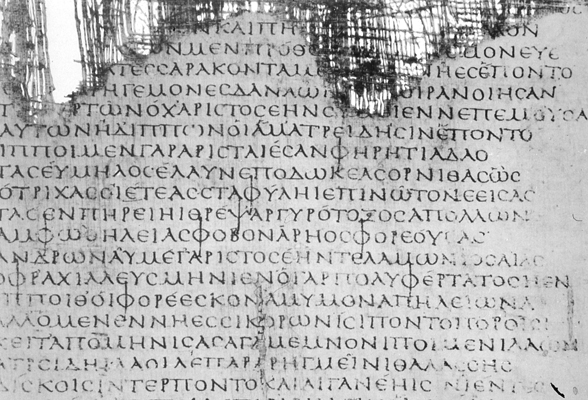
(Severe Style) Bacchylides Papyrus [PSI V 446]

(Upright Ogival Majuscule) P.Oxy XI 1352


(Sloping Ogival Majuscule) PSI X 1165