Showing posts with label P75. Show all posts

Tuesday, May 26, 2026

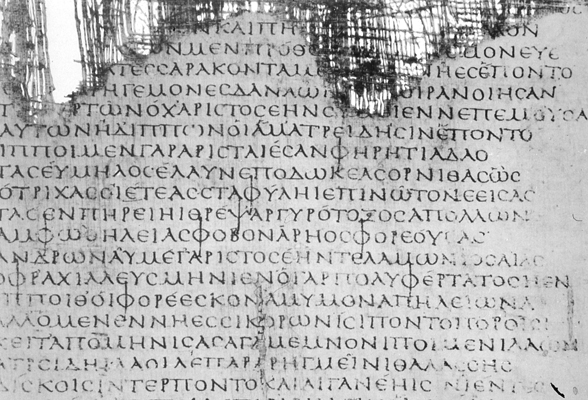
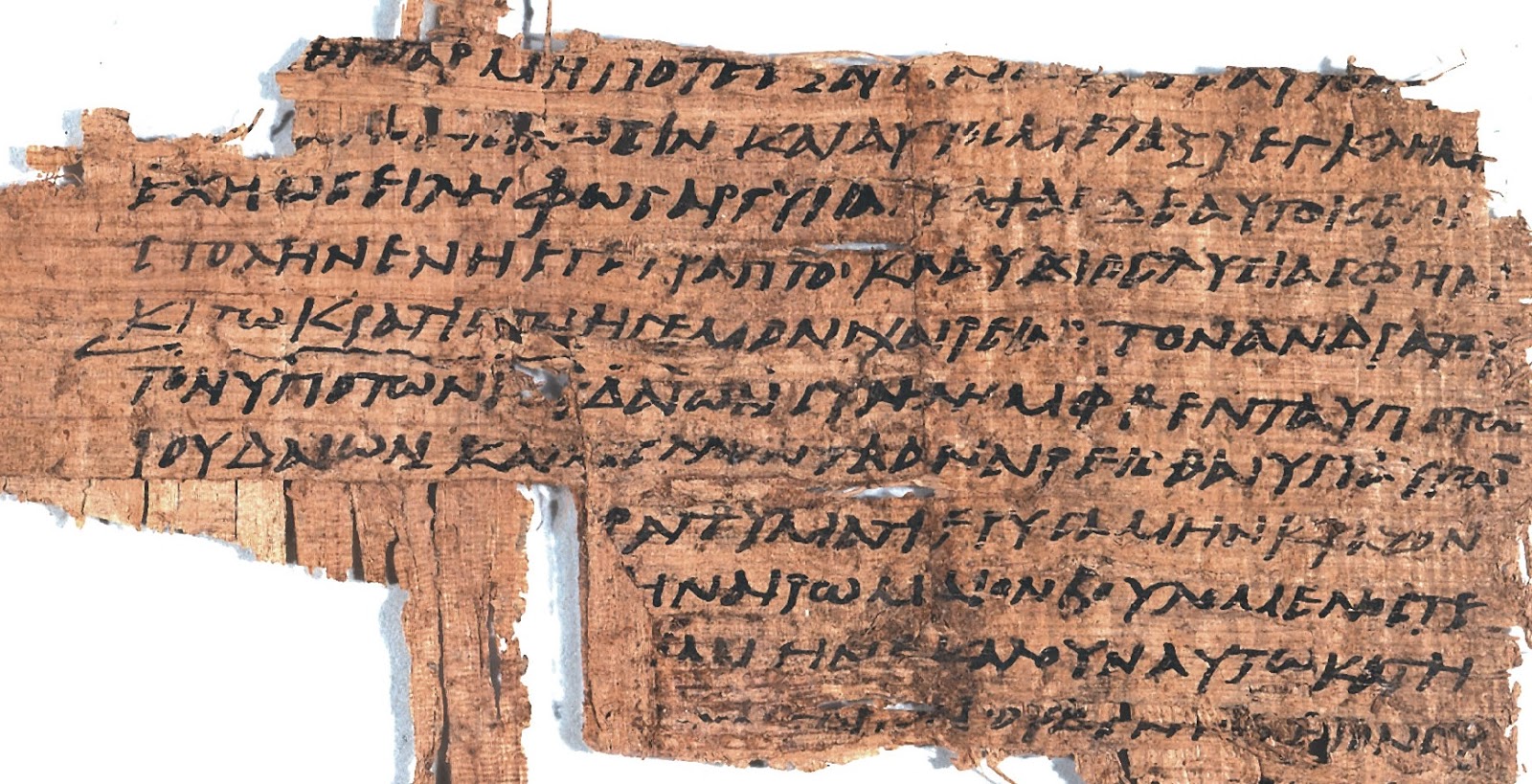
Forthcoming in The Journal of Theological Studies: Moses as a Symbol of the Crucified Jesus: An Early Reference to the Staurogram?


Early on in my studies, I came across Larry Hurtado's book The Earliest Christian Artifacts: Manuscripts and Christian Origins. It was deeply informative and fascinating to learn of all the features that were characteristic of Christian books; the codex, readers aids, and the nomina sacra (among other distinctives). I used his work as the basis for a detailed adult Sunday School class that I gave at my home Church over a period of several weeks that covered the information found in The Earliest Christian Artifacts. I had the opportunity to share this with Hurtado one time at SBL and he was thrilled. He said that one of his goals for writing that book was to inform the every day Christian of the rich heritage of the manuscript tradition of the New Testament. 

Hurtado was also well known for his work on the staurogram, to which he dedicated a chapter in his book. I too became fascinated with the nomina sacra (thanks to Hurtado), and in particular this curious tau-rho ligature. I was convinced by Hurtado's arguments that this device was used as a sort of crude pictogram of the crucified Jesus. Eventually this curiosity led to me writing an article on the origin of this device. After an earlier draft version was rejected by JBL, I submitted my manuscript to The Journal of Theological Studies and I recently learned that it was accepted for publication. I wish that Hurtado was still with us because I would love to talk about the staurogram with him over a cup of coffee.

I am not sure when the article will appear in print. Until that time, here is the title and an abstract to whet your appetite.

Moses as a Symbol of the Crucified Jesus: An Early Reference to the Staurogram?

Abstract:
This article investigates the origins of the Christian use of the staurogram, a ligature formed by the superimposed Greek letters tau and rho, as a symbol of the crucified Jesus, in three early New Testament gospel codices; P66, P75, and P45. Evidence is presented from the Epistle of Barnabas 12.1-3, which interprets Moses’s outstretched arms during the battle against Amalek as a prefiguring of Jesus’s crucifixion, demonstrating that the veneration of cruciform imagery was already present within the imagination of some Christian communities. This suggests that all the necessary ingredients and catalysts were present for the appropriation of the tau-rho ligature at the beginning of the second century. The presence of the staurogram in the Beratius Nikatoras inscription, several Christian gemstone rings, Codex Sinaiticus, and the “Jung Codex,” and the nomen sacrum evidence from a recently discovered Frankfurt Silver amulet, are used to construct a chronological framework for the adoption of the staurogram in the New Testament gospel papyri. This article argues that there is good reason to believe staurograms could have appeared in manuscripts of the canonical gospels as early as the end of the second century and were adopted as standalone pictograms by the fourth century

Key words: staurogram, nomina sacra, Epistle of Barnabas, Ephrem the Syrian, Frankfurt Silver Amulet, P45, P66, P75, Codex Sinaiticus


Monday, March 30, 2026

P.Bodmer II (P66), a Marginal Correction, and the Useful Life of Books

While re-reading James Royse's discussion of P66, I came across his brief mention of a correction at John 13:19a. It seems that the original copyist skipped over an entire line in their exemplar and omitted the following phrase in red, 

ἀπ᾽ ἄρτι λέγω ὑμῖν πρὸ τοῦ γενέσθαι, ἵνα πιστεύσηται ὅταν γένηται τι ἐγώ εἰμι.

The interesting feature about this correction is that it appears to be the only correction not made by the original copyist of the manuscript. Here are Gordon Fee's comments in full.

"However, there is one correction which seems clearly to be the work of a second hand: the addition of απ αρτι λεγω υμιν προ at 13:19. The square μ and υ simply demand a second hand: in the original scribe’s hand (even in the corrections which are obviously his) these letters are always well-rounded. Although this particular hand does not seem to be clearly in evidence at any other point, it does indicate that a second hand has had access to the MS." (Fee, Papyrus Bodmer II, 59)

The script used in P66 has been classified by Turner as "informal round" which has letters that "are rounded but also seem flattened" (Turner and Parsons, Greek Manuscripts of the Ancient World, 21). Orsini and Clarysse have placed the script of P66 into their "Alexandrian Stylistic Class" which is characterized by letters that are "unimodular and looped, and the strokes end in apices (in the lower parts) and small hooks (in the upper parts); sometimes curves and flourishes are added at the end of letters." (Orsini and Clarysse, "Early New Testament Manuscripts and Their Dates," 458).


P.Bodmer II showing correction at John 13:19

When examining the interlinear correction at John 13:19 in closer detail, the difference in the two scripts is apparent. As Fee noted in the quote above, the μ and υ are markedly different, the correction being more angular and less looped and curved than the letters of the main text. Also note the difference in shape and the flow of the pen strokes in the way the alpha, mu, upsilon, and omicron are formed (these letters are highlighted in red below).

Closeup detail of John 13:19 correction in P.Bodmer II (P66). Compare the highlighted letters in the original script with those of the interlinear correction at the top.


Also, added to the difference in letter shapes is the difference in ink. It is difficult to see the details in the gray scale image, but it appears that the ink of the marginal correction is darker and the ductus is sharper with less fading from the ink. Again, it is difficult to tell from this image, but it appears to be a different ink that was used in the correction as compared to the main body of text. When comparing the script of the correction at John 13:19 with the more formal rounded biblical majuscule of the fourth and fifth centuries, clear parallels can be seen.

Closeup detail of John 13.19 in Codex Sinaiticus (top), Codex Alexandrinus (Second from top), Codex Vaticanus (Second from Bottom), and the Correction at John 13.19 in P66 (bottom).

I aligned the same text from John 13:19 with the text from three other codices in order to illustrate the close similarities between the style of script used in these manuscripts (in Sinaiticus and Vaticanus, the text spread across two lines so I altered the image so that the text from these manuscripts would appear horizontally together for comparison purposes). When looking at the overall letter forms, it seems that the scribe of the correction in P66 was using a very similar script to that used in these other manuscripts. This script is designated by Orsini and Clarysse as "Biblical majuscule" and they place both Codex Vaticanus and Codex Sinaiticus into this classification (Orsini and Clarysse, "Early New Testament Manuscripts and Their Dates," 451). According to Orsini and Clarysse, this script was used as early as the second century and they place P64+67+4 into an early stream of this style and assign a date of the late second to the early third century.

John 13.19 Correction in P66 (top) and detail from P4 (bottom)

Though the image from P4 is not as high quality, I compared similar letters from P4 with the correction at John 13:19 in P66 (highlighted in red above). There are definately close similarities between these scripts, especially with the more uniform thickness of the strokes, when compared with the corresponding thinner-thicker ductus of the fourth century codices. Therefore, purely on palaeographical grounds, this interlinear correction at John 13:19 could have occurred anywhere from the third century, into the fourth or even fifth centuries. However, the uniform thickness of the strokes in the P66 correction looks closer to the script in P4, so if this fact holds any chronological weight, then the correction is likely earlier rather than later within this 3rd to fourth century spectrum.

This correction indicates that someone was using P.Bodmer II at a date sometime after the book was produced, they noticed the omission by the copyist, and added the missing text in between the lines. It's possible that this correction occurred during one of the many rebindings that P66 underwent in its (apparently long) useful life. Nongbri has a detailed discussion of this rebinding in his treatment of the appearance of quire signatures in P66. The quire signatures could be from the orginal binding, or could possibly originate from a later rebinding. Either way, the quire signatures do not correspond with the latest binding preserved in the manuscript .According to Nongbri, quire signatures are first seen in the early fourth century so it is likely that multiple rebindings occurred on P66 in the fourth and possibly early fifth centuries (See the full discussion in Nongbri, "The Limits," 29-32).


P.Bodmer II detail showing reinforcement repair in the spine (highlighted in red)

P.Bodmer II detail showing reinforcement repair in the spine (highlighted in red)


 Figures 20 and 21 taken from Nongbri "The Limits of Palaeographic Dating of Literary Papyri," pg. 30, with the quire signatures highlighted in red.


If a third century production of the codex holds true, then the manuscript was used for about one hundred years before it was repaired sometime in the fourth century. It is possible, as Nongbri suggests, that at this time the quire signatures were placed in the manuscript and perhaps, the marginal interlinear correction at John 13:19 was made by the scribe who was facilitating the rebinding (highly speculative I admit). The manuscript continued to be used and the reinforcing strips and possibly another rebinding ocurred in the later fourth or even into the fifth century and the page margins (and the remains of the quire numbers) where trimmed. Then finally, the codex was deposited into its final location in the fifth, or perhaps (if Robinson's material is included in the same deposit) into the sixth or even seventh centuries (Nongbri, "The Limits," 25). That means that this manuscript was being used anywhere from 200 to 300 years before it was deposited into its final location (see earlier blog post here). 

One final comparison of scripts is worth noting here. P.Bodmer XIV–XV (P75) also contains a marginal comment that uses a similar "Biblical Majuscule" script as that used in the John 13:19 correction of P66. 


The marginal comments in P.Bodmer XIV-XV (P75) compared with the correction at John 13:19 in P.Bodmer II (P66) 
 

Though not an exact match, the marginal comments in P75 are very similar to the correction at John 13:19 in P66. Look especially at the two circled alphas, their shape and form is very similar, though they are not exactly the same hand because there are minor differences in the size and shape of the upsilon and the omicron, and the marginal hand in P75 has no serifs or hooks like those in the correction in P66. With that said, this indicates that these new testament codices were being used and read well into the fourth and fifth centuries. This corresponds with Houston's assessment.

"The identification of such collections, and of the manuscripts within them, provides new evidence on an old question: how long did a papyrus roll last? The evidence from our collections indicates that a usable lifetime of about 100 to 125 years was common and can reasonably be considered the norm; a small but significant number of manuscripts were still usable some 300 years after they were first created; and on rare occasions a manuscript might last, it seems, for half a millennium." (Inside Roman Libraries, p. 257)

____________________________________________

Fee, Gordon, Papyrus Bodmer II (P66): Its Textual Relationships and Scribal Characteristics (Studies and Documents, 34; Salt Lake City: University of Utah Press, 1968). 

Houston, George W. Inside Roman Libraries: Book Collections and Their Management in Antiquity (Chapel Hill: UNC Press, 2014).

Nongbri, Brent, “The Limits of Palaeographic Dating of Literary Papyri: Some Observations on the Date and Provenance of P. Bodmer II (P66),” Museum Helveticum 71 (2014): 1-35

Orsini, Pasquale and Willy Clarysse, “Early New Testament Manuscripts and Their Dates: A Critique of Theological Palaeography,” Ephemerides Theologicae Lovanienses 88 (2012): 443-74. 

Royse, James Ronald. Scribal Habits in Early Greek New Testament Papyri (NTTSD 36. Leiden: Brill, 2008).

Turner, E. G. Greek Manuscripts of the Ancient World (2nd edition, ed. P. J. Parsons. London: University of London, Institute of Classical Studies, 1987) 


Sunday, September 9, 2018

Review: "God's Library," by Brent Nongbri


In recent years, the study of “Christian” manuscripts as cultural artifacts has been gaining traction in the academic world. The binding, the textual formatting, aids to the reader, and other aspects of these manuscripts are being studied by researchers in order to better understand the cultural milieus in which these documents were produced and used.

Brent Nongbri is Honorary Research Fellow at Macquarie University in Sydney, Australia, and his new book, "
God’s Library," is a timely contribution to this trend of studying manuscripts as ancient artifacts. Nongbri writes, “the overall effect of my research is to raise consciousness about how messy and fragmentary our knowledge about these books is” (p. 14-15).

This review begins with a detailed summary for each chapter, for the benefit of those who have not read the book and are considering a purchase. This is followed by an evaluation of a few of the central arguments posited in the work.

The first chapter, “The Early Christian Book,” does a great job at introducing the unfamiliar reader to the materials used in making ancient books (either papyrus or animal skins, p. 24-27), along with the inks used in writing the text (p. 26), though more thorough treatments can be found in other handbooks. Where this chapter shines is in the overview of the various kinds of binding and quire gatherings used in stitching codices (p. 27-36), the various extant covers (p. 38-40), and the ancient repairing of codices (p. 40-41). Nongbri makes sure to note that the differences in codex construction, the style of stitching, the use of single or multi-quires, “do not, however, have any bearing on the dates of our surviving copies” (p. 36).

The various methods used in dating ancient manuscripts is discussed in chapter two, “The Dating Game” (p. 47-82). Nongbri introduces the reader to the methods palaeographers use to establish the dates of undated literary manuscripts and highlights several problems with the discipline (p. 49-72). The use of “Radiocarbon analysis” to determine the date of manuscripts is evaluated and several problems with the technique are discussed (p. 72-80). Methods of “Ink Analysis” are examined and the case of the “Gospel of Judas” (Codex Tchacos) is brought to bear as evidence of difficulties with the method (p. 80-82). At the end of the chapter Nongbri warns the reader that “if you see reports of dates like ‘circa 150 CE’ or ‘about the year 200’ in reference to an early Christian manuscript, you should be very suspicious” (p. 82).

In chapter three, “Finding Early Christian Books,” Nongbri recounts several interesting anecdotes surrounding the discoveries of several important ancient Christian manuscript collections; “The Coptic Codices of Hamuli” (p. 86-91), and “The Coptic Codices of Nag Hammadi” (p. 108-115). Other important or interesting manuscript find locations (if known) are also surveyed.

The Following two chapters analyze the two most famous early Christian manuscript collections; chapter four “A Discovery ‘Which Threw All Others in the Shade’: The Beatty Biblical Papyri” (p. 116-156), and, the longest chapter in the book, chapter five “An Elusive Collection: The Bodmer Papyri” (p. 157-215). Tapping into the findings of his own archival research, Nongbri attempts to correct misinformation surrounding these famous book collections.

The generally accepted dates of several of the codices in these collections are re-examined and challenged. The Beatty Codex VI (Number, Deuteronomy) is generally thought to be the oldest manuscript in the collection (ca. 150 CE) Nongbri (citing E. G. Turner) opts for a date range of 2nd to 3rd century, stating that “Greater precision on the basis of paleography alone is simply not possible” (p. 150). The date assigned to Beatty Codex I (P45), which has recently been re-evaluated as belonging to the 3rd century by Orsini and Clarysse, is also questioned. This is because, it is argued, “our corpus of dateable samples is taken almost entirely from rolls, and our concern here is a codex. The unstated working assumption is that the dateable rolls give a full representation of the span of time this type of writing was in use, even though the roll format was largely supplanted by the codex by the end of the fourth century” (p. 138). Though Beatty Codex II (P46) has been recently dated to 200-225 CE, Nongbri contends that “no truly compelling securely dated parallels for the script of the Pauline Epistles codex have been proposed” (p. 144).

Referring now to the Bodmer collection, it is argued “that the antiquity of P.Bodmer II [P66] has been exaggerated” (p. 199). This conclusion is supported mainly by the similarity in appearance of P.Bodmer II to P.Bodmer XX and Schøyen MS 193 (a codex believed to be originally part of the ancient collection), both in the squarish shape and general appearance of script (p. 199). Nongbri also contends for a fourth century date for P. Bodmer XIV-XV (P75) by comparing the elongated codex shape (width half the height) and construction with other fourth century codices in the Bodmer collection and the Nag Hammadi Codices (p. 199-202). Along with codicology, Nongbri appeals to the broadly similar appearance of the scripts with two securely dated letters from the fourth century, P.Herm 4 and 5 (p. 202).

Chapter six, “Excavating Christian Litter and Literature at Oxyrhynchus,” introduces the history of the late 19th and early 20th century expeditions to Oxyrhynchus, Egypt by Bernard P. Grenfell and Arthur S. Hunt (p. 216-246). Personal correspondence, contemporary news reports and magazine articles are brought to bear. The chapter lists out all the Christian papyri discovered at Oxyrhynchus according to genre and frequency of pieces found and the dates assigned to them (p. 231-233). Nongbri observes that there is a notable decrease in the number of papyri from the third to the fourth centuries, which, according to him, seems at odds with the rise in power of the Christian Emperor Constantine in the early fourth century (p. 244). He surmises that this may indicate that the dates assigned to the “New Testament” material are being artificially “pulled early” (p. 245) When the texts of undated literary Christian codices are compared with these securely dated re-used rolls, it results in an artificially early date (p. 244-245).

In the final chapter, “Fabricating a Second-Century Codex of the Four Gospels,” Nongbri recounts the history of the New Testament fragments P64+P67+P4. The story begins with the “discovery” of a Philo codex allegedly found bricked up in a wall (p. 248). The codex was thought to have been placed there in hiding during the “Diocletianic persecutions” in 292 CE (p. 249). Fragments of a papyrus codex containing Luke were found with the Philo codex, commonly known as P4 (p. 249). Because it was thought that the Lukan fragments were part of the binding cartonnage of the Philo codex, then P4 must date before (likely sometime earlier) than the late third century (p. 249). When fragments of Matthew (P64, P67) were thought to originate from the same codex, Colin H. Roberts postulated these as evidence of a second century four Gospel codex (p. 254).

Through his own archival research, Nongbri discovered that the (allegedly) securely dated Philo codex was not necessarily recovered in the wall of a house in Koptos Egypt. Rather, the information likely (Nongbri surmises) came from a local antiquities dealer after it was bought on the market and thus its provenance is unknown (p. 262). Thus, the date of the Lukan fragments (P4) are not as secure as once thought and this throws the entire second century four Gospel codex theory into doubt (p. 263-267). Based on the use of ekthesis in these Gospel fragments, Nongbri postulated that they should be dated closer to the fourth century where “similar techniques of division of the text are known to occur in manuscripts generally assigned to the fourth and fifth centuries” (p. 267).

Though Nongbri’s extreme caution towards dating manuscripts too early and with an unrealistically narrow range is appropriate in the specific cases he examines, at times his suspicion comes across as overdone. In several places this skepticism undercuts his own attempts at assigning later dates to some of the manuscripts discussed.

In the first chapter, “The Early Christian Book,” he argues that the differences in codex construction, the style of stitching, the use of single or multi-quires, “do not, however, have any bearing on the dates of our surviving copies” (p. 36). He writes that,
The variety of construction techniques of surviving codices from Egypt suggests that the rise and spread of the codex format was a drawn-out process involving both diffusion of the technology from one locality to another and independent experimentation at the local level. Refinement of construction techniques at any given time would have varied widely from place to place. (p. 36)
Yet, at several places in the book Nongbri appeals to codicology as a gauge of date (cf. p. 80). For example, when suggesting that the antiquity of P. Bodmer II (P66) has been exaggerated, Nongbri highlights the similarity of the squarish shape and the construction of P. Bodmer II with the squarish shape and similarity in binding of other fourth century codices in the collection (p. 195-199). If codicology has no “bearing on the dates” then the similarity in shape and binding between the Bodmer papyri should not be marshalled as evidence of a later date for P. Bodmer II or any other undated manuscripts (see also p. 202-206, et al.).

Nongbri helpfully distills dating by palaeography down to its primary assumption that “Graphic similarity equates to temporal similarity,” and this comparison is best made against securely dated writings samples rather than against other non-securely dated examples (p. 57-58). In the second chapter, Nongbri expresses skepticism towards dating strictly by palaeography, listing out reasons that “challenge the key assumption I mentioned at the outset—that graphic similarity necessarily equates to chronological similarity” (p. 64). In a later footnote, when discussing whether palaeography is strictly a “science,” Nongbri writes, “What is more certain in terms of social history is that the modern academic discipline of palaeography emerged out of the aesthetic interests and connoisseurship of elite circles in the eighteenth and nineteenth centuries” (p. 296, note 20).

If palaeography, however, is merely a product of eighteenth and nineteenth centuries’ anachronistically applying different classifications to ancient scripts, then scholars cannot use palaeography to assign dates to undated manuscripts. It appears that Nongbri intends to bring this point home throughout the book, yet he consistently uses the graphic similarity between scripts as a criterion for assigning later dates to “Biblical” manuscripts (cf. p. 202).

With this level of contradiction and circular argumentation readers will likely come away from God’s Library scratching their heads and asking themselves, ‘Can palaeography be used to date undated manuscripts, or not? Can codicology be used to date un-dated manuscripts, or not?’

Despite these glaring problems, there is much to like about this book. The Prologue (if one reads Prologues), is well written and draws the reader into the book. The work is supported by extensive archival research that is both illuminating and, in the case of some manuscripts and ancient collections, paradigm shifting. The footnotes and bibliography are extensive which will likely make this book the standard guide for future studies in the provenance of manuscripts and collections. There are plenty of maps, diagrams, charts, and images of manuscripts that aid the reader in navigating the often times unfamiliar locations and visualizing these ancient books as artifacts.

Finally, much of the skepticism and warnings of overconfidence in dating ancient manuscripts is appropriate and warranted. Nongbri does well at highlighting issues with assigning the date of a manuscript solely on palaeography. He gives several examples from the past century of scholars attributing dates to manuscripts with little or no support from securely dated writing samples or instances of the same manuscripts being assigned widely differing dates. Christian apologists, theologians of every stripe, and historians of early Christianity should heed Nongbri’s warnings and apply an extra dose of caution and transparency when drawing conclusions or basing arguments on these early Christian books.

Monday, June 6, 2016

P75, P66, and the Useful Life of Papyrus Codices

The Summer 2016 issue of The Journal of Biblical Literature published a new piece by Brent Nongbri, a researcher at Macquarie University of Sydney, Australia: 
"Reconsidering the Place of Papyrus Bodmer XIV–XV (𝔓75) in the Textual Criticism of the New Testament." Journal of Biblical Literature 135, no. 2 (2016): 405-37.
In this essay, Nongbri argues that Papyrus Bodmer XIV–XV (P75) should be dated into the fourth century (ca. 350 CE) rather than in the first half of the third century. This new proposed date is 100-150 years later than the traditional ca. 200-250 CE date. His essay follows a similar line of argumentation as in his previous article which contended for a fourth century date for P66 as well.
“The Limits of Palaeographic Dating of Literary Papyri: Some Observations on the Date and Provenance of P. Bodmer II (P66),” Museum Helveticum 71 (2014): 1-35.
One interesting line of evidence which Nongbri brings to bear in these articles is that both codices appear to originate from the same ancient library/collection, the so-called Bodmer collection. A large portion of the collection dates into the 4th and 5th centuries. Therefore, Nongbri argues, this is evidence that both P66 and P75 date into the 4th century as well.

The Useful Life of Papyrus Codices.


I do not wish to debate the particulars of Nongbri's assessment, however, what I thought interesting was that the latest pieces included in the Bodmer collection date to the 5th century. And, if some of the additional papyri that Robinson contended were part of the assemblage as well, then the latest pieces date into the 6th or 7th centuries ("The Limits," pg. 25). What this means is that the manuscripts could not have been deposited in their location any earlier than the 5th century (probably the latter part of that century). Even if one agrees with Nongbri's 4th century date for P66 and P75, then these codices were in use for at least 100-150 years before they were discarded, add another 200 years if the collection was deposited in the 7th century. If the traditional dating holds for these codices (early third century) then we are looking at a useful life of 200-250 years, or, if the Bodmer papyri were deposited in the 7th century, 400-450 years of useful life.

In his masterful study of Roman libraries, George Houston noted the useful life of papyrus bookrolls:

"The identification of such collections, and of the manuscripts within them, provides new evidence on an old question: how long did a papyrus roll last? The evidence from our collections indicates that a usable lifetime of about 100 to 125 years was common and can reasonably be considered the norm; a small but significant number of manuscripts were still usable some 300 years after they were first created; and on rare occasions a manuscript might last, it seems, for half a millennium." (Inside Roman Libraries, p. 257)
The useful life of P66 and P75 appear to fall within the upper end of Houston's assessment. However, it is important to note that Houston's observations were specifically in regard to bookrolls and not codices (for the difference between bookrolls and codices read here). In the case of the Bodmer papyri, we have at least one instance from antiquity that confirms Houston's assessment with regard to the useful life of the papyrus codex as well.

The Marks of a Long Useful Life.
 

Nongbri notes that P75 had been rebound and repaired sometime in antiquity and bore other marks of continued use ("Reconsidering," pg. 431-432). Besides the evidence of rebinding, P75 has several interesting marginal notations that are not made by the original copyist's hand. Nongbri notes that at least two of these marginal notations use a 4th or 5th century majuscule hand ("Reconsidering," pg. 432-433).
P75 Marginal Note in Later Majuscule Hand

Whether or not one agrees or disagrees with Nongbri's dating of P66 and P75 into the 4th century, he has teased out some very interesting details that highlight the long useful life of papyrus codices. Those who read them in antiquity obviously valued them. They repaired these books and rebound them. They studied their texts while making notes in the margin. These codices are more than just husks that carried texts, they are ancient artifacts that inform us on how early Christians used and valued these books.

(For more discussion on the useful life of papyrus books, read here, and read here)

________________________
Bibliography

Houston, George W. Inside Roman Libraries: Book Collections and Their Management in Antiquity. Chapel Hill: UNC Press, 2014.

Nongbri, Brent. "Reconsidering the Place of Papyrus Bodmer XIV–XV (𝔓75) in the Textual Criticism of the New Testament." Journal of Biblical Literature 135, no. 2 (2016): 405-37.

____________. “The Limits of Palaeographic Dating of Literary Papyri: Some Observations on the Date and Provenance of P. Bodmer II (P66),” Museum Helveticum 71 (2014): 1-35.


Tuesday, February 23, 2016

Greek Palaeography: Bookhands of the Imperial Peak


The previous post discussed the type of writing used for copying Greek literature, the bookhand. During the Roman imperial era, this handwriting was bilinear, that is, each letter was written between two parallel imaginary lines. This period is often referred to as the "Imperial Peak" because there is an increase in the number of ancient papyri preserved from this time. Several styles of bookhands developed during the Roman era. This abundance of writing samples has allowed scholars to study the development of these various hand writing styles. This is good news for scholars who are assigning dates to early Christian papyri. The earliest copies of the New Testament writings have been dated during this "imperial peak," from the 2nd through the 4th centuries. In regard to the Roman period, Cavallo wrote;

"[Bookhands], in the course of this period not only reach full maturity but also exhibit a typological variety that allows us to distinguish a whole series of graphic streams sometimes also visible in documents, thereby enabling us to arrive at better-founded dates." (Cavallo, "Greek and Latin Writing in the Papyri, p. 112)

During this period, there are several main types of what palaeographers refer to as “scripts,” that is, a type of handwriting used by a scribe that has common stylistic features.

Round Majuscule (Turner: Formal Round)
(In use ca. 1st to the 2nd century CE)
Characterized by the “Hawara Homer” papyrus

Biblical Majuscule
(In use ca. 2nd to the 9th or 10th century CE)
Characterized by Codex Sinaiticus and Vaticanus

Alexandrian Majuscule (Turner: Informal Round)
(In use ca. 2nd to the 8th century CE)
Characterized by PSI V 446

Severe Style (Turner: Formal Mixed)
(In use ca. 2nd to the 3rd century CE)
Characterized by the “Bacchylides” papyrus

Ogival Majuscule (Pointed Majuscule)
Developed from the "Severe Style"
(In use ca. 3rd to the 11th century CE)
Upright type characterized by P.Oxy XI 1352
Sloping type characterized by PSI X 1165

Though the development of these scripts are discernible in the papyri, palaeographers are careful not to assign too narrow a date to any particular manuscript. Turner wrote,

"For book hands a period of 50 years is the least acceptable spread of time. A palaeographer familiar with the material will refuse assent to a precise date allocated to a manuscript simply by comparison with other texts and by no other criterion." (Turner, GMAW, p. 23)

_________________
Select Bibliography

Bianconi, Daniele. "Greek Palaeography." Pages 297-305 in Comparative Oriental Manuscript Studies: An Introduction. Edited by, Alessandro Bausi, Pier Giorgio Borbone, Françoise Briquel-Chatonnet, Paola BuziJost Gippert, Caroline Macé, Marilena Maniaci, Zisis Melissakis, Laura E. Parodi, Witold Witakowski, Eugenia Sokolinski. Hamburg: Tredition, 2015.

Cavallo, Guglielmo. "Greek and Latin Writing in the Papyri." Pages 101-148 in The Oxford Handbook of Papyrology. Edited by Roger S. Bagnall. Oxford: Oxford University Press, 2009.


Orsini, Pasquale and Willy Clarysse, “Early New Testament Manuscripts and Their Dates: A Critique of Theological Palaeography,” Ephemerides Theologicae Lovanienses 88 (2012): 443-74.

Turner, E. G. Greek Manuscripts of the Ancient World. 2nd edition. Edited by P. J. Parsons. London: University of London, Institute of Classical Studies, 1987.

 
(Round Majuscule) "Hawara Homer" P.Haw 24-28
(Biblical Majuscule) Codex Sinaiticus
(Alexandrian Majuscule) PSI V 446
(Severe Style) Bacchylides Papyrus [PSI V 446]

(Upright Ogival Majuscule) P.Oxy XI 1352


(Sloping Ogival Majuscule) PSI X 1165