Showing posts with label letter carriers. Show all posts

Sunday, June 25, 2023

Libanius of Antioch and His Letter Carriers


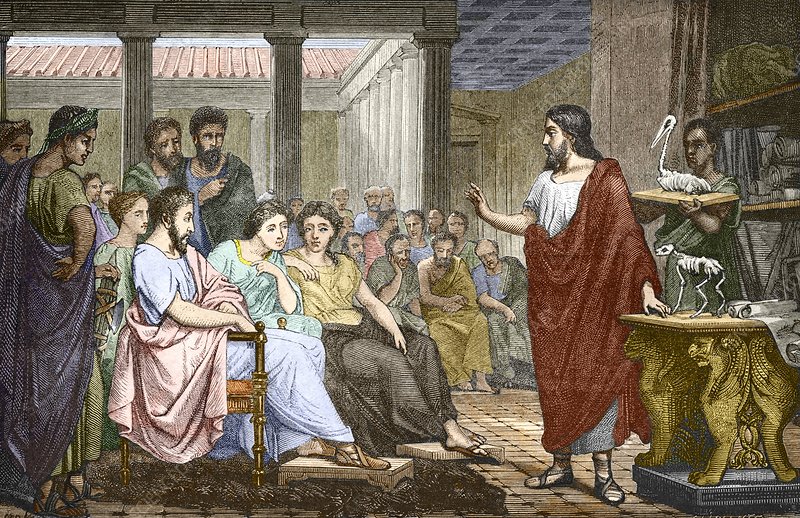
I am currently reading the book "The School of Libanius in Late Antique Antioch" by Raffaella Cribiore. It features the life and work of Libanius of Antioch who taught rhetoric in Constantinople and Nicomedia but settled in Antioch when he accepted a chair of rhetoric. Though Libanius was a pagan, he taught several notable Christian scholars including John Chrysostom, Basil the Great and had some dealings with Gregory of Nazianzus and Gregory of Nyssa. Another famous student of his was Julian who became Emperor, better known as Julian the Apostate. I find it fascinating that both Christian and pagan alike had the same educational background at the time. Apparently, John Chrysostom despised his formal teacher and openly mocked him in his work "On Babylas" (Cribiore, 140). There are a significant number of his letters that survive to this day. There are a few interesting details in the book that I find tantalizing. One is that Libanius would write letters that would give reports of his student's progress to their parents or guardians. These reports were often summarized by the letter carriers. One such letter Cribiore translates in the book.
(ca. 355 CE)
To Eupator,
Your children are enduring in Daphne the work that ends in summer. They have our permission so that the trees, the waters, and the breezes may make their task more palatable. If someone criticizes them on account of the place, let it be known that he is, in truth, a false accuser.
The bearer of this letter will tell you what I think about both of them. I consider both you and your sons blessed because of him: Olympius, the best of men on earth, cares about your family. (Cribiore, 262)
Several of Libanius's students were from outside Antioch and were sent there to study under Libanius along with their slave, a pedagogue, that was entrusted with their learning. These pedagogues were often tasked by the parent or guardian of the student with giving regular updates and progress reports. In one of Libanius's progress reports, he mentions that the student's pedagogue is the letter carrier and is tasked with giving greater details of the students progress once he arrives.
(ca. 359/360 CE)
To Letoius iii
When you participated in the meeting concerning important matters that was called in the presence of a friend of ours, you said that your nephew was with us and that you intended to write to him and to me about him, but you did not do either. We, however, are writing and are sending the pedagogue, who does not allow us to write a long letter. If I praised this young man at length, he is the one you would ask if my words were true, so it is better to give my report about these things to him. (Cribiore, 290)
That Libanius relies not only on a trusted letter carrier to deliver his message, but to elaborate on it has several parallels in the New Testament. For example, in Ephesians 6:21, Paul relies on Tychicus to not only bear his letter but to give a more detailed report as well. 
So that you also may know how I am and what I am doing, Tychicus the beloved brother and faithful minister in the Lord will tell you everything. I have sent him to you for this very purpose, that you may know how we are, and that he may encourage your hearts. (Ephesians 6:21-22)
_____________________________

Raffaella Cribiore, "The School of Libanius in Late Antique Antioch" (Princeton: Princeton University Press, 2007) 


Friday, March 24, 2023

The Oxyrhynchus Papyri and The Titles to Paul's Letters

I have been reading through a new book by Benjamin Laird, Associate Professor of Biblical Studies at Liberty University. This new monograph covers the formation of the Pauline letter collection; "The Pauline Corpus in Early Christianity: Its Formation, Publication, and Circulation."


I was planning on giving a concise review of the book (I was given a copy for review), but haven't yet finished reading it. I found the topic so intriguing and thought provoking, however, that I wanted to give a few of my thoughts before I was completely finished reading through the book. In the monograph, Laird discusses such topics as the early Christian use of the codex, the manner in which Greco-Roman authors circulated "editions" of their letter collections, etc. I hope to comment on these topics in further posts, for now, what has caught my interest was Laird's observations and arguments on the titles to Paul's letter collection. To briefly summarise, Laird highlights the uniformity of the titles to the Pauline letter collection in the earliest extant manuscripts, reviewing such early witnesses as P46 and Codex Sinaiticus among other witnesses (pages 74-82). He notes that the titles throughout all the collections remain consistent (page 82). Laird argues that because Paul's letters were carried by trusted letter carriers that knew the author and the recipients, "it may not have been necessary at the time the writings were originally dispatched for subscriptions or letter titles to be included" (pages 74). Because the Pauline letters were named after the recipients of the letters, Laird argues, it was unlikely that they circulated as part of other letter collections (page 83). He uses Philemon as an example, in this case, the letter was actually addressed to several individuals, Philemon being only one of them (Phlm 1; page 84). Because of this, Laird surmises,

"Because the address includes the names of several individuals, it is not a foregone conclusion that the title ΠΡΟΣ [Φ]ΙΛΗΜΟΝΑ would have been universally recognized had it not been created by a particular individual or a small team on a specific location." (page 84)

Supporting this notion, Laird points to the letter to the Ephesians (page 87). The earliest manuscripts (P46, 01, and 03) all testify to the title ΠΡΟΣ ΕΦΕΣΙΟΥΣ. Yet in these earliest witnesses the letter is uniformly written as ΠΡΟΣ ΕΦΕΣΙΟΥΣ. According to Laird, this points to the early circulation of an influential edition of Paul's letters.

These assertions had me thinking about the many examples of personal letters that have survived from Oxyrhynchus. There are a plethora of letters preserved that have the recipient written on the reverse side and have a named letter carrier known and trusted by the sender of the letter. Of course, I cannot be exhaustive, but here are a few examples.

P.Oxy 3.530. This second century letter is one from a son to his mother concerning money matters. The letter carrier is named, a certain Chaeremon, and is obviously known and trusted by the sender of the letter because Chaeremen holds money to give to the sender's mother. Even though the letter carrier is known and trusted by the sender of the letter, the name of the one to receive the letter is still written on the back of the document.

"Dionysius to Tetheus his mother, greeting. I have received all the letters concerning which you write, and with regard to the wheat which the collectors have demanded from you it is admitted (?), but I had forgotten to make any order for payment; I have however paid in full the naubion and other taxes. Do not be concerned that the matter about which I wrote to Theon has not been carried out and that I have so long been engaged with Pausirion’s business to no purpose ... Please receive from Chaeremon the bearer of this letter 112 drachmae of silver of which you will give to my friend Sarapion son of Apei 100 drachmae and redeem my clothes, with 8 drachmae on account of interest, and keep 4 drachmae for yourself for the expenses of the festival. If I had had more I would have forwarded a further sum; I have borrowed to send even this. So pay him the money and get my clothes back safe, and put them in a secure place. Do not be anxious about us, for there is nothing the matter with us and we are at harmony with each other. Theonas salutes you. Salute the boys Apion and his brother Hermatois, Dionutas, those with Nice and the little Thaisous, all those with..., Heras and his household, Leontas the proud and his household, those with Taamois, and Thermoutharion. Good-bye. The 20th of the month Caesareus. (P.S.) Send me word about this immediately after the festival, whether you received the money and whether you recovered my clothes. Salute Dionutas and Theon. (Addressed) To my mother Tetheus." (translation taken from https://papyri.info/ddbdp/p.oxy;3;530)

P.Oxy 3.530

P.Oxy 3.530 with the reverse showing to whom the letter is addressed:
Τεθεῦτι μητρί (Tetheus my mother)

P.Oxy 6.930. This is a letter written from a mother to her son. The first part of the letter normally containing the opening greeting is missing. Yet the receiver of the letter is preserved, written on the reverse side. Along with this, the mother is equally adressing her son's tutor who is apparently responsible for the boy. Even though the letter is addressed to her son on the reverse, she is also writing to her son's tutor Eros. 
" ... do not hesitate to write to me about anything which you require. It grieved me to learn from the daughter of our teacher Diogenes that he had sailed, for I had no anxiety about him, knowing that he intended to look after you to the best of his ability. I took care to send and ask about your health and learn what you are reading; he said that it was the sixth book and testified at length concerning your attendant. So my son, I urge both you and your attendant to take care that you go to a suitable teacher. Many salutations are sent to you by your sisters and Theonis’ children, whom the evil eye shall not harm, and by all our friends by name. Salute your esteemed attendant Eros ... (Addressed) ... to her son Ptolemaeus." (translation taken from https://papyri.info/ddbdp/p.oxy;6;930)

P.Oxy 6.930

Both of these papyri are examples of why Laird's observations on the titles of Paul's epistles do not necessitate an early edited and released collection published in a single codex. The titles of Paul's letters most likely came from the recipient written on the back of the letter as we see from these two examples. Or, for the longer epistles, written on the outside of the folded sheets of papyrus. P.Oxy 3.530 is an example of a trusted letter carrier (Chaeremon) who is known by the sender, yet the address is stil written on the back. P.Oxy 6.930 helps to answer Laird's concerns over Ephesians. In this oxyrhynchus letter, the written recipient is not preserved at the beginning of the letter (as is the case for Ephesians in P46, etc). Yet we still know who the intended recipient of the letter was because it was preserved by being written on the back of the letter. The same could be true for the letter to the Ephesians. Assuming the theory of a circular letter is true, if the earliest copy of the letter to Ephesians had the recipients omitted in the text of the letter, but the first copy was sent to the Church at Ephesus and the recipient was written on the back, then this could account for the recipients being left blank in the body of the text, but the title being preserved as "to the Ephesians."

Considering these two letters, it is much more likely that the titles of the Pauline letters actually derived from the intended recipients being written on the outside of the original folded and dispatched letter. Especially when we consider that Colossians 4:16 actually gives evidence that individual letters were being circulated at the begining and not as part of an "official" published edition.
"And when this letter has been read among you, have it also read in the church of the Laodiceans; and see that you also read the letter from Laodicea." (Col 4:16; ESV)
Despite this disagreement with Laird on the title origins of the Pauline letter collection, I still have found Laird's book thought provoking and suggestive. I hope to post more thoughts and reflections in the near future.

Tuesday, January 21, 2020

Paul’s Letter Carriers Tychicus And Onesimus


Ancient writings were largely circulated within communities through copying and distributing, with no legal copyright or formal system to control plagiarism. Once a work began to circulate the author became powerless to control the quality of the copying process or to select the audience that would read the work. The permanency of writing and the lack of control over who came into contact with a composition often led authors to exercise caution concerning the work they committed to writing. This realization was expressed well by Plato (ca. 370’s BCE), who wrote,
"Once a thing is put in writing, the composition, whatever it may be, drifts all over the place, getting into the hands not only of those who understand it, but equally of those who have no business with it; it does not know how to address the right people and not to address the wrong. And when it has been ill-treated and unfairly abused it always needs its parent to come to its help, being unable to defend or help itself.” (Plato, Phaedrus 275 d-e; Alexander, 54-55)
The physician Galen (ca. 160’s CE) expressed a strikingly similar concern. He feared that his lectures would disseminate more broadly than those who were present at the time a lecture or demonstration was given (Mattern, 12). In one particular instance, Galen told of a public demonstration in which he was speaking about several ancient medical writers. The demonstration quickly escalated into a debate between Galen and a follower of Martialius (a rival physician). Galen’s criticism and debate with the follower of Martialius drew great praise from those present who were watching the spectacle. Because of the fame, Galen wrote that a friend
“begged me to dictate what I had said to a person he would send to me who was trained in a form of shorthand writing, so that, if he suddenly had to leave Rome for his home city, he would be able to use it against Martialius during examinations of patients. When I subsequently returned to Rome on my second visit (at the summons of the emperors), the friend who had taken this document had died; but to my amazement the book, written in the context of the rivalry of a particular moment, and while I was quite young (still in my thirty-fourth year), was now in the possession of a large number of people. (De libr. propr., 14-15; Translation taken from, Singer).
Galen regretted that this debate, meant for a specific audience in a unique context, had disseminated so widely and vowed never to give a public lecture again.

The lack of control by the author over a written work that was circulating was also felt by those who wrote and dispatched letters. During Cicero’s time (60-40’s BCE) the crumbling Roman Republic was fraught with political intrigue and Cicero had to be sure that letters to his friends did not contain any sensitive political or military information. To combat this danger he would send verbal messages along with the written epistle which were conveyed to the letter carrier, who was charged with delivering this verbal message along with the written dispatch. Following are a few of these examples.

In June 48 (BCE), Cicero wrote to his longtime friend Atticus,

“You ask me about the war news. You will be able to learn it from Isidorus [the courier of this letter]. It looks as if what remains won't be too difficult. Do please see to what you know I have most at heart [Tullia's dowry]. ... Brutus is my friend; he is zealous in the cause. That is as much as I can prudently put on paper.” (Att. 11.4a; Nicholson, 42)
In another letter he wrote to Atticus,
“You will be able to learn what is going on here [at Pompey's camp in Dyrrachium] from the bearer of this letter.” (Att. 11.3.1; June 48 (BCE); Nicholson, 42)
To Appius Claudius, Cicero wrote in July 51 (BCE),
“I arrived at Tralles on 27 July. There to meet me was L. Lucilius [otherwise unknown] with your letter and messages. You could not have sent me any friendlier or, as I suppose, better qualified or more sensible informant to tell me what I want to know. I was glad to read your letter, and I have listened carefully to Lucilius.” (Fam. 3.5.1; Nicholson, 42)
There are a few instances in the Pauline corpus that exhibit a similar practice as illustrated by the example of Cicero. Scholars have argued that the letter carrier would read out and even perform the message of Paul’s epistle, though other scholars argue against this practice (for a brief overview with examples and references, see Head, 280-282). It is true, however, that Paul sometimes incorporated a verbal message along with the written contents of the letter both of which were conveyed by the dispatch carrier. This can be seen in the role of Tychicus and Onesimus the couriers who brought Paul’s letter to the Church at Colossae. At the end of the epistle Paul wrote,
“Tychicus will tell you all about my activities. He is a beloved brother in the Lord. I have sent him to you for this very purpose, that you may know how we are and that he may encourage your hearts, and with him Onesimus, our faithful and beloved brother, who is one of you. They will tell you of everything that has taken place here.” (Col. 4:7-9: ESV: Head, 280)
There are many reasons that a letter writer might wish to convey a message verbally rather than in writing (for several examples from the Oxyrhynchus papyri see Head, 289-296). And Paul could have given verbal messages for those reasons. It is also equally possible that Paul wished to control the audience of this message and did not wish for the details of his circumstance to fall into the wrong hands. Paul always had intended his letter to the Church at Colossae to be circulated widely beyond the original recipients (Col. 4:16). Paul was in prison at the time of writing (Col. 4:18) and it is possible that Tychicus and Onesimus had sensitive information about his imprisonment that Paul did not want to be widely circulated. Peter noted at the end of his epistle that there were those who were twisting the words of Paul’s epistles,
“And count the patience of our Lord as salvation, just as our beloved brother Paul also wrote to you according to the wisdom given him, as he does in all his letters when he speaks in them of these matters. There are some things in them that are hard to understand, which the ignorant and unstable twist to their own destruction, as they do the other Scriptures.” (2 Pet. 3:15-16; ESV)
Of course, there could be many other reasons for conveying a message orally, yet Paul might have needed to exercise control over who heard this information because of his captivity. In his letter to the Philippian Church Paul notes that his imprisonment became widely known “throughout the whole imperial guard” (Phil 1:13; ESV). He also shared that though some Christians were emboldened by his imprisonment, others were preaching the Gospel from “envy and rivalry”(Phil 1:15, 17). This “rivalry” was somehow connected with the occasion of Paul’s imprisonment, these individuals were seeking to harm Paul in some way (Phil 1:15, 17; ESV). In light of this, Paul had every reason to exercise caution in purveying news of his imprisonment. 
____________________________

Alexander, Loveday. “Luke’s Preface in the Context of Greek Preface-Writing.” Novum Testamentum 28.1 (1986): 48-74.

Galen, Selected Works (P. N. Singer, trans. Oxford: Oxford University Press, 1997).

Head, Peter M. "Named letter-carriers among the Oxyrhynchus Papyri." Journal For The Study Of The New Testament 31, no. 3 (March 1, 2009): 279-299.

Mattern, Susan P. Galen and the Rhetoric of Healing (Baltimore: Johns Hopkins University Press, 2008).

Nicholson, John. “The Delivery and Confidentiality of Cicero's Letters.” The Classical Journal 90.1 (1994): 33-63


Sunday, October 28, 2012

Paul and His Letter Carriers

It can be difficult to imagine the writings of Paul as individual letters, unbound and separate from the contents pages of our modern Bibles. Each of Paul's letters had their own unique reason for being written, and each had a specific intended audience. Each unique circumstance required intimate knowledge and communication with the recipient Churches. At first glance, this may appear easy enough, in our modern age of social media, email and public mail services. It was not so easy in the first century Roman world of Paul's time. Our knowledge of how the ancient world communicated would be sparse at best if not for the vast amounts of papyrus documents found in the garbage dumps of antiquity (The largest quantity of papyri were found in the ancient Egyptian city of Oxyrhynchus). These papyrus documents are mainly personal letters, receipts of sale, contracts, daily correspondence, inventories, left over remnants of daily life from several hundred years before and after the time of Paul in the first century. Studying these papyri gives access to a wealth of information on how people lived their lives thousands of years ago. Particularly, they give us insight into how people corresponded and communicated during Paul's time.


The Letter Carrier
If someone wanted to write a letter in antiquity, to ensure that it made its way to the intended recipients, one had to obtain the services of a letter carrier. As can be seen in the many examples of papyrus letters, finding someone to act as courier (especially a trustworthy person) could prove difficult (Head, 283). Thus finding a reliable letter carrier often times occasioned the need to write (Epp, 45).  Peter Head quotes this papyrus letter from the early first century (the name of the letter carrier is missing);
Since...is going up stream, I judged it necessary to salute to you by letter and in invite you to write to me about what ever you may want. (Head, 284; P. Oxy 3806)
In a similar fashion, it appears that Paul took advantage of Epaphroditus' recovery from poor health to write to the Philippians;
But I thought it necessary to send to you Epaphroditus, my brother and fellow worker and fellow soldier; who is also your messenger and minister to my need; because he was longing for you all and was distressed because you had heard that he was sick. (Phil 2:25-26).
Though not mentioned specifically in the verse, Epaphroditus undoubtedly carried Paul's epistle to the Philippian believers, and Paul took the opportunity of Epaphroditus' trip back to Philippi to send the letter (Llewelyn, 338).
The papyri also illustrate that the letter carrier often functioned as a purveyor of goods from the writer to the recipients of the letter (Head, 287). This is illustrated by a letter from the second or third century C. E. (Head, 288);
Unopened ancient papyrus letter with seal (BAR, 48)
Chaereas to his brother Dionysius, greeting. I have already urged you in person to have the horoscope (?) in the archives prepared and also the sale of the slaves' children, and to sell the wine that comes from both the near and the far vineyard, keeping the money in a safe place until I come. I send you some good melon seeds through Diogenes the friend of Chaereas the citizen, and two strips of cloth sealed with my seal, one of which please give to your children. Salute your sister and Cyrilla, Rhosope and Arsinous salute you. I pray for your health. (P. Oxy 117; Vol. 1, pg. 183)
Epaphroditus had acted as a "messenger" for the Philippian Church, and doubly functioned as a purveyor of their financial gifts, which were carried to Paul in his imprisonment (4:18).
Stephanus and Fortunatus and Achaicus came to Paul for service from Corinth, and probably brought provisions and money for Paul from the Church (1 Cor 16:17). Also, they are most likely the ones who brought the letter from the Corinthians asking Paul questions concerning doctrine and Christian living (7:1). Also, Paul asked Corinth for letter carriers to carry letters from him as well as money;
And when I arrive, whomever you may approve, I shall send  them with letters to carry your gift to Jerusalem. (1 Cor 16:3)
The papyri also give examples of requests for information and for the recipient to give word or to visit. Consider this very old third century B.C. letter;
Polycrates to his father, greeting. I am glad if you are in good health, and everything else is to your mind. We ourselves are in good health. I have often written to you to come and introduce me, in order that I may be relieved of my present occupation. And now if it is possible, and none of your work hinders you, do try and come to the Arisinoe festival; for if you come, I am sure that I shall easily be introduced to the King. Know that I have received 70 drachmas from Philonides. Half of this I have kept by me for necessaries, but the rest I have paid as an installment of interest. This happens because we do not get our money in a lump sum, but in small installments. Write to us yourself that we may know you are circumstanced, and not be anxious. Take care of yourself that you may be well, and come to us in good health. Farewell. (Milligan, 7-8; P. Petr II)
Compare the above exchange with Paul's elaborate instructions, greetings and requests given to Timothy;
Make every effort to come to me soon; for Demas, having loved this present world, has deserted me and gone to Thessalonica; Crescens has gone to Galatia, Titus to Dalmatia. Only Luke is with me. Pick up Mark and bring him with you, for he is useful to me for service. But Tychicus I have sent to Ephesus. When you come bring the cloak which I left at Troas with Carpus, and the books, especially the parchments. Alexander the coppersmith did me much harm; the Lord will repay him according to his deeds. Be on guard against him yourself, for he vigorously opposed our teaching. At my first defense no one supported me, but all deserted me; may it not be counted against them....Greet Prisca and Aquila, and the household of Onesiphorus. Erastus remained at Corinth, but Trophimus I left sick at Miletus. Make every effort to come before winter. Eubulus greets you, also Pudens and Linus and Claudia and all the brethren. The Lord be with your spirit. Grace be with you. (2 Tim 4:9-22)
Digging up ancient papyrus at Oxyrhynchus (ancientlives.org)
The papyri bring a real cultural and historical perspective on the epistles of Paul. What now comprises most of the New Testament were real letters, written in particular circumstances, for specific people and places, and carried by real people. Paul felt the need to find trustworthy couriers to bring his letters faithfully to their recipients, and to carry money and gifts (such as to the Jerusalem church). Paul also benefited from Churches sending their own messengers to carry letters, money and provisions to care for him in his ministry and imprisonment.

________________
 Bibliography

BAR Magazine. “Biblical Archaeology Review.” Vol 35 No 3.


Epp, Eldon. “New Testament Papyrus Manuscripts and Letter Carrying in Greco-Roman Times.” The Future of Early Christianity: Essays in Honor of Helmut Koester (ed. B. A. Pearson, in collaboration with A. T. Kraabel, G. W. E. Nickelsburg, and N. R. Petersen; Minneapolis, MN: Fortress, 1991) 35–56.


Head, Peter M. "Named letter-carriers among the Oxyrhynchus Papyri." Journal For The Study Of The New Testament 31, no. 3 (March 1, 2009): 279-299.


Llewelyn, Stephen. "Sending Letters in the Ancient World : Paul and the Philippians." Tyndale Bulletin 46, no. 2 (November 1, 1995): 337-356.


Milligan, George. Selections from the Greek Papyri. Cambridge: Cambridge University Press, 1912.