Sunday, April 24, 2016

Did Justin Martyr Make Reference to Mark?


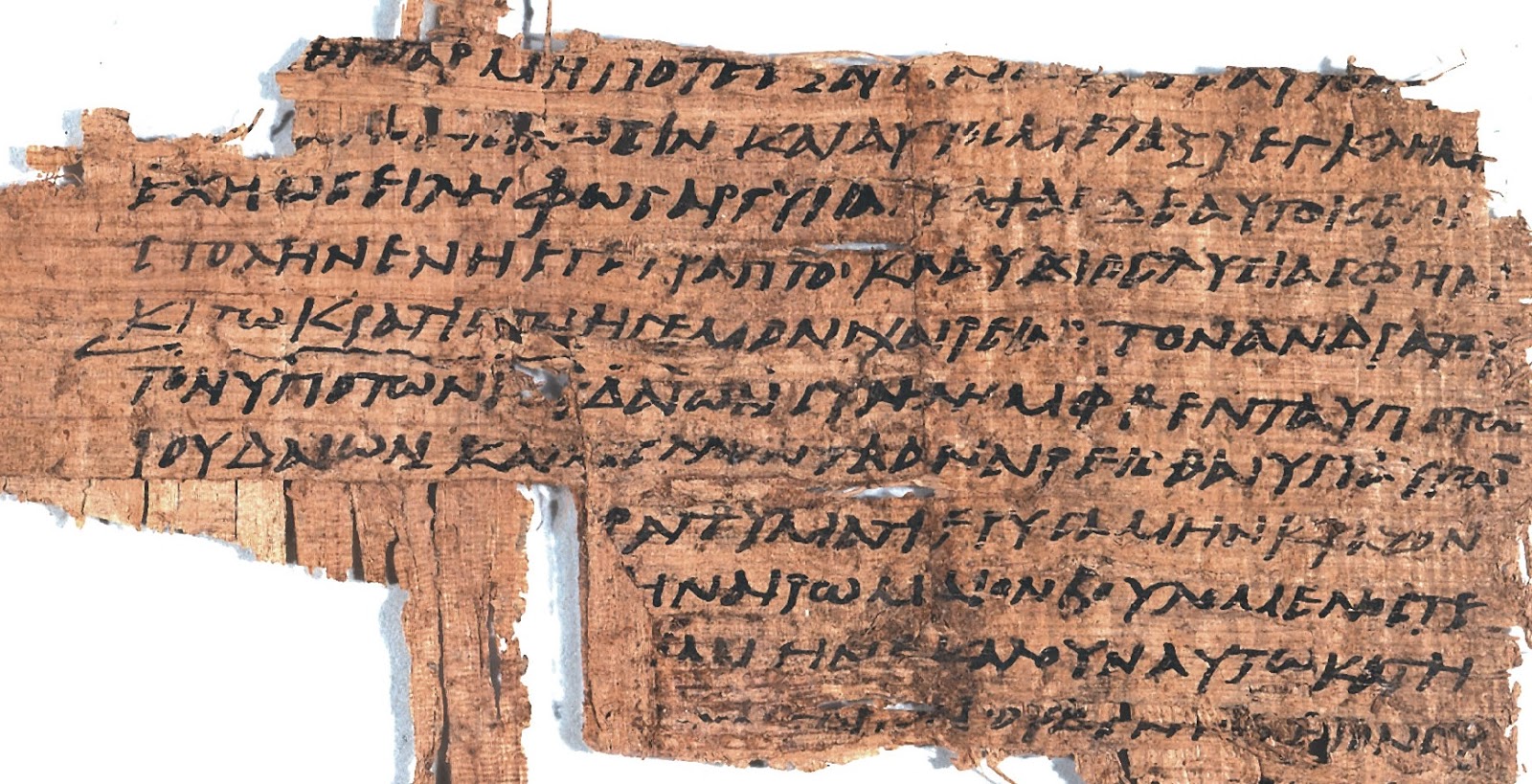
Recently, the radio show "Unbelievable" aired a debate between noted New Testament scholars Bart Ehrman and Richard Bauckham. The debate centered around Ehrman's new book "Jesus Before the Gospels" where Ehrman contends that the stories about Jesus were circulated, altered, and invented by the followers of Jesus before they were written down. Bauckham, provides a counter-argument, where, in his book "Jesus and the Eyewitnesses," he has argued that the Gospels were written within "living memory" of those eyewitnesses of Jesus' ministry and these Gospels are based upon this testimony.
During this spirited discussion Ehrman mentions the second century Church figure Justin Martyr (140's CE) who makes reference throughout his writings to the "memoirs of the apostles." In regard to this, at 48:43, Ehrman states that  "he doesn't call them by our Gospels. . . the only memoir he names is the memoirs of Peter. . . he's talking about the Gospel of Peter."
The reference that Ehrman is referring to is Justin Martyr's comments in his Dialogue with Trypho;


“And when it is said that He changed the name of one of the apostles to Peter; and when it is written in the memoirs of Him that this so happened, as well as that He changed the names of other two brothers, the sons of Zebedee, to Boanerges, which means sons of thunder. . ." (Dia. 106; ANF)

Justin is referring to the memoirs of Peter and he is loosely quoting an incident recorded in this "memoir." That Jesus changed the name of an apostle to Peter and the names of two others to "Boanerges." In all of the Gospels, this account can only be found in the Gospel of Mark at 3:16-17;


"He appointed the twelve: Simon (to whom he gave the name Peter); James the son of Zebedee and John the brother of James (to whom he gave the name Boanerges, that is, Sons of Thunder);" (ESV)

 No where in the Gospel of Peter is this account of the naming of Peter and the sons of Zebedee mentioned (Hill, 133-134). Therefore, contrary to Ehrman's claims, Justin Martyr can only be referring to the Gospel of Mark and here he connects it to Peter, independently verifying Papias' famous comments on the origins of Mark's Gospel;


"And the Elder used to say this: 'Mark, having become Peter's interpreter, wrote down accurately everything he remembered, though not in order, of the things either said or done by Christ. For he neither heard the Lord nor followed him, but afterward, as I said, followed Peter, who adapted his teachings as needed but had no intention of giving an ordered account of the Lord's sayings. Consequently Mark did nothing wrong in writing down some things as he remembered them, for he made it his one concern not omit anything which he heard or to make any false statement in them." (Eusebius Hist. eccl. 3.39; Holmes, 569)

Here are at least two independent sources, one from the late first century (Papias) and one from  mid second century (Justin Martyr) that point to a common understanding in the early Church; that the Gospel of Mark was sourced in the testimony of the apostle Peter.

____________________
Hill, C. E. Who Chose the Gospels: Probing the Great Gospel Conspiracy. New York: Oxford University Press, 2010.

Holmes, Michael W., ed. The Apostolic Fathers: Greek texts and English translations. Grand Rapids: Baker Books, 1999.


Tuesday, April 19, 2016

The Staurogram and The Epistle of Barnabas: Further Discussion

In a previous post, the comments of Dr. Brent Nongbri in reference to the staurogram and its place in a third century manuscript were taken up. At issue is whether Christian scribes of the second and third centuries were experimenting with images of Jesus on the cross in their art and worship practices. Dr. Nonbgri argued that,
"At the very least, such experimentation with cruciform imagery [in the staurogram] would appear less out of place in the fourth century than in the late second or early third century. (pg. 33-34)"
These observations are striking when looking at the many references in early Christian writings of the second and third century; Minucius Felix, Tertullian, Clement of Alexandria, and the author of the Epistle of Barnabas. These authors mention the cross and cross shapes as venerated symbols of Christian identity. Yet, it is argued by Nongbri, each of these early Christian examples are merely allusions to the cross and its shape and not to the image of the crucified Jesus, which scholars purport the staurogram to be.
There was an oft repeated story in early Christian literature that may serve to illustrate that the image of Jesus as a crucified figure on the cross was a familiar Christian icon. In the Epistle of Barnabas, reference is made to the story of Israel defeating the armies of Amalek in Exodus 17:8-13. In this account, Moses lifted up his hands as a sign to the Lord; when his hands were held aloft, Israel was victorious, when his hands fell to his side, Amalek was victorious. Aaron and Hur eventually held Moses' hands aloft as he grew weary and the Israelites won the battle. In light of this story, the Epistle of Barnabas (70-135 CE) wrote;
"Once again you have a reference about the cross and about him who was destined to be crucified. And again he speaks to Moses, when war was being waged against Israel by foreigners, and in order that he might remind those being attacked that they had been handed over to death because of their sins, the Spirit says to the heart of Moses that he should make a symbol of the cross and of him who was destined to suffer because, he is saying, unless they place their hope in him, war shall be waged against them forever. Therefore Moses piled one shield upon another in the midst of the battle, and standing high above them all he stretched out his hands, and so Israel was again victorious. But whenever he lowered them, the men began to be killed. Why so? So that they might learn that they cannot be saved unless they place their hope in him. (12:1-3)"
There are some aspects of this story that bear reflection. First, the Epistle of Barnabas assumes that Moses raised his hands horizontally, in the shape of the cross, and this is mentioned in such a way that this must have been a familiar Christian interpretation of this story. And second, the Epistle of Barnabas specifically references this as a symbol of the crucified Jesus and not just of the cross. At one point Barnabas uses the word "suffer" (πασχειν) (12:2) and the middle/passive infinitive (σταυρουσθαι) to refer to this event as a reference to Jesus (12:1). It is clear that Barnabas was viewing the imagery of Moses standing with arms outstretched as a visual representation of Jesus suffering on the cross.
Moses with outstretched hands as a symbol of Jesus on the cross
This story in Barnabas is set in the midst of several allegorical references to the cross that were found in the familiar passages and stories of the Old Testament. At Barnabas 8:1,5; 9:7; 11:1,8; and 13:5. In each of these other references the cross is mentioned as a stand alone representation of salvation with no visualization of the crucified Jesus. However, at 12:1-3, specific mention is made to the imagery of Moses with outstretched hands as a visual representation of the suffering Jesus on the cross.

Though, there is no specific reference to scribes taking this iconography and creating a staurogram, the impetus for doing so is already present in Barnabas some 80-100 years before it is found, represented by the staurogram, in the texts of P66, P45, and P75. The reverence for Jesus and the cross was already tied to a textual representation in the nomina sacra at Barn. 9:7-8. It takes no stretch of the imagination to conclude that a visual representation of Jesus on the cross, as found at Barn. 12:1-3, would find expression in a staurogram.

_______________ 
 
Holmes, Michael W., ed. The Apostolic Fathers: Greek texts and English translations. Grand Rapids: Baker Books, 1999.
Hurtado, Larry W. Lord Jesus Christ: Devotion to Jesus in Earliest Christianity. Grand Rapids: Eerdmans, 2005.
Hurtado, Larry W. The Earliest Christian Artifacts: Manuscripts and Christian Origins. Grand Rapids: Eerdmans, 2006.
Longenecker, Bruce W. The Cross Before Constantine The Early Life of a Christian Symbol. Minneapolis: Fortress Press, 2015.

Nongbri, Brent. “The Limits of Palaeographic Dating of Literary Papyri: Some Observations on the Date and Provenance of P. Bodmer II (P66),” Museum Helveticum 71 (2014): 1-35.

Tuesday, February 23, 2016

Greek Palaeography: Bookhands of the Imperial Peak


The previous post discussed the type of writing used for copying Greek literature, the bookhand. During the Roman imperial era, this handwriting was bilinear, that is, each letter was written between two parallel imaginary lines. This period is often referred to as the "Imperial Peak" because there is an increase in the number of ancient papyri preserved from this time. Several styles of bookhands developed during the Roman era. This abundance of writing samples has allowed scholars to study the development of these various hand writing styles. This is good news for scholars who are assigning dates to early Christian papyri. The earliest copies of the New Testament writings have been dated during this "imperial peak," from the 2nd through the 4th centuries. In regard to the Roman period, Cavallo wrote;

"[Bookhands], in the course of this period not only reach full maturity but also exhibit a typological variety that allows us to distinguish a whole series of graphic streams sometimes also visible in documents, thereby enabling us to arrive at better-founded dates." (Cavallo, "Greek and Latin Writing in the Papyri, p. 112)

During this period, there are several main types of what palaeographers refer to as “scripts,” that is, a type of handwriting used by a scribe that has common stylistic features.

Round Majuscule (Turner: Formal Round)
(In use ca. 1st to the 2nd century CE)
Characterized by the “Hawara Homer” papyrus

Biblical Majuscule
(In use ca. 2nd to the 9th or 10th century CE)
Characterized by Codex Sinaiticus and Vaticanus

Alexandrian Majuscule (Turner: Informal Round)
(In use ca. 2nd to the 8th century CE)
Characterized by PSI V 446

Severe Style (Turner: Formal Mixed)
(In use ca. 2nd to the 3rd century CE)
Characterized by the “Bacchylides” papyrus

Ogival Majuscule (Pointed Majuscule)
Developed from the "Severe Style"
(In use ca. 3rd to the 11th century CE)
Upright type characterized by P.Oxy XI 1352
Sloping type characterized by PSI X 1165

Though the development of these scripts are discernible in the papyri, palaeographers are careful not to assign too narrow a date to any particular manuscript. Turner wrote,

"For book hands a period of 50 years is the least acceptable spread of time. A palaeographer familiar with the material will refuse assent to a precise date allocated to a manuscript simply by comparison with other texts and by no other criterion." (Turner, GMAW, p. 23)

_________________
Select Bibliography

Bianconi, Daniele. "Greek Palaeography." Pages 297-305 in Comparative Oriental Manuscript Studies: An Introduction. Edited by, Alessandro Bausi, Pier Giorgio Borbone, Françoise Briquel-Chatonnet, Paola BuziJost Gippert, Caroline Macé, Marilena Maniaci, Zisis Melissakis, Laura E. Parodi, Witold Witakowski, Eugenia Sokolinski. Hamburg: Tredition, 2015.

Cavallo, Guglielmo. "Greek and Latin Writing in the Papyri." Pages 101-148 in The Oxford Handbook of Papyrology. Edited by Roger S. Bagnall. Oxford: Oxford University Press, 2009.


Orsini, Pasquale and Willy Clarysse, “Early New Testament Manuscripts and Their Dates: A Critique of Theological Palaeography,” Ephemerides Theologicae Lovanienses 88 (2012): 443-74.

Turner, E. G. Greek Manuscripts of the Ancient World. 2nd edition. Edited by P. J. Parsons. London: University of London, Institute of Classical Studies, 1987.

 
(Round Majuscule) "Hawara Homer" P.Haw 24-28
(Biblical Majuscule) Codex Sinaiticus
(Alexandrian Majuscule) PSI V 446
(Severe Style) Bacchylides Papyrus [PSI V 446]

(Upright Ogival Majuscule) P.Oxy XI 1352


(Sloping Ogival Majuscule) PSI X 1165

Saturday, January 30, 2016

Greek Palaeography: Writing Between the Lines

Scribes of the Greco-Roman period often used a very specific style of writing known commonly as the "book-hand" which is characterized by its "bilinearity." These are imaginary lines above and below that govern the height and shape of the letters. There are many examples of finely crafted bookrolls that exhibit these well formed slowly written letters. Students worked hard at developing this writing style as can be seen in a second century wax tablet example (see below, MS. 34186). This wax tablet has the teacher's steady handed example written between two lines, and the student's less fine copy written below. Notice how each letter is bound by the upper and lower lines. The only letter that extends past these lines are the single vertical strokes of the Φ (phi). The student is less successful at keeping the letters between the lines.
Training students to write in this fashion was common enough in antiquity that Plato (5th cen. BCE) could use this as an analogy of the function of laws within a society;
Their sons begin school at the earliest age, and are freed from it at the latest. And when they are released from their schooling the city next compels them to learn the laws and to live according to them as after a pattern, that their conduct may not be swayed by their own light fancies, but just as writing-masters first draw letters in faint outline with the pen for their less advanced pupils, and then give them the copy-book and make them write according to the guidance of their lines, so the city sketches out for them the laws devised by good lawgivers of yore, and constrains them to govern and be governed according to these (Protag.326c-d)
Another common feature of ancient books was that words and sentences were often written out syllable-by-syllable. Bookrolls were written in columns of continuous writing, scriptio continua (see previous post). In prose texts, the scribe would often break and divide a word at the end of a line only at the syllable level (see Tuner, GMAW2, p. 17). Teachers instructed their students to write and copy-out texts syllable-by-syllable. An example of this can be seen in a wooden tablet from late antiquity (see below, P.Duk.inv. 232). Lined columns contain the student's repeated writing of various syllables. Quintilian (ca. 95 CE) stressed the importance of student's learning these syllables;
As regards syllables, no short cut is possible: they must all be learnt, and there is no good in putting off learning the most difficult; this is the general practice, but the sole result is bad spelling. Further we must beware of placing a blind confidence in a child's memory. It is better to repeat syllables and impress them on the memory and, when he is reading, not to press him to read continuously or with greater speed, unless indeed the clear and obvious sequence of letters can suggest itself without its being necessary for the child to stop to think. (Inst. 1.1.30).
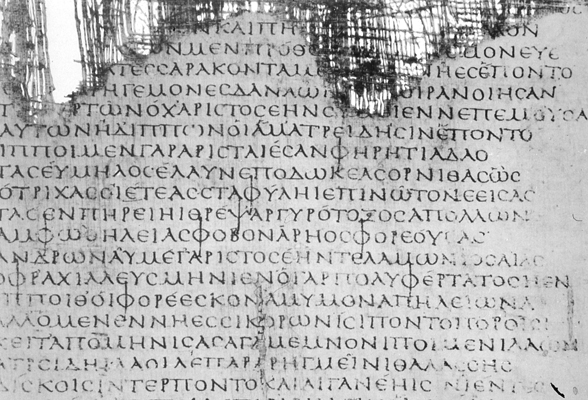
These two common traits of Greek writing are evident in most of the New Testament manuscripts. One example is P. Bodmer XIV-XV (P75), an early third century codex of Luke and John (see below). The scribe who copied this manuscript used a form of the "bilinear" script or "book-hand" as discussed above. Another feature of this New Testament manuscript is that the scribe copied syllable-by-syllable. E. C. Colwell and James Royse noticed this in the type of errors the scribe produced while copying out the text (Colwell, Scribal Habits, p. 116; Royse, Scribal Habits, p. 653, 672).
____________________
Bibliography


Colwell, E. C. “Method in Evaluating Scribal Habits: A Study of P45 P66 P75,” in Studies in Methodology in Textual Criticism of the New Testament (NTTS 9; Grand Rapids, Mich.: Eerdmans, 1969)

Royse, James Ronald. Scribal Habits in Early Greek New Testament Papyri (NTTSD 36. Leiden: Brill, 2008).


Turner, E. G. Greek Manuscripts of the Ancient World (2nd edition, ed. P. J. Parsons. London: University of London, Institute of Classical Studies, 1987)

Teacher's Example Above, Student's Writing Below. Wax Tablet, II CE. (British Museum MS. 34186)
School Writing Exercise, Syllable Combinations, 30 BCE- 640 CE (P.Duk.inv. 232)
P. Bodmer XIV-XV (P75) Showing the end of G.Luke and the Beginning of G.John