Showing posts with label scribal practices. Show all posts

Sunday, January 19, 2020

Chaerammon the Literate Slave

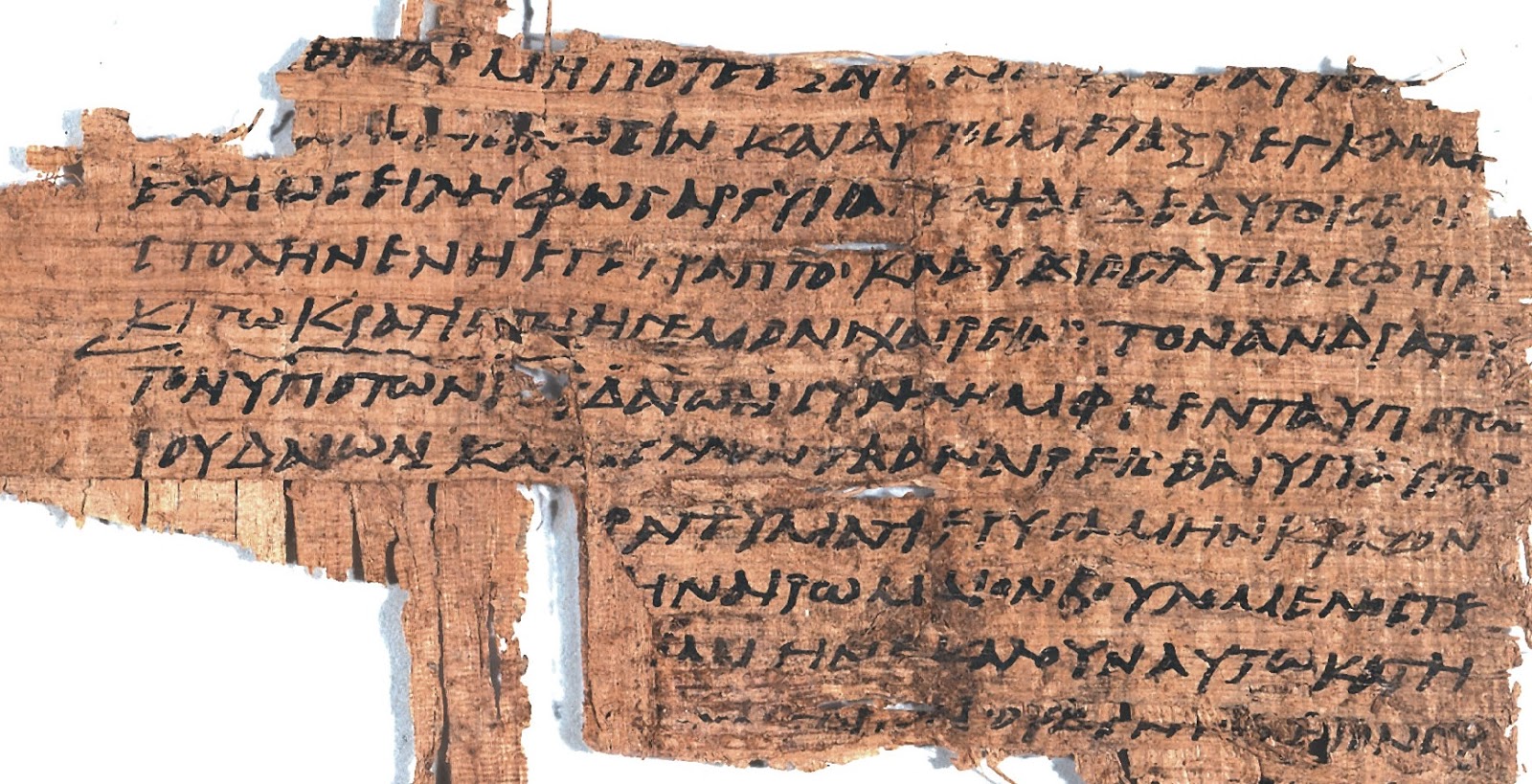
While reading through a work on the documentary papyri, I came across a citation from a contract that dates to 1 March 155 CE (Lewis, 136).

Panechotes also called Panares, ex-cosmetes of Oxyrhynchus, through his friend Gemellus, to Apollonius, writer of shorthand, greeting. I have placed with you my slave Chaerammon to be taught the signs which your son Dionysius knows, for a period of two years dating from the present month Phamenoth of the 18th year of Antoninus Caesar the lord at the salary agreed upon between us, 120 silver drachmae, not including feast-days; of which sum you have received the first instalment amounting to 40 drachmae, and you will receive the second instalment consisting of 40 drachmae when the boy has learnt the whole system, and the third you will receive at the end of the period when the boy writes fluently in every respect and reads faultlessly, viz. the remaining 40 drachmae. If you make him perfect within the period, I will not wait for the aforesaid limit; but it is not lawful for me to take the boy away before the end of the period, and he shall remain with you after the expiration of it for as many days or months as he may have done no work. The 18th year of the Emperor Caesar Titus Aelius Hadrianus Antoninus Augustus Pius, Phamenoth 5. (P.Oxy 4.724)

This papyrus tells us that a slave owner, Panechotes, worked out a contract with a local artisan, Apollonius, skilled in writing short hand. The contract agreed to have Panechotes's slave Chaerammon apprenticed to Apollonius for two years for the purpose of learning the skill of writing short hand. There are two stipulations of the contract that each party was responsible for;
1) Apollonius would receive his pay in three installments, at the beginning, when Chaerammon "learned the whole system" (presumably the shorthand system), and when the "boy writes fluently in every respect and reads faultlessly";
2) Panechotes was to leave his slave there for a certain amount of time, even if Chaerammon learned quickly so that he could fulfill an expected level of work for Apollonius.

This papyrus helps us to understand that literacy levels did not follow social classes. Here we have a slave that would potentially be a highly skilled scribal artisan, yet held no social status. This is in stark contrast to Petaus who was a village scribe and held some type of official clerical post yet could barely write his own name! (See P.Petaus 121). In the context of the early Church, I find it intriguing to think that a slave like Chaerammon, if they were Christian, could have been in a position to copy out scriptural books for a local Christian community. 
________________________________________________________________

Grenfell, Bernard P., and Arthur S. Hunt.
The Oxyrhynchus Papyri. Vol. 4. (London: Egypt Exploration Fund, 1904); 204-205

Lewis, Naphtali.
Life in Egypt Under Roman Rule. Atlanta: Scholars Press, 1999.

Saturday, December 30, 2017

Ancient Marginal Notes on Variant Readings

Map of Constantinople by Sebastian Munster (ca. 1550)
At the 2017 Evangelical Theological Society Meeting, an exciting series of lectures were given in the session entitled "Growing Up in the Ehrman Era: Retrospect and Prospect on Our Text-Critical Apologetic." I was unable to attend the meeting but fortunately was able to listen to the audio recordings of each presentation. The lecture by Greg Lanier, "Dating Myths: Why Later Manuscripts Can Be Better Manuscripts" was particularly good. In the midst of his excellent paper, one of the things that Lanier highlights is the manuscript GA 1582 studied in Amy Anderson's excellent work "The Textual Tradition of the Gospels: Family 1 in Matthew." 

GA 1582 is a Gospel codex that was carefully copied in 948 CE by the Constantinopolitan scribe Ephraim (Anderson, 6, 24). Ephraim produced several carefully copied manuscripts, one of which being Codex GA 1739, a collection of Acts and the epistles copied from a much older exemplar. One of the peculiar features of both of these manuscripts are a series of extensive marginal notations indicating textual problems. Anderson stated that "the text and marginalia of 1582 provide a record of early textual variation" (Anderson, 69). She also notes that
"it is unlikely that the marginalia are the result of Ephraim's own gathering of variants. Rather, Ephraim has preserved marginalia compiled by a much earlier scholar" (Anderson, 69).
One of the clues that points to a late 5th century compilation for the marginalia in 1582 is that Cyril of Alexandria is the latest father cited who died in the 440s CE (Anderson, 70).

Three interesting marginal notes are found at the end of the Gospel of Mark and at the end of John introducing the story of the Woman Caught in Adultery.
Instead of the story of the Woman Caught in Adultery being found at John 7:53-8:11 like most medieval Greek manuscripts, it is placed at the end of John with a long marginal note stating,


“in most copies it is not found. And not from the comments of the holy fathers; John Chrysostom, Cyril of Alexandria, and Theodore of Mopseustia...”

1582 at the end of John showing textual note before the story of the Woman Caught in Adultery.
Another series of marginal notes are found at the end of the Gospel of Mark. At the end of Mark 16:8 there is a note before the longer ending of Mark. This note reads in part,

"In some of the copies up to this point the gospel ends also up to to which Eusebius Pamphilus made his cannons. But in many also these [verses] are also found."


1582 Marginal at the end of Mark 16:8 and before the longer ending.

Another note is found in the long ending of Mark in the margin at 16:19. This marginal note reads,

"Irenaeus, who was near to the apostles, in the third book ‘Against Heresies’ quotes this saying as found in Mark.”


1582 marginal note at Mark 16:19

The compiler's knowledge of the church fathers is revealed in this note for Irenaeus does indeed quote from Mark 16:19 in his "Against Heresies" 3.10.5 reads, "Also towards the conclusion of his Gospel, Mark says, “So then, after the Lord Jesus had spoken to them, he was received up into heaven , and sitteth on the right hand of God” (ANF 1:426).

These series of marginal notes reveals a knowledge and concern for textual variation in the manuscript tradition. Even in 10th century Constantinople, when many of the Greek New Testament manuscripts produced contained the longer ending of Mark and the story of the Woman Caught in Adultery, scribes such as Ephraim were copying older texts and marginalia that discussed these textual problems.

________________

Amy S. Anderson, "The Textual Tradition of the Gospels: Family 1 in Matthew." (Leiden: Brill, 2004).


Friday, November 10, 2017

The Monks of Codex Sinaiticus

The grand Biblical manuscript, Codex Sinaiticus had an extremely long useful life (see previous post). It was manufactured around the middle of the 4th century and continued to be valued up to its modern "re-discovery" by Constantine von Tischendorf. Signs of its long useful life can be found in the margins of its parchment leaves. Several marginal notes scattered throughout the manuscript were written by readers and scribes of the codex.

The first group of notes were written sometime in the 12th century by a monk named Dionysius.

Bottom margin of Q39-f3r (www.codexsinaiticus.org)
On the bottom left margin of Q39-f3r, under 1 Maccabees 1:9, reads a note (see image above). The following Greek transcription is taken from www.codexsinaiticus.org
"μνησθητι κε την ψυχην του αμαρτωλου
διονυσιου μοναχου οταν ελθησ εν τη βασιλεια σου"
"Remember Lord the soul of the sinner Dionysius the monk when you come in your kingdom." (Parker, 117)

Bottom margin of Q66-f6r (www.codexsinaiticus.org)
On the bottom margin of Q66-f6r, under Song of Songs 3:5 reads another note that is simply Dionysius' name "διονυσιο(σ) (μον)αχ(οσ)" (Greek transcription is taken from www.codexsinaiticus.org).

Bottom left margin of Q66-f7r (www.codexsinaiticus.org)

The final note left by Dionysius is found on the bottom margin of Q66-f7r, under Song of Songs 6:3 reads in Greek (transcription taken from www.codexsinaiticus.org)
"μνησθητηκε
διονυσι(ου)μ(ον)αξ(ου)
αμαρτωλ(ου)"
"Remember Lord the monk Dionysius the sinner." (Parker, 117)
Another lengthy marginal note dating from around 1200 CE identifies a monk or scribe named Theophylact.

Bottom right margin of Q68-f1v (www.codexsinaiticus.org)
Bottom left margin of Q68-f2r (www.codexsinaiticus.org)
The marginal notes as they are viewed when the pages are open
On the bottom right hand margin on Q68-f1v and extending over into the bottom left hand margin of  Q68-f2r reads a note in Greek (transcription taken from www.codexsinaitcus.org);
"Ο πας(ης) σοφι(ας) χορηγ(ος) υ(ιο)σ θυ̅ και
λογ(ος) η ενυποστατ(ος) σοφια του π̅ρ̅ς̅
η διδασκουσα α̅ν̅ο̅ν̅ γνως(ιν) σοφισον
αμαρτωλ(ον) θεοφυλα(κτον) προς δοξαν" (Q68-f1v)
"του ονοματος σ(ου) ει το ποιης(αι) το θελημα σ(ου)" (Q68-f2r)
 
"The bestower of all wisdom, Son of God and Word, the incarnate Wisdom of the Father who teaches knowledge to man, instruct the sinner Theophylact to the glory of your name that he may do your will." (Parker, 118)

Though these marginal notes give sparse information about the scribes who wrote these entreaties to God, they reveal that the codex was still in use 850 years after its production.
________________________

Parker,, D. C. "Codex Sinaiticus: The Story of the World's Oldest Bible." London: Hendrickson, 2010

Sunday, January 8, 2017

Teaching Aids for Ancient Christian Readers

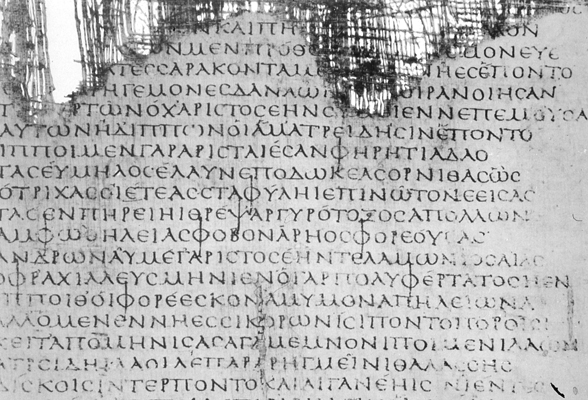
Some of the earliest copies of the New Testament writings were copied in such a way that they aided the reader in their task of deciphering the scriptio continua. Bookrolls from the Roman world (1st -3rd century CE) which contained works of literature had very little by way of assistance for the reader. Take for example P. Lond. Lit. 134 (ca. 200 CE), a copy of  Hyperides, In Philippidem. It has a steady stream of letters uninterrupted by spaces or any type of punctuation.
P. Lond. Lit. 134. (Johnson, "Bookrolls and Scribes," 400)

Those fortunate children in antiquity with access to an education had to be taught methods of deciphering this system of writing. Grammarians (ancient teachers) facilitated this instruction by creating models of ancient works such as Homer's Iliad that incorporated spaces between words and markings differentiating syllables and sense units. One example of a teacher's model is a wooden tablet from Roman Egypt that contains Homer's Iliad (3rd century). The wooden slate uses spaces between words and markings to assist beginning readers in comprehending the text.

AM 13839 (Cribiore, "Gymnastics of the Mind," 135)
Similar phenomena of reading aid can be detected in some early copies of New Testament writings. For example, spaces between words can clearly be seen throughout P46 (2nd/3rd century), a collection of Paul's epistles.


The beginning of Galatians in P46
Spaces and limited punctuation can be seen in P66 (2nd/3rd century), a copy of John's Gospel. 


The beginning of the Gospel of John in P66.

There are some interesting parallels between early New Testament manuscripts such as P46 and P66 and teachers models such as AM 13839. Both types of documents employ clear and legible scripts, give generous space between lines, and use spacing between words and sense units. These features have been highlighted elsewhere on this blog (here, and here). It has already been noted that reading aids seem to reveal that these Christian books were produced for less than capable readers.
Coupled with this, perhaps the presence of reader's aids in copies of New Testament manuscripts also reveal another parallel with teacher's models; that of instruction. Just like teacher's models were used almost exclusively in the context of learning, perhaps these Christian manuscripts were produced so that they could be used primarily within teaching contexts.
_____________________


Cribiore, Raffaella. Gymnastics of the Mind: Greek Education in Hellenistic and Roman Egypt. Princeton, NJ: Princeton University Press, 2005.


Johnson, William A., Bookrolls and Scribes in Oxyrhynchus. Toronto: University of Toronto Press, 2004.

Tuesday, November 29, 2016

Galen's Rules of Textual Alteration

While reading through Eric W. Scherbenske's "Canonizing Paul: Ancient Editorial Practice and the Corpus Paulinum," I came across a fascinating discussion over Galen's (129 - 216 CE) scholarship on the text of the Hippocratic corpus. In the midst of analyzing the textual work and editions of two former Hippocratic scholars who were active in the first part of the second century, Galen wrote;
"A second book written in place of one formerly written is said to be revised (επιδιεσκευασθαι), when it has the same 'hypothesis' (υποθεσις) and most of the same words; some (of the words) taken out from the former work; some added; some altered. If you want an example of this for the sake of clarity, you have the second Autolycus of Eupolis revised from the former. Thus the doctors from Cnidus published the second 'Cnidian Opinions' in place of the former ones; some having the same in every way; but some added; some taken away; just as some altered. This then is the second book of Hippocrates which they say is more medical than the former." (Hipp. vict. acut. 120.5-14; Scherbenske's translation)
Galen sets limits on the amount of textual tampering an ancient Hippocratic scholar should perform on the text by defining an 'edition' of an ancient work. The original author's "hypothesis," that is, the foundational concept or idea written by the author (in this case, Hippocrates), should not be altered in any way. When a scholar in Galen's time was preparing an edition of an ancient work, the scholar was "revising" the text when it had the same "hypothesis" and "most of the same words." These words could be altered, however, by the scholar, as long as "most of the same words' were retained.

A similar mentality can be detected in much of the transmission history of the New Testament writings, especially the Gospels. Michael W. Holmes noted that the fluidity of movement in the words at the sentence or verse level in the manuscript tradition is "remarkable." Despite this, the overall structure of the Gospels in the manuscript tradition is very stable. Holmes wrote;

"No matter how fluid the text of a particular verse or episode maybe, the overall narrative structure is extremely stable. The circumstances of Luke and Acts are very similar to those of Matthew, John, and Mark. In short, a very high percentage of the variation evident in the text of the Four Gospels and Acts affects a verse or less of the text. On this level, the fluidity of wording within a verse, sentence, or paragraph is sometimes remarkable. At the same time, however, in terms of overall structure, arrangement, and content, these five documents are remarkably stable. They display simultaneously, in other words, what one may term micro level fluidity and macro level stability." (Holmes, 674)
It seems then, that as in the case of Galen's criteria, the overall "hypothesis" of the Gospels remains unaltered. The wording of the Gospels was merely shifted and the order of words altered slightly, with some words added and removed. Perhaps Galen's understanding of textual alteration and "edition" was more widely held by scribes in the ancient and medieval world.

Estoire del Saint Graal, France (Royal MS 14 E III c. 1315 – 1325 AD)

______________________
Holmes, Michael W. “From ‘Original Text’ to ‘Initial Text’: The Traditional Goal of New Testament Textual Criticism in Contemporary Discussion.” Pages 637-681 in The Text of the New Testament in Contemporary Research: Essays on the Status Quaestionis. Second Edition. Edited by Bart D. Ehrman and Michael W. Holmes. New Testament, Tools, Studies and Documents 42. Leiden: Brill, 2013.

Scherbenske, Eric W. Canonizing Paul: Ancient Editorial Practice and the Corpus Paulinum (Oxford: Oxford University Press, 2013), 39.

Wednesday, August 24, 2016

Cassiodorus on the Task of the Scribe


Cassiodorus (Gesta Theodorici: Leiden, University Library, Ms. vul. 46, fol. 2r)

Cassiodorus is famous for the foundation of his monastery at Vivarium in southern Italy and the copying of books and manuscripts. These activities, however, occurred later in his life. He spent a large part of his earlier career as a Roman statesman serving the administration of Theodoric the Great. Many of his letters are preserved from this time, and in Book 12, letter 21 we find him writing to a certain Deusdedit, a Scribe of Ravenna, about the duties of a scribe. In one place Cassiodorus declares that;
"Banish, therefore, all thoughts of venality from your mind. The worst moth that gets into papers and destroys them is the gold of the dishonest litigant, who bribes the Scribes to make away with evidence which he knows to be hostile. Thus, then, be ready always to produce to suitors genuine old documents; and, on the other hand, transcribe only, do not compose ancient proceedings. Let the copy correspond to the original as the wax to the signet-ring, that as the face is the index of the emotions so your handwriting may not err from the authentic original in anything." (Ep. 12.21)
The context appears to be that of a courtroom, where the scribe is admitting evidence of some kind (contracts, wills, deeds, and the like) and transcribing the minutes of the court proceedings. I find it particularly telling that Cassiodorus declares that the scribes task is to "transcribe only" and not to "compose." And in relation to the copying of texts, he states, "let the copy correspond to the original" and ensure that the "handwriting may not err from the authentic original in anything."
Though the topic of Cassiodorus's letter primarily concerns the scribes task in the courtroom (a primary task for an official city scribe), I cannot help but think that this gives a glimpse into his attitudes towards the copying of biblical texts later in his life.

_____________________
 
Hodgkin, Thomas, trans. The Letters of Cassiodorus. London: Henry Frowde, 1886. (pg. 511-512)

Saturday, August 6, 2016

Avoiding The Damaged Page: Imperfections Creating Errors in the Copying of a Text (?)

In 2015, Dr. Brice Jones published a fascinating piece on the scribal practice of avoiding imperfections in the writing material while copying out a text;
"Scribes Avoiding Imperfections in Their Writing Matierials" Archiv für Papyrusforschung 61.2 (2015): 371-383.
Dr. Jones discussed several phenomenon of imperfections that a scribe may encounter while performing their task; cracks, folds, tears, holes, separated or shrunken fibers, stains, and κολλήσεις (joint seams). The article is summarized nicely on his blog, here.
In short, if a scribe encountered a feature on the page they were inscribing, the copyist would more than likely have to pull the pen away from the page and then place it back in a (sometimes drastically) different location. For example, in the case of a hole, the scribe would have to alter the placement of the letters by writing around the defect in some way. Dr. Jones highlighted this phenomenon on pages 376-378. This occurred in the case of Codex Sinaiticus through-out the manuscript, in particular, on Q84-f.5.r, at the bottom of the first column.

A Scribe avoiding a hole in the parchment C. Sinaiticus (Q84-f.5.r)

Dr. Jones also highlights another similar case at Q18-f.6.r on page 377 of his article.
I find this fascinating, especially in its relation to the introduction of scribal errors in the copying of the text. In a particularly bad case in Codex Bezae that Jones highlights on page 377 of his article, the scribe had to avoid a large hole, writing the text around the imperfection.

A scribe avoiding a hole in C. Bezae (f. 205r)
This brought to mind another excellent article that drew attention to the scribal practice of re-inking the pen, which inadvertently led to the introduction of errors in the transcribing of the text.
Peter M. Head and Mike Warren, "Re-inking the Pen: Evidence from P. Oxy. 657 (P13) Concerning Unintentional Scribal Errors." New Testament Studies 43 (1997): 466-473.
In the article, Dr. Head and Dr. Warren contend that, 
"the constant necessity to re-ink one's pen provided the opportunity for scribal distraction at the level of eye, memory, judgement and pen, and would thus have been an occasion for the introduction of unintentional copying error." (pg. 466)
 This may (must) be true in the case of defects in the writing material. The lifting of the pen and the distraction of avoiding the imperfection may have led to the introduction of an error in the copying of the text.

Thursday, June 30, 2016

Quintilian, Transcriptions, Publication, and Mark's Gospel

Mark writing the Gospel, London Rothschild Hours

Quintilian, a famous orator from the later part of the first century CE (see previous post), wrote his most famous work "Institutes of Oratory" in response to requests made by his students. Apparently, his students and followers wished for Quintilian to put down his vast knowledge and experience in teaching and practicing the art of rhetoric into a more permanent written form (Pref. 1-3). He dedicated the work to Marcellus Victorius because of his "extraordinary love of letters" and because, Quintilian wrote, "my treatise seemed likely to be of use for the instruction of your son" (Pref. 6).
It seems, however, that portions of Quintilian's teaching on rhetoric was already circulating in written form. He wrote that, 

"This I rather designed, because two books on 'The Art of Rhetoric' were already in circulation under my name, though neither published by me nor composed for that object, for after holding two days' discourse with me, some youths, to whom that time was devoted, had caught up the first by heart; the other, which was learned indeed in a greater number of days (as far as they could learn by taking notes), some of my young pupils, of excellent disposition, but of too great fondness for me, had made known through the indiscreet honor of publication. In these books, accordingly, there will be some things the same, many altered, very many added, but all better arranged, and rendered, as far as I shall be able, complete." (Pref. 7-8)
It is clear that this work, "The Art of Rhetoric," contained transcriptions of Quintilian's lectures, but was not written by Quintilian himself, and was done without his knowlege. Though this writing was attributed to Quintilian, he did not regard it as a sanctioned work, fully polished and complete, worthy of circulation. He contrasted this poorly written transcription with his "Institutes," which was designed to teach "from the very cradle as it were of oratory, through all the studies which can at all assist the future speaker to the summit of that art" (Pref. 6). It was Quintilian's desire that this new, carefully crafted work would supplant the inferior transcription in circulation, for he told Victorius that the material in the "Institutes" was "better arranged, and rendered, as far as I shall be able, complete" (Pref. 8).

Quintilian's account of the transcription of his lectures being published, brings to mind Papias's account (ca. 100 CE) of the circumstances surrounding the composition of Mark's Gospel.
"And the Elder used to say this: 'Mark, having become Peter's interpreter, wrote down accurately everything he remembered, though not in order, of the things either said or done by Christ. For he neither heard the Lord nor followed him, but afterward, as I said, followed Peter, who adapted his teachings as needed but had no intention of giving an ordered account of the Lord's sayings. Consequently Mark did nothing wrong in writing down some things as he remembered them, for he made it his one concern not omit anything which he heard or to make any false statement in them." (Eusebius, Hist. eccl. 3.39; Holmes, 569)
According to Papias, Mark copied down the teaching of Peter, arranged the material into a written document that contained everything that Peter taught. An interesting difference between Quintilian and Mark is that, in Quintilian's case, the transcriptions were circulated under his name, whereas, Mark's Gospel, as far as we know, was never circulated under Peter's name. Perhaps this is due to the fact that Mark was more instrumental in "composing" material while keeping it faithful to Peter's teaching. Also, Quintilian does not seem to be too pleased that this writing is circulating under his name and would rather have something more polished and complete attributed to him.
__________
Bibliography

Holmes, Michael W., ed. The Apostolic Fathers: Greek texts and English translations. Grand Rapids: Baker Books, 1999.

Quintilian. 2006. Institutes of Oratory. Ed. Lee Honeycutt. Trans. John Selby Watson. http://rhetoric.eserver.org/quintilian/ (accessed June 30, 2016).

Tuesday, April 19, 2016

The Staurogram and The Epistle of Barnabas: Further Discussion

In a previous post, the comments of Dr. Brent Nongbri in reference to the staurogram and its place in a third century manuscript were taken up. At issue is whether Christian scribes of the second and third centuries were experimenting with images of Jesus on the cross in their art and worship practices. Dr. Nonbgri argued that,
"At the very least, such experimentation with cruciform imagery [in the staurogram] would appear less out of place in the fourth century than in the late second or early third century. (pg. 33-34)"
These observations are striking when looking at the many references in early Christian writings of the second and third century; Minucius Felix, Tertullian, Clement of Alexandria, and the author of the Epistle of Barnabas. These authors mention the cross and cross shapes as venerated symbols of Christian identity. Yet, it is argued by Nongbri, each of these early Christian examples are merely allusions to the cross and its shape and not to the image of the crucified Jesus, which scholars purport the staurogram to be.
There was an oft repeated story in early Christian literature that may serve to illustrate that the image of Jesus as a crucified figure on the cross was a familiar Christian icon. In the Epistle of Barnabas, reference is made to the story of Israel defeating the armies of Amalek in Exodus 17:8-13. In this account, Moses lifted up his hands as a sign to the Lord; when his hands were held aloft, Israel was victorious, when his hands fell to his side, Amalek was victorious. Aaron and Hur eventually held Moses' hands aloft as he grew weary and the Israelites won the battle. In light of this story, the Epistle of Barnabas (70-135 CE) wrote;
"Once again you have a reference about the cross and about him who was destined to be crucified. And again he speaks to Moses, when war was being waged against Israel by foreigners, and in order that he might remind those being attacked that they had been handed over to death because of their sins, the Spirit says to the heart of Moses that he should make a symbol of the cross and of him who was destined to suffer because, he is saying, unless they place their hope in him, war shall be waged against them forever. Therefore Moses piled one shield upon another in the midst of the battle, and standing high above them all he stretched out his hands, and so Israel was again victorious. But whenever he lowered them, the men began to be killed. Why so? So that they might learn that they cannot be saved unless they place their hope in him. (12:1-3)"
There are some aspects of this story that bear reflection. First, the Epistle of Barnabas assumes that Moses raised his hands horizontally, in the shape of the cross, and this is mentioned in such a way that this must have been a familiar Christian interpretation of this story. And second, the Epistle of Barnabas specifically references this as a symbol of the crucified Jesus and not just of the cross. At one point Barnabas uses the word "suffer" (πασχειν) (12:2) and the middle/passive infinitive (σταυρουσθαι) to refer to this event as a reference to Jesus (12:1). It is clear that Barnabas was viewing the imagery of Moses standing with arms outstretched as a visual representation of Jesus suffering on the cross.
Moses with outstretched hands as a symbol of Jesus on the cross
This story in Barnabas is set in the midst of several allegorical references to the cross that were found in the familiar passages and stories of the Old Testament. At Barnabas 8:1,5; 9:7; 11:1,8; and 13:5. In each of these other references the cross is mentioned as a stand alone representation of salvation with no visualization of the crucified Jesus. However, at 12:1-3, specific mention is made to the imagery of Moses with outstretched hands as a visual representation of the suffering Jesus on the cross.

Though, there is no specific reference to scribes taking this iconography and creating a staurogram, the impetus for doing so is already present in Barnabas some 80-100 years before it is found, represented by the staurogram, in the texts of P66, P45, and P75. The reverence for Jesus and the cross was already tied to a textual representation in the nomina sacra at Barn. 9:7-8. It takes no stretch of the imagination to conclude that a visual representation of Jesus on the cross, as found at Barn. 12:1-3, would find expression in a staurogram.

_______________ 
 
Holmes, Michael W., ed. The Apostolic Fathers: Greek texts and English translations. Grand Rapids: Baker Books, 1999.
Hurtado, Larry W. Lord Jesus Christ: Devotion to Jesus in Earliest Christianity. Grand Rapids: Eerdmans, 2005.
Hurtado, Larry W. The Earliest Christian Artifacts: Manuscripts and Christian Origins. Grand Rapids: Eerdmans, 2006.
Longenecker, Bruce W. The Cross Before Constantine The Early Life of a Christian Symbol. Minneapolis: Fortress Press, 2015.

Nongbri, Brent. “The Limits of Palaeographic Dating of Literary Papyri: Some Observations on the Date and Provenance of P. Bodmer II (P66),” Museum Helveticum 71 (2014): 1-35.

Tuesday, February 23, 2016

Greek Palaeography: Bookhands of the Imperial Peak


The previous post discussed the type of writing used for copying Greek literature, the bookhand. During the Roman imperial era, this handwriting was bilinear, that is, each letter was written between two parallel imaginary lines. This period is often referred to as the "Imperial Peak" because there is an increase in the number of ancient papyri preserved from this time. Several styles of bookhands developed during the Roman era. This abundance of writing samples has allowed scholars to study the development of these various hand writing styles. This is good news for scholars who are assigning dates to early Christian papyri. The earliest copies of the New Testament writings have been dated during this "imperial peak," from the 2nd through the 4th centuries. In regard to the Roman period, Cavallo wrote;

"[Bookhands], in the course of this period not only reach full maturity but also exhibit a typological variety that allows us to distinguish a whole series of graphic streams sometimes also visible in documents, thereby enabling us to arrive at better-founded dates." (Cavallo, "Greek and Latin Writing in the Papyri, p. 112)

During this period, there are several main types of what palaeographers refer to as “scripts,” that is, a type of handwriting used by a scribe that has common stylistic features.

Round Majuscule (Turner: Formal Round)
(In use ca. 1st to the 2nd century CE)
Characterized by the “Hawara Homer” papyrus

Biblical Majuscule
(In use ca. 2nd to the 9th or 10th century CE)
Characterized by Codex Sinaiticus and Vaticanus

Alexandrian Majuscule (Turner: Informal Round)
(In use ca. 2nd to the 8th century CE)
Characterized by PSI V 446

Severe Style (Turner: Formal Mixed)
(In use ca. 2nd to the 3rd century CE)
Characterized by the “Bacchylides” papyrus

Ogival Majuscule (Pointed Majuscule)
Developed from the "Severe Style"
(In use ca. 3rd to the 11th century CE)
Upright type characterized by P.Oxy XI 1352
Sloping type characterized by PSI X 1165

Though the development of these scripts are discernible in the papyri, palaeographers are careful not to assign too narrow a date to any particular manuscript. Turner wrote,

"For book hands a period of 50 years is the least acceptable spread of time. A palaeographer familiar with the material will refuse assent to a precise date allocated to a manuscript simply by comparison with other texts and by no other criterion." (Turner, GMAW, p. 23)

_________________
Select Bibliography

Bianconi, Daniele. "Greek Palaeography." Pages 297-305 in Comparative Oriental Manuscript Studies: An Introduction. Edited by, Alessandro Bausi, Pier Giorgio Borbone, Françoise Briquel-Chatonnet, Paola BuziJost Gippert, Caroline Macé, Marilena Maniaci, Zisis Melissakis, Laura E. Parodi, Witold Witakowski, Eugenia Sokolinski. Hamburg: Tredition, 2015.

Cavallo, Guglielmo. "Greek and Latin Writing in the Papyri." Pages 101-148 in The Oxford Handbook of Papyrology. Edited by Roger S. Bagnall. Oxford: Oxford University Press, 2009.


Orsini, Pasquale and Willy Clarysse, “Early New Testament Manuscripts and Their Dates: A Critique of Theological Palaeography,” Ephemerides Theologicae Lovanienses 88 (2012): 443-74.

Turner, E. G. Greek Manuscripts of the Ancient World. 2nd edition. Edited by P. J. Parsons. London: University of London, Institute of Classical Studies, 1987.

 
(Round Majuscule) "Hawara Homer" P.Haw 24-28
(Biblical Majuscule) Codex Sinaiticus
(Alexandrian Majuscule) PSI V 446
(Severe Style) Bacchylides Papyrus [PSI V 446]

(Upright Ogival Majuscule) P.Oxy XI 1352


(Sloping Ogival Majuscule) PSI X 1165